
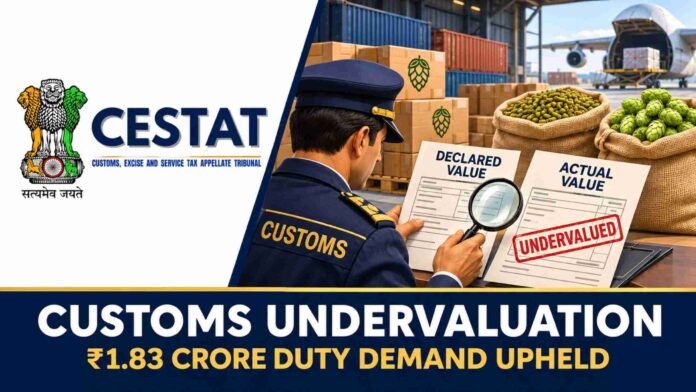
The Customs, Excise and Service Tax Appellate Tribunal (CESTAT), New Delhi, has upheld a differential customs duty demand of ₹1.83 crore in a case involving undervaluation of imported hop pellets and hop extracts used in the brewery industry.
The bench of Dr. Rachna Gupta (Officiating President) and P.V. Subba Rao (Technical Member) has observed that parallel invoices, reports from German Customs, records obtained from independent agencies and statements recorded during the investigation established that the imports had been cleared on understated values.
Buy Now: Indirect Tax Judgments E-Compilation – October 2026
The bench upheld the reassessment of the goods at ₹4,90,47,116 against the declared value of ₹84,40,716. It also sustained the findings on confiscation liability and the penalties imposed under the Customs Act, 1962.
The proceedings originated from intelligence received by the Special Intelligence and Investigation Branch at the Air Cargo Complex, New Delhi, concerning alleged customs duty evasion through undervaluation and fabrication of import documents.
The investigation covered hop products imported from European countries, including Germany and Belgium. These agricultural products are used in brewing and include bitter and aroma varieties.
Customs authorities seized goods covered by a bill of entry dated May 13, 2016, and examined earlier imports using information retrieved from the Customs ICES system. The disputed demand concerned imports made during December 2013 to January 2016.
A show cause notice dated November 16, 2018 proposed rejection of the declared values, reassessment of duty, recovery of differential duty with interest, confiscation liability and penalties. The Principal Commissioner confirmed the proposals through an order dated February 28, 2020, which was challenged before the tribunal.
A central feature of the investigation was the recovery of invoices bearing the same number but reflecting different prices.
The tribunal examined documents recovered during searches and retrieved from a laptop and hard disk, alongside invoices obtained from airlines and other sources. Comparing these documents with the invoices submitted to Indian Customs, it found that the customs declarations reflected altered or reduced values.
The order refers to an invoice showing a price of ₹701 per kg instead of ₹233.66 per kg. It also records statements acknowledging documents reflecting a value of €8.5 per kg against a declared value of €1.5 per kg.
The bench found that the differences were supported by admissions and independent documentary evidence.
Overseas enquiries provided further support for the department’s findings.
According to the tribunal, certified information received from German Customs confirmed the genuineness of invoices recovered during the investigation in India. The material included correspondence concerning supplies and prices, along with information about accounts used for payments.
The bench recorded that the overseas enquiry revealed payments corresponding to suppressed values through third-party accounts in Hong Kong, the UAE and the Philippines.
It also noted that German exporters denied knowledge of the lower-value invoices presented for customs clearance in India. The overseas reports supported the finding that these invoices were forged and substantially understated the value of the imported goods.
The tribunal considered this material together with the documents recovered domestically to conclude that the declared prices were unreliable.
The tribunal also examined documents obtained from the Bank of India’s overseas branch and Oriental Insurance Company.
It noted that the lower-value invoices submitted to the bank matched those produced before Indian Customs. In contrast, invoices submitted to the insurer reflected higher values corresponding to documents retrieved from the computer and hard disk.
The bench held that records obtained from independent agencies corroborated the recovered electronic documents. In those circumstances, it found that procedural non-compliance was insufficient to discredit the corroborated documentary evidence.
The tribunal separately considered the evidentiary value of statements recorded under Section 108 of the Customs Act.
It observed that Section 108 empowers gazetted customs officers to summon persons to give evidence or produce documents. Persons summoned are required to state the truth, and the enquiry has the statutory character of a judicial proceeding.
Referring to Supreme Court decisions, including Illias v. Collector of Customs, K.I. Pavunny v. Assistant Collector and Surjeet Singh Chhabra v. Union of India, the bench discussed the distinction between statements recorded by customs officers and confessions made to police officers.
It emphasised the relevance of voluntary admissions and the principle that admitted facts need not be independently proved.
The tribunal also acknowledged the procedural requirements under Section 138B concerning the relevance of statements. However, considering the distinguishing facts before it, the bench held that the statements had rightly been relied upon.
The tribunal specifically noted that the statements under consideration had not been retracted and were corroborated by documentary evidence. Its conclusion thus rested on the combined record of admissions, recovered invoices and independent verification.
The department also obtained invoices and other material relating to comparable imports by other businesses during the relevant period.
The tribunal referred to records showing materially higher prices for comparable hop products. It noted that certain contemporary import prices were four to six times the values declared by the appellants.
The bench additionally considered a European Commission report recording an average farm-gate price of €4.25 per kg for bitter hops in Germany in 2014 under long-term forward contracts.
It reasoned that the international selling price of processed hop products would ordinarily include additional costs such as processing, transportation, marketing and the manufacturer’s profit.
Viewed alongside the remaining evidence, the bench found the declared prices of €1.5 per kg for certain pellets and €1.5 to €2.2 per tin or per kg for extracts to be unsupported.
Addressing the valuation framework, the tribunal referred to Section 14 of the Customs Act and the Customs Valuation (Determination of Value of Imported Goods) Rules, 2007.
It observed that transaction value ordinarily forms the basis of assessment, while Rule 12 permits customs authorities to reject the declared value where the applicable requirements are satisfied.
Relying on the Supreme Court’s decision in CCE v. Sanjivani Non-Ferrous Trading (P) Ltd., the bench stressed that rejection must be supported by reasons and material explaining the assessable value adopted.
In the present case, it found that Customs had obtained parallel invoices, supplier verification and contemporary import data sufficient to justify rejection and reassessment.
The tribunal held that the valuation rules had been followed sequentially and found no infirmity in the reliance on Rules 4 and 5, concerning transaction values of identical and similar goods, respectively.
It consequently upheld the redetermined value of ₹4,90,47,116 against the declared value of ₹84,40,716.
The tribunal upheld the differential duty demand of ₹1,83,65,433 under Section 28(4) of the Customs Act.
It also sustained the finding that the goods were liable to confiscation under Section 111(m), concerning discrepancies between imported goods and their declared value or other particulars.
The bench upheld the penalty imposed on the importer under Section 114A, equal to the differential duty. It further sustained penalties on the other appellants under Sections 112 and 114AA.
Accordingly, the adjudication order was upheld and all four appeals were dismissed.
Membership Required to Access Case Details & Order Copy
To view the complete Case Details and Download Order Copy, you must have an active membership. Please subscribe to continue.

