
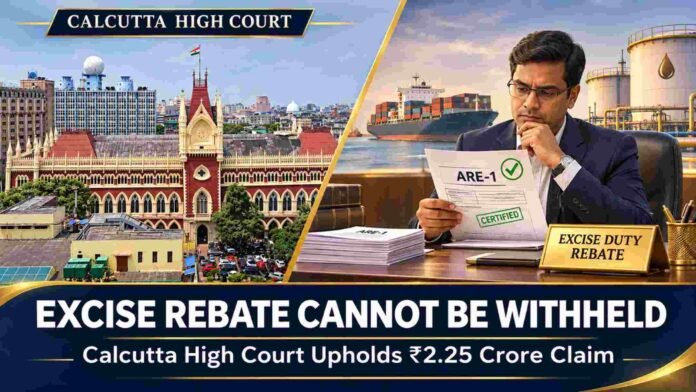
The Calcutta High Court has dismissed the Revenue’s appeal against an order allowing an excise duty rebate claim holding that the authorities could not withhold the benefit on vague allegations of missing documents when duly certified ARE-1 forms and supporting records established payment of duty and export of the goods.
The Bench of Justice Ravi Krishan Kapur and Justice Atarup Banerjee observed that the department had never questioned the validity or genuineness of the certified documents during the earlier stages of adjudication. It could not subsequently travel beyond the show-cause notice to resist the rebate claim through general objections about documentation.
Buy Now: Indirect Tax Judgments E-Compilation – October 2026
The Court also emphasised that the enthusiasm shown in collecting taxes must extend to releasing lawful refunds and rebates.
The dispute arose from three shipments of Pyrolysis Gasoline exported by Respondent/assessee between September and November 2003 after payment of excise duty.
The company sought a rebate of ₹2,25,66,522 under Rule 18 of the Central Excise Rules, 2002. Its claim was supported by prescribed ARE-1 forms bearing certifications from the Excise and Customs authorities regarding duty payment and export.
On August 24, 2004, the department issued a show-cause notice alleging contravention of Rule 18 read with Notification No. 43/02-Cus dated April 19, 2002, and proposed rejection of the claim.
The company submitted its response, but the adjudicating authority disallowed the rebate by an order dated December 20, 2005.
The company challenged the rejection through a statutory appeal. On March 29, 2007, the Commissioner of Central Excise (Appeals-I), Calcutta, allowed the appeal and held that the rebate was admissible.
The Revenue then sought revision under Section 35EE of the Central Excise Act, 1944, contending that the claim should be rejected for non-submission of relevant documents.
By an order dated July 21, 2010, the Revisional Authority accepted that the rebate was admissible under Rule 18 but held that further examination was required concerning documentary proof of export and duty payment. It remanded the matter to the original authority and directed the company to produce relevant and legible records.
The company challenged this remand before the High Court. On January 8, 2019, the Single Judge allowed the writ petition, recording that the ARE-1 forms had been duly submitted and that there was no justification for withholding the rebate.
The Revenue’s appeal against that decision came before the Division Bench.
The Revenue argued that submission of ARE-1 forms and supporting documents did not prevent the department from seeking additional records for verification.
It maintained that the rebate claim required a comprehensive investigation under the Supplementary Instructions, 2005, and that the demand for further information was justified.
The Division Bench rejected this contention in the circumstances of the case, finding that the company’s applications were complete and supported by documents whose authenticity had never been disputed.
Examining Rule 18 and Paragraph 8 of the Supplementary Instructions, 2005, the Court distinguished between the substantive conditions governing entitlement to rebate and the procedure for establishing that entitlement.
Paragraph 8 prescribes documents for filing a rebate claim, including the original ARE-1 form, the prescribed invoice, self-attested copies of the shipping bill and bill of lading, and a disclaimer certificate where applicable.
The Bench explained that a claimant must substantiate its claim through cogent evidence. This could be done through the documents contemplated by the instructions or through secondary evidence.
For the rebate in question, the essential requirements were proof that excise duty had been paid on the goods and that those goods had been exported. Certifications issued by the Excise and Customs authorities addressed both requirements.
The Court relied on the Bombay High Court’s decision in UM Cables Ltd. v. Union of India, which distinguished mandatory conditions and limitations from procedural requirements intended to facilitate verification of a rebate claim.
It also referred to the Supreme Court’s decision in Mangalore Chemicals & Fertilizers Ltd. v. Deputy Commissioner, as discussed in UM Cables, on the distinction between substantive conditions underlying a benefit and requirements belonging to the sphere of procedure.
The Bench noted that similar principles had been reiterated in Zandu Chemicals Ltd., Rai Petro Specialties and Ashland India Pvt. Ltd.
Applying these principles, the Court found that the company had submitted ARE-1 forms together with the necessary supporting documents.
The Excise authorities had certified payment of duty, while the Customs authorities had certified export. These attestations had not been questioned by the Revenue at any earlier stage.
The company had also produced bank certificates indicating export realisations and original shipping bills for verification. The shipping bill numbers had been certified by the Customs authorities.
The Bench stressed that this was not a case involving incomplete or incorrect ARE-1 forms. No defect had been identified in the forms or supporting records.
Since the documents had been issued or certified by the Revenue authorities themselves, the Court found no material basis for the department to suspect them.
The Division Bench further held that the Revenue could not indirectly expand the dispute beyond the show-cause notice and attempt to defeat the rebate on a vague allegation.
Membership Required to Access Case Details & Order Copy
To view the complete Case Details and Download Order Copy, you must have an active membership. Please subscribe to continue.
Read More: GST Assessment Doesn’t Restart Liquidation Claim Deadline: NCLAT

