
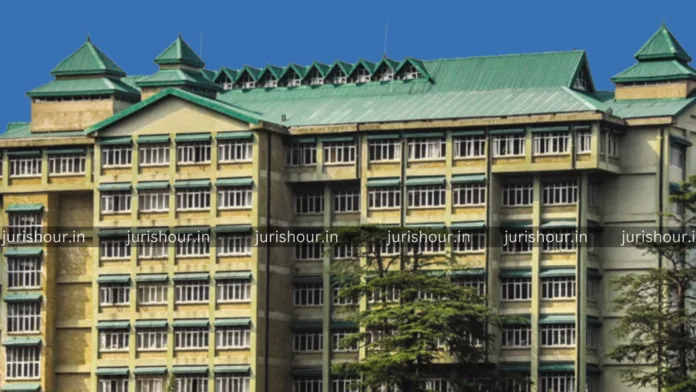
The Himachal Pradesh High Court has held that excise department cannot red mark property in revenue records for old tax dues against auction purchaser.
The Bench of Justice Tarlok Singh Chauhan and Justice Rakesh Kainthla has relied on the decision in the case of Rajinder Singh vs. State of H.P. & Ors in which it was held that the busi- ness liability of the Erstwhile Dealer (Loanee) could not be fastened unless “an auction purchaser or purchaser became owner by transfer of such business liability” under section 39 of the HP VAT Act.
The bench stated that fastening of business liability amounts to prejudicing and putting the auction purchaser to a disadvantageous position by acting in total defiance of the object and spirit of the SARFAESI Act.
The petitioner/assessee purchased the immovable property from UCO Bank in an E-auction held on 11.09.2018 by which land measuring 2 Bighas 4 Biswas and factory building comprised in Khasra No. 736/586/2-4 Kita in Khata/Khatauni No. 81/88 Min situated in village Kunjahal, Pargana Dharampur, Tehsil Baddi, District Solan, H.P. in accordance with the provisions of the Securitisation and Reconstruction of Financial Assets and Enforcement of Security Interest Act, 2002 (SARFAESI Act). The reserve price of the secured assets was kept Rs. 117 lakhs.
The petitioner participated in the auction and offered the highest bid. The ‘Secured Creditor” under the SARFAESI Act while exercising power under Section 13 read with Rules 8 and 9 of the Security Interest (Enforcement) Rules, 2002 issued Sale Certificate in favour of the petitioner mentioning the description of the immovable property purchased by it.
Later on, the petitioner came to know that Department of Excise and Taxation had got a mutation recorded regarding the fact that the property stood charged with respondent, whereas Department of Excise and Taxation had already created a charge over the property vide mutation No. 298, dated 10.01.2018, where the property stood charged with Department of Excise and Taxation prior to the charge.
The court allowed the petition and held that Adversarial red ink entry existing in the revenue records which restrict, defeat and curtail the rights, title and interest acquired by petitioner, a bonafide auction purchase under SARFAESI Act is declared inoperative, illegal and is accordingly quashed and set-aside.
Case Details
Case Title: M/s H M Industries Versus State of H.P. & Ors.
Case No.: CWP No. 14348 of 2024
Date: 08.01.2025
Counsel For Petitioner: Rajat Awasthy
Counsel For Respondent: Anup Rattan

