
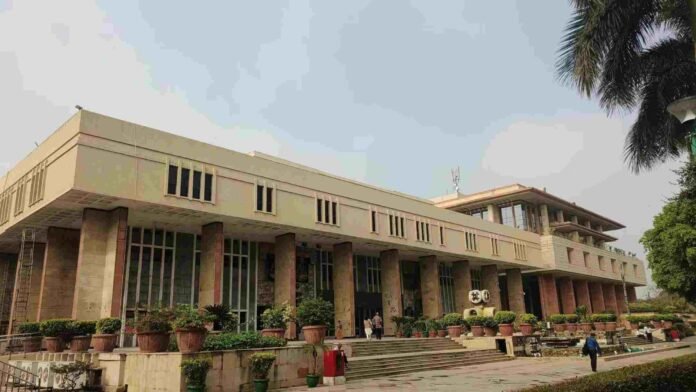
The Delhi High Court has dismissed a writ petition challenging an order of the Customs, Central Excise & Service Tax Settlement Commission that had refused to allow adjustment of ₹31,93,569 towards reversal of CENVAT credit against the petitioner’s Central Excise duty liability.
The Bench of Justice Anil Kshetarpal and Justice Manmeet Pritam Singh Arora has observed that a High Court exercising writ jurisdiction cannot sit in appeal over the Settlement Commission by re-appreciating the sufficiency or evidentiary value of documents placed before it.
The central issue was whether the Settlement Commission was justified in declining the claimed adjustment after finding that the documentary material produced to establish the CENVAT credit reversal was insufficient.
The dispute originated from manufacturing activities undertaken during January 2005 to December 2005 in relation to Stainless-Steel Cladding and Railing. The petitioner had initially proceeded on the understanding that the activity did not amount to manufacture and, consequently, did not discharge Central Excise duty. It subsequently admitted its duty liability and approached the Settlement Commission under the Central Excise Act, 1944.
During the relevant period, the petitioner claimed that it had reversed CENVAT credit. For the period from January 2005 to September 2005, the reversal was stated to have been made on a pro-rata basis, while for October 2005 to December 2005, reversal was made at the rate of 10% of the sale price under Rule 6(3) of the CENVAT Credit Rules, 2004.
The total amount claimed as reversed was ₹31,93,569. The petitioner sought adjustment of this amount against its Central Excise duty liability in the settlement proceedings.
The litigation had an earlier chapter before the Delhi High Court. In an earlier judgment dated May 11, 2010, passed in W.P.(C.) No. 3652/2007, the Court had directed the Settlement Commission to re-examine the claim relating to reversal and adjustment of CENVAT credit.
The earlier order noted that material had already been placed before the Settlement Commission and permitted it to call for further information from either side if such information was considered necessary.
Following the remand, the Settlement Commission sought additional records, including RG-23A Part II registers, input invoices and other statutory documents relating to the relevant period. According to the respondents, the petitioner did not furnish the required documents for the entire period and the material available—including ER-1 returns and a correlation sheet—was insufficient to verify the claimed reversal.
The petitioner, however, maintained that it had already furnished ER-1 returns, RG-23A records, sales working sheets and a correlation statement and that these materials were sufficient. It argued that the admissibility of the underlying CENVAT credit had never been in dispute and that the Settlement Commission had effectively travelled beyond the scope of the High Court’s earlier directions by requiring documents to establish the original eligibility of the credit.
After considering the material and submissions, the Settlement Commission rejected the claim for adjustment of ₹31,93,569. The petitioner then approached the High Court under Article 226 of the Constitution, challenging the Settlement Commission’s decision.
Before the High Court, the petitioner argued that the Settlement Commission had exceeded the remit of the earlier 2010 judgment. It contended that the Commission was required to examine the reversal of CENVAT credit and not reopen the question of the credit’s admissibility.
It also argued that the documents already placed on record were adequate and that, after more than fifteen years, requiring additional records relating to transactions of 2005 imposed an unreasonable evidentiary burden.
The Revenue opposed the petition, arguing that the writ proceedings effectively sought an appellate re-appreciation of the Settlement Commission’s findings. It maintained that the Commission had been expressly permitted to seek further information and that the petitioner had failed to provide documents necessary to verify the claim.
The principal question before the Bench was the extent to which a High Court can interfere with an order passed by the Settlement Commission in exercise of its statutory and discretionary jurisdiction.
The Court relied upon the Supreme Court’s decision in Jyotendrasinhji v. S.I. Tripathi, as subsequently reaffirmed in Kotak Mahindra Bank Limited v. Commissioner of Income Tax, Bangalore & Ors., to emphasise that judicial review of Settlement Commission orders operates within narrow parameters. The Court noted that interference is not warranted merely because the High Court might have reached a different assessment of the material.
The Bench stressed that the High Court, while exercising jurisdiction under Article 226, does not function as an appellate forum over the Settlement Commission. The relevant inquiry is whether the Commission’s order suffers from a legal infirmity warranting judicial interference—not whether the High Court would have evaluated the evidence differently.
Applying this principle to the dispute, the Court found that the petitioner was essentially asking it to determine whether the ER-1 returns, correlation statement and other documents were sufficient to establish the reversal of CENVAT credit.
The respondents, on the other hand, maintained that the documents could not be verified without corresponding invoices and RG-23A Part II records for the entire period.
According to the High Court, this dispute fundamentally concerned the sufficiency, adequacy and evidentiary value of the material placed before the Settlement Commission. Those questions fell within the Commission’s domain. Since the Commission had considered the material and concluded that the documentary evidence was insufficient, the High Court held that it could not re-appreciate that evidence as though it were hearing an appeal.
The Bench also rejected the argument that the Settlement Commission had acted beyond the scope of the High Court’s 2010 directions by asking for additional documents.
The earlier High Court order had required the Commission to re-examine the claim and had expressly permitted it to call for further information if necessary. Therefore, the fact that the Commission sought RG-23A Part II registers and input invoices could not, by itself, demonstrate that it had exceeded its jurisdiction.
The Court observed that whether such records were actually necessary for verification, and whether the material already supplied was sufficient, were matters concerning appreciation of evidence before the Settlement Commission.
The petitioner had also relied upon the fact that the Department had not disputed the availment of CENVAT credit during the relevant period.
The High Court held that this circumstance did not provide a basis for interference under Article 226. The Settlement Commission was required to determine whether the claimed amount of ₹31,93,569 had been sufficiently established for adjustment against the duty liability. The High Court could not substitute its own assessment of the evidentiary record for that of the specialised forum.
The Court further noted that there was no allegation of fraud, bias or mala fides against the Settlement Commission, nor had the petitioner demonstrated that any statutory provision had been contravened in a manner warranting judicial review.
An important aspect of the judgment is the Court’s emphasis on the statutory objective of settlement proceedings.
Referring to the Supreme Court’s observations, the Bench reiterated that frequent judicial interference with Settlement Commission proceedings should be avoided. The High Court should not scrutinise a reasoned order of the Settlement Commission as an appellate court, particularly because the settlement mechanism is intended to promote finality and bring litigation to an end.
The Court also rejected the argument that the absence of an appellate remedy against the Settlement Commission’s order automatically enlarged the scope of Article 226 review. While the writ jurisdiction remains available in an appropriate case, its exercise continues to be governed by the established limitations applicable to judicial review of specialised statutory bodies, particularly the Settlement Commission.
Concluding that the Settlement Commission had passed a reasoned order and that no legally recognised ground for judicial intervention had been established, the Delhi High Court declined to interfere with the order dated April 29, 2020.
The Court held that the challenge essentially sought re-appreciation of the evidence and substitution of the Settlement Commission’s view with the petitioner’s preferred view, an exercise impermissible within the narrow scope of judicial review.
Membership Required to Access Case Details & Order Copy
To view the complete Case Details and Download Order Copy, you must have an active membership. Please subscribe to continue.

