
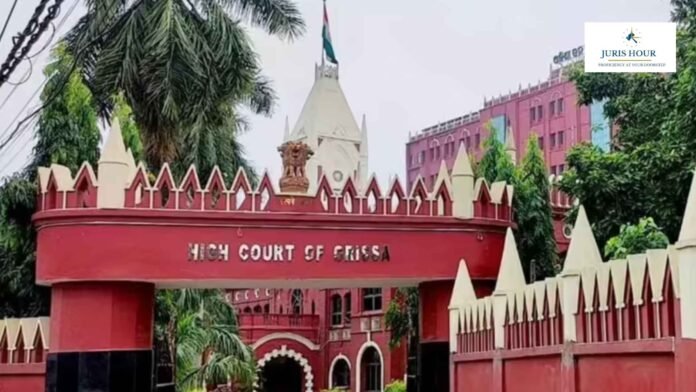
The Orissa High Court has dismissed a writ petition filed challenging a GST adjudication order, holding that a litigant cannot repeatedly invoke the writ jurisdiction of the High Court against the same order after earlier writ petitions concerning the same cause of action had been withdrawn.
The Bench of Justice Sanjeeb K Panigrahi and Justice Murahari Sri Raman has observed that the petitioner had challenged the September 2024 adjudication order nearly a year later, had subsequently withdrawn the first writ petition without liberty, filed another writ petition, withdrew that petition with liberty to file a better petition, and then filed the present proceeding challenging substantially the same order.
Buy Now: 100+ Judgements On Customs Classification
The petitioner/assessee is a private limited company engaged in execution of works contracts and registered under the CGST and OGST Acts, had availed input tax credit on the basis of original tax invoices and disclosed the credit in its GSTR-3B returns.
The DGGI, Bhubaneswar Zonal Unit issued a show-cause notice dated 30 March 2022 under Section 74 of the GST Act, covering multiple financial years, namely 2017-18, 2018-19 and 2019-20. The notice followed intelligence concerning non-filing of GSTR-3B and GSTR-1, which was stated to have been admitted during the course of enquiry.
The adjudicating authority subsequently determined, among other things, excess and ineligible input tax credit. The authority referred to the statutory time-limit for claiming ITC under Section 16(4) read with Section 39 of the GST Actand recorded that adequate opportunity, including personal hearing, had been provided to the taxpayer.
The company, however, contended that the position concerning its ITC had been affected by the retrospective amendment introduced through the Finance Act, 2024, particularly Section 16(5), pursuant to which the ITC claimed in the returns stood adjusted.
Before the High Court, the petitioner argued that the show-cause notice itself was vague and legally untenable. It contended that proceedings under Section 74 covering multiple financial years were contrary to the statutory scheme.
The petitioner also questioned the notifications issued under Section 168A of the GST Act, contending that the notifications did not disclose circumstances relating to force majeure that prevented completion of adjudication within the statutory period.
The Department strongly opposed the maintainability of the writ petition, pointing out that the taxpayer had already approached the High Court on two earlier occasions challenging the same adjudication order.
The Department brought to the Court’s attention to the writ petition, in which the petitioner had challenged the same Order-in-Original dated 27 September 2024. That petition was withdrawn pursuant to an order dated 23 December 2025, without liberty to institute a fresh writ petition.
The earlier petition had sought quashing of the adjudication order, which involved a demand under Section 74(9), alleged ineligible ITC, penalty under Section 122(2)(b) and interest under Section 50(1) and (3) of the CGST/OGST Acts. It had also sought refund of amounts of ₹3,49,85,668 and ₹7,66,998 allegedly recovered from the petitioner’s GST cash ledger.
Thereafter, the petitioner filed another writ petition again challenging the very same adjudication order and seeking substantially identical reliefs.
That petition was also withdrawn. However, on that occasion, the High Court permitted withdrawal with liberty to file a better petition, by order dated 14 May 2026.
The third writ petition once again sought, among other reliefs, quashing of the DGGI show-cause notice dated 30 March 2022 and the adjudication order dated 27 September 2024.
The petitioner also challenged Notification No. 09/2023-Central Tax dated 31 March 2023 and a corresponding State Government notification dated 15 April 2023, besides seeking restraint against recovery of tax and penalty arising from the adjudication order.
Upon comparing the three proceedings, the High Court found that the prayers and nature of reliefs were essentially identical and that all three writ petitions were directed against the same Order-in-Original dated 27 September 2024.
The Division Bench considered the Supreme Court’s decision in Sarguja Transport Service v. State Transport Appellate Tribunal, M.P., Gwalior, wherein the Supreme Court had held that, as a matter of public policy, a person who withdraws a writ petition without permission to file a fresh petition cannot ordinarily invoke Article 226 again in respect of the same cause of action.
The Supreme Court had explained that the principle was not necessarily based on res judicata but on public policy, including the need to prevent repeated litigation and bench-hunting.
The Orissa High Court also examined other authorities concerning withdrawal of writ proceedings, including Ramesh Chandra Sankla v. Vikram Cement, where the Supreme Court observed that withdrawal without leave could signify abandonment of the claim and that public policy does not permit a fresh round of litigation to re-agitate a claim already given up.
The Bench also discussed the Supreme Court’s decision in Puran Singh v. State of Punjab, concerning the applicability of procedural principles of the Civil Procedure Code to proceedings under Articles 226 and 227.
The High Court noted that the CPC does not automatically apply to writ proceedings. However, principles underlying the CPC may be extended where they advance public policy and promote equitable and just outcomes.
The Court further referred to the legal position that principles of the CPC which advance public policy may be applied to writ proceedings even though the CPC does not per se govern such proceedings.
A significant aspect of the judgment was the availability of an alternative statutory appellate remedy under Section 107 of the GST Act.
The High Court noted that Section 107(1) requires an appeal to be filed within three months from communication of the decision or order. Under Section 107(4), the Appellate Authority has discretion to condone delay for a further period of one month, upon being satisfied that sufficient cause prevented filing within the prescribed period.
The Bench observed that the petitioner had an alternative remedy to challenge, among other things, the issue of limitation relating to the adjudication order.
The Court noted that the Order-in-Original was dated 27 September 2024, whereas the first writ petition challenging it was filed only on 26 September 2025, approximately one year later. The Court found that the petitioner had not adequately explained the delay in approaching the High Court.
The Court referred to an earlier decision in Orissa Mineral Development Co. v. Commissioner of Sales Tax, observing that although existence of an alternative remedy does not invariably prevent the High Court from exercising jurisdiction under Article 226, a party should not ordinarily be permitted to use writ jurisdiction to escape statutory limitation applicable to the appropriate appellate or revisional remedy.
The Bench also noted that an appellate authority possesses broader fact-finding powers and can independently examine the matter.
The High Court found that the petitioner had not explained why the first writ petition was withdrawn without seeking liberty to file a fresh petition.
Membership Required to Access Case Details & Order Copy
To view the complete Case Details and Download Order Copy, you must have an active membership. Please subscribe to continue.
Read More: S. 110(5) Customs Act: Patna HC Mandates Pre-Decisional Hearing Before Attachment Extension

