
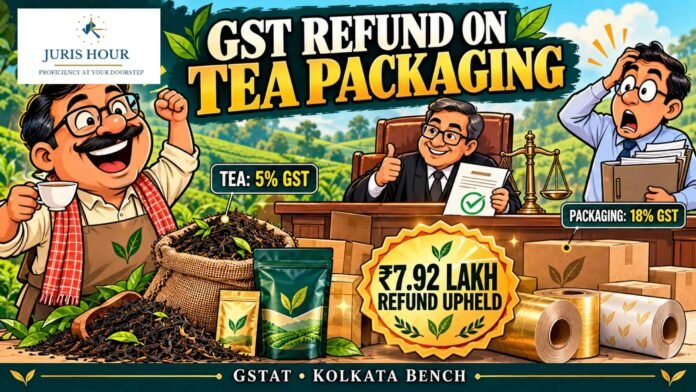
The Goods and Services Tax Appellate Tribunal (GSTAT), Kolkata Bench, has upheld refund claims totalling ₹7,92,122, holding that higher-taxed packaging materials cannot be ignored when examining eligibility for an inverted tax structure refund merely because bulk tea and packaged tea both attract GST at 5%.
The Bench of Sunil Kumar Singh (Judicial Member) and Bijoy Kumar Kar (Technical Member) has observed that credit on packaging materials was eligible and could support a refund under Section 54(3)(ii). Their ancillary role did not justify excluding them from the assessment of the inverted tax structure.
BUY NOW: E-Magazine: 1000+ Landmark GST Judgments (2017–2026)
The company purchases tea in bulk and supplies it in customised retail packs of different quantities according to customer requirements. Bulk tea attracts GST at 5%, while packaging materials attract 18%. The outward supply of packaged tea is taxable at 5%.
The dispute concerned a refund of ₹5,37,664 under SGST for April–June 2024 and another refund of ₹2,54,458 for October 2023–March 2024. The latter comprised ₹2 lakh under CGST and ₹54,458 under SGST.
The Assistant Commissioner rejected both claims on September 18, 2024, reasoning that the inputs and output were the same goods, falling under the same HSN classification, and therefore did not qualify for refund under Section 54(3)(ii) of the CGST Act.
The Joint Commissioner (Appeals) allowed both claims through orders dated August 28, 2025. The department challenged these decisions before the Tribunal.
The department contended that tea was the principal commodity and attracted the same 5% GST rate on purchase and sale. According to the department, the higher tax rate on packaging materials alone could not justify a refund under the inverted tax structure category.
It relied on CBIC Circular No. 135/5/2020-GST dated March 31, 2020, and Circular No. 173/05/2022-GST dated July 6, 2022, to argue against refund eligibility where the input and output supplies were the same.
The department also sought to distinguish the Calcutta High Court’s decision in Shivaco Associates, relied upon by the first appellate authority, arguing that the earlier case concerned LPG attracting different tax rates.
The company, represented by Advocate S. N. Dhuria, submitted that Section 54(3)(ii) refers to all inputs and does not limit the examination to the principal commodity. It maintained that packaging materials qualify as inputs and that circulars cannot impose restrictions beyond the statute.
The Tribunal held that Section 54(3)(ii) permits refunds where credit accumulates because the tax rate on inputs exceeds the rate on output supplies.
It emphasised that the legislature used the expression “inputs” in the plural and made no distinction between principal and ancillary inputs. Restricting the comparison to tea alone would therefore introduce a limitation absent from the statute.
The Bench found that comparing bulk tea with packaged tea while ignoring packaging materials was factually incorrect and rejected the Revenue’s argument.
It relied on the Delhi High Court’s decision in Indian Oil Corporation Limited, which recognised that multiple inputs may be used or consumed in making outward supplies. The relevant inquiry is whether accumulated credit arises from higher tax rates on inputs than on output supplies.
The Tribunal examined Section 2(59) of the CGST Act, which defines inputs as goods other than capital goods used or intended to be used in the course or furtherance of business.
It held that packing materials, labels, cartons and plastic containers are indispensable to marketing packaged tea and qualify as inputs.
The Bench also referred to paragraph 13 of CBIC Circular No. 79/53/2018-GST dated December 31, 2018, which recognises input tax credit on packing materials used for business or taxable supplies, subject to applicable statutory restrictions.
The Tribunal rejected the department’s reliance on Circular No. 135/5/2020-GST, explaining that paragraph 3 concerns credit accumulation caused by a reduction in the GST rate on the same goods over time.
In this case, bulk tea and packaged tea continued to attract 5% GST. The accumulation arose from packaging materials taxed at 18%, rather than any subsequent reduction in the tax rate on tea.
The Bench consequently held that the circular did not apply to these refund claims.
It also rejected reliance on Circular No. 173/05/2022-GST, observing that the clarification concerns supplies under concessional notifications and addresses circumstances different from those involved here.
Referring to the Delhi High Court’s ruling in Indian Oil Corporation Limited, the Tribunal reiterated that CBIC’s powers under Section 168 concern uniform implementation of the Act. Circulars cannot add restrictions to, or curtail entitlements available under, the statute.
The Tribunal dismissed both Revenue appeals and upheld the refund claims totalling ₹7,92,122. It directed the parties to bear their own costs.
Membership Required to Access Case Details & Order Copy
To view the complete Case Details and Download Order Copy, you must have an active membership. Please subscribe to continue.
Read More: Interest Can’t Be Levied on Grounds Beyond GST Notice: GSTAT

