
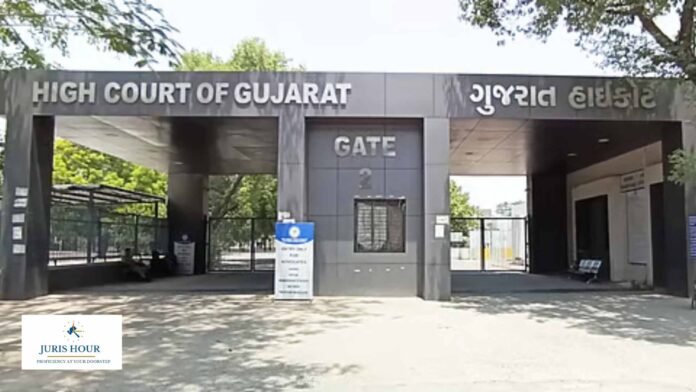
The Gujarat High Court has held that where an original refund application is filed within the prescribed limitation period, subsequent rectified refund applications filed pursuant to deficiency memos cannot be treated as fresh proceedings for the purpose of limitation.
The bench of Justice Bhargav D. Karia and Justice Pranav Trivedi quashed the rejection of a deemed export refund claim of ₹83.51 lakh that had been denied solely on the ground of limitation and directed the authorities to reconsider the claim on merits.
The petitioner, a textile manufacturer registered under the GST regime, had procured capital goods under the Export Promotion Capital Goods (EPCG) Scheme and claimed refund of IGST paid on deemed export supplies. The company filed a refund application in Form GST RFD-01 on 13 November 2018 seeking refund of ₹83,51,438.
Subsequently, the refund claim underwent multiple rounds of scrutiny. After the issuance of a deficiency memo, the petitioner filed a rectified refund application on 28 December 2019. A second rectified application was filed on 31 May 2021 along with supporting documents. Although the department acknowledged the application as complete, it later rejected the claim. The rejection was challenged before the High Court, which had earlier set aside the order on grounds of violation of natural justice and remanded the matter for fresh consideration.
Following the remand, the petitioner filed a third rectified refund application on 16 August 2023. However, the department again rejected the claim through an order dated 24 November 2023, holding that the refund application was beyond the limitation period prescribed under Section 54 of the CGST Act.
The central issue before the High Court was whether a rectified refund application filed after the issuance of a deficiency memo should be treated as a fresh refund claim for limitation purposes or merely as a continuation of the original refund proceedings.
The petitioner argued that once the original refund application had been filed within the statutory time limit, subsequent rectified applications submitted in compliance with Rule 90(3) of the CGST Rules could not be treated as separate legal proceedings. According to the petitioner, the limitation period must be reckoned from the date of the original refund application.
The tax department, on the other hand, contended that after rectification of deficiencies, the fresh refund application was required to independently satisfy the limitation requirement under Section 54 of the CGST Act.
The Court noted that the issue was no longer res integra and had already been settled in earlier decisions, including La-Gajjar Machineries Pvt. Ltd. and the Delhi High Court ruling in National Internet Exchange of India.
Referring to the proviso inserted in Rule 90(3) through Notification No. 15/2021 dated 18 May 2021, the Court observed that the period between the filing of the original refund claim and the issuance of the deficiency memo must be excluded while computing limitation for filing a rectified refund application. The Bench held that the amendment was clarificatory in nature and aligned with the objective of Section 54(1) of the CGST Act.
The Court further emphasized that once a refund application is filed in the prescribed form and manner within the statutory period, limitation stops running. Merely because the proper officer seeks additional documents or clarifications, the application cannot be treated as non est for limitation purposes.
The court concluded that the rejection of the refund claim solely on the ground of limitation was unsustainable. It held that the original refund application had been filed within time and the subsequent rectified applications were merely continuations of the same refund proceedings. Therefore, the department could not reject the claim as time-barred.
The Court observed that the exclusion mechanism provided under Rule 90(3) ensured that taxpayers are not prejudiced because of departmental deficiency memos and procedural rectifications.
The Gujarat High Court quashed the order dated 24 November 2023 rejecting the refund application on limitation grounds.
The Court restored the third rectified refund application dated 16 August 2023 and directed the proper officer to examine the refund claim afresh on merits and complete the exercise within twelve weeks from receipt of the order.
Membership Required to Access Case Details & Order Copy
To view the complete Case Details and Download Order Copy, you must have an active membership. Please subscribe to continue.
Read More: Gujarat High Court Refuses to Enhance CBDT Informant Reward

