
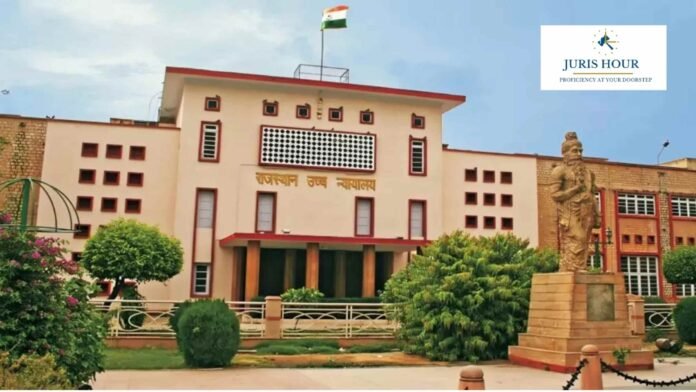
The Rajasthan High Court has reaffirmed that the mandatory pre-deposit requirement under Section 129E of the Customs Act, 1962 cannot be waived merely because an appellant claims financial hardship.
Holding that the discretion to grant such waivers was consciously removed by Parliament through the 2014 amendment, the bench of Justice Arun Monga and Justice Ashutosh Kumar dismissed an appeal challenging the Customs, Excise and Service Tax Appellate Tribunal’s (CESTAT) refusal to exempt it from depositing 7.5% of the penalty amount before entertaining its appeal.
The bench had rejected the company’s application seeking waiver of the statutory pre-deposit and consequently dismissed its appeal against the Order-in-Original, which had imposed penalties aggregating ₹15.69 crore. As a result, the appellant was required to deposit 7.5% of the penalty amount, amounting to approximately ₹1.18 crore, before its appeal could be entertained.
Buy Now: 70+ Judgements Indirect Tax – July 2026 | E-Magazine
The appellant contended before the High Court that it had shut down its business operations and was facing severe financial distress. On this basis, it sought exemption from the statutory pre-deposit requirement, arguing that insisting upon the deposit would effectively deprive it of its right to pursue the appeal before the Tribunal.
However, the Court observed that the appellant had failed to substantiate its plea with any documentary evidence. No audited balance sheets, bank statements, financial records or other material demonstrating its inability to make the deposit had been produced. The Bench held that a mere oral assertion of financial hardship, unsupported by evidence, could not justify any relief.
The High Court undertook a detailed examination of the evolution of Section 129E of the Customs Act. It noted that prior to the Finance (No. 2) Act, 2014, appellate authorities possessed discretionary powers to waive or dispense with the requirement of pre-deposit in cases of “undue hardship,” subject to appropriate safeguards for protecting government revenue.
The Court explained that Parliament fundamentally altered this framework through the 2014 amendment. Instead of requiring deposit of the entire disputed amount, the amended provision introduced a significantly reduced mandatory pre-deposit of 7.5% or 10%, subject to a ceiling of ₹10 crore. Simultaneously, however, Parliament deliberately removed the discretion previously vested in appellate authorities to waive or reduce the pre-deposit requirement.
According to the Bench, this legislative change reflected a conscious policy decision to replace discretionary hardship-based waivers with a fixed and predictable statutory mechanism.
The High Court relied extensively on the Supreme Court’s decision in Chandra Sekhar Jha v. Union of India, which authoritatively interpreted the amended Section 129E.
Referring to the apex court’s ruling, the Bench observed that the legislative intent behind the amendment was unmistakable. While the burden on litigants had been substantially reduced by limiting the pre-deposit to a small percentage of the disputed demand, the corresponding discretion to waive that amount had been completely withdrawn.
The Court held that the statutory scheme itself balances the competing interests of access to justice and protection of revenue, leaving no scope for appellate authorities to entertain appeals without compliance with the prescribed pre-deposit requirement.
Rejecting the appellant’s principal argument, the Bench held that financial hardship, even if genuine, is no longer a legally recognised ground for seeking exemption from the mandatory pre-deposit under the amended provision.
The Court observed that the language of Section 129E is mandatory, particularly the expression that appellate authorities “shall not entertain any appeal” unless the prescribed deposit has been made. It held that this creates an absolute statutory bar, subject only to the limited relaxations expressly provided in the provision itself.
The Bench further remarked that, in the present case, the appellant had not only failed to establish financial incapacity through evidence but had also failed to demonstrate any exceptional circumstances warranting exercise of the High Court’s extraordinary jurisdiction.
The appellant also argued that the CESTAT had committed an error by incorrectly attributing a legal proposition to the Delhi High Court when it had actually originated from a coordinate Bench of the Tribunal.
While acknowledging this inadvertent error, the High Court held that the mistake did not affect the correctness of the Tribunal’s conclusion. The legal proposition applied by the Tribunal—that pre-deposit under Section 129E is mandatory and incapable of being waived—was independently supported by the binding judgment of the Supreme Court in Chandra Sekhar Jha. Consequently, an incorrect citation could not invalidate an otherwise legally sound order.
Dismissing the appeal, the Rajasthan High Court held that the plea seeking exemption from the mandatory pre-deposit under Section 129E was unsupported by evidence and legally untenable. No ground existed to interfere with the CESTAT’s order refusing waiver of the statutory pre-deposit. The appeal was accordingly dismissed, along with all pending applications, without any order as to costs.
Membership Required to Access Case Details & Order Copy
To view the complete Case Details and Download Order Copy, you must have an active membership. Please subscribe to continue.

