
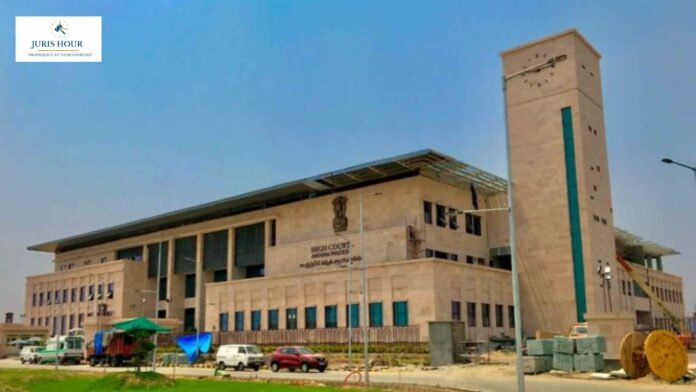
The Andhra Pradesh High Court has dismissed a writ petition challenging GST rectification and re-rectification orders, holding that the petitioner had failed to challenge the original assessment order and that the disputed issues raised could not be examined in proceedings under Article 226 of the Constitution.
The Bench of Justice R. Raghunandan Rao and Justice T.C.D. Sekhar declined to exercise its extraordinary writ jurisdiction and left it open to the petitioner to pursue the remedies available under the GST law. The writ petition was dismissed without costs.
The petitioner was a registered GST dealer engaged in providing manpower services to the Andhra Pradesh Southern Power Distribution Company Limited (APSPDCL) for continuous spot electricity billing in specified areas.
Buy Now: 130 GST Judgments – E-Magazine July 2026
Following an inspection by the GST authorities, the petitioner was directed to produce books of account relating to the tax periods from FY 2019-20 to FY 2022-23. According to the Court’s order, the petitioner did not produce the books of account before the concerned authority.
During verification, the authorities noticed that the petitioner had received TDS amounts which had not been declared in GSTR-3B returns. On that basis, the department alleged suppression of outward supplies amounting to ₹2,53,21,014 and proposed tax liability on the said turnover. A pre-intimation in Form GST DRC-01A dated November 28, 2022 was issued.
As the petitioner did not file objections to the pre-intimation, a show cause notice in Form GST DRC-01 dated December 30, 2022, was subsequently issued under Section 74 of the GST Act, 2017. The Court recorded that the notice was served through email and was also uploaded on the GST portal. The petitioner again did not submit objections.
Consequently, the GST authorities passed an assessment order dated April 17, 2023, raising a demand of ₹1,01,05,575 towards tax, interest and penalty for the period covering FY 2019-20 to FY 2022-23.
The proceedings also had a history concerning cancellation of the petitioner’s GST registration.
The petitioner’s registration had been cancelled by order dated June 23, 2022, on the ground that GSTR-3B returns had not been filed. The petitioner challenged the cancellation before the High Court in W.P. No. 8386 of 2023.
That writ petition was disposed of on May 4, 2023, with the Court directing the petitioner to make an application for revocation of cancellation in terms of Notification No. 3 of 2023 dated March 31, 2023, issued by the Central Board of Indirect Taxes and Customs. The petitioner’s GST registration was subsequently restored.
After the assessment order was passed, the petitioner subsequently filed GSTR-3B returns and moved rectification applications dated July 6, 2023 and July 8, 2023, invoking Section 161 of the GST Act.
When the rectification applications were not considered, the petitioner approached the High Court again. The Court directed the authorities to consider and dispose of the rectification applications within four weeks from receipt of the order.
Pursuant to those directions, the authorities considered the applications and passed rectification orders. Those orders subsequently became the subject matter of the present writ petition.
The petitioner challenged rectification orders issued for different financial years, including orders dated January 24, 2025, January 25, 2025 and February 15, 2025.
The petitioner alleged that the orders were not reasoned, did not properly appreciate the material on record and violated principles of natural justice. It was also alleged that the petitioner had been denied effective assistance of legal counsel and a fair opportunity of personal hearing.
Among the allegations was a challenge concerning Form GST INS-01 dated October 26, 2022, which, according to the petitioner, had been subsequently modified to October 28, 2022 by making a handwritten alteration. The petitioner contended that the alleged action was without jurisdiction and contrary to various provisions of the APGST Act, including Sections 61, 74, 75, 83, 107, 160 and 161.
The petitioner also sought relief concerning bank and third-party attachments issued through Form GST DRC-13 dated October 11, 2023 and November 14, 2023.
The State tax authorities opposed the writ petition, principally contending that it was not maintainable because the petitioner had an effective statutory remedy of appeal against the orders under challenge.
The respondents also pointed out that the petitioner had received the pre-intimation and show cause notice but had chosen not to submit objections. According to the department, in the absence of any explanation for the failure to respond to the notices, the assessment order had been validly passed.
The department further maintained that the rectification applications were considered and orders were subsequently passed, leaving no basis for alleging illegality in the impugned orders.
A significant factor in the Court’s decision was that the petitioner had not challenged the original assessment order dated April 17, 2023.
The Bench noted that the assessment order had been passed after the statutory procedure was followed. The petitioner had received both the pre-intimation notice and the show cause notice but had not filed objections. The authorities thereafter proceeded on the basis that the petitioner had suppressed outward supplies and passed the assessment order.
The Court specifically observed that the petitioner did not challenge the assessment order after receiving it. Instead, the petitioner subsequently approached the authorities through rectification applications under Section 161.
The Bench also referred to the scope of rectification under Section 161 of the GST Act.
The Court noted that the provision empowers the authorities to rectify an error which is apparent on the face of the record in a decision, order, notice, certificate or other document.
In the present case, the Court found that the rectification applications had in fact been considered and orders had been passed. The petitioner therefore could not use the writ proceedings to reopen disputed factual issues concerning those orders, particularly when the underlying assessment order itself had not been challenged through the appropriate statutory mechanism.
The High Court also rejected the allegation that the rectification proceedings had been conducted in breach of natural justice.
The record showed that the petitioner was issued a notice dated January 18, 2025, requiring him to attend a personal hearing on January 20, 2025. The petitioner did attend the hearing, and the objections raised by him were considered before the authorities passed orders on the rectification applications.
The Court therefore found that the record did not substantiate the allegation that the authorities had failed to follow the prescribed procedure.
The High Court ultimately held that the petition involved disputed questions of fact which could not appropriately be adjudicated while exercising jurisdiction under Article 226 of the Constitution.
The Bench observed that if the petitioner was aggrieved by the rectification orders, the appropriate course was to challenge them by filing an appeal as provided under the GST law.
The Court consequently held that the writ petition could not be entertained and declined to exercise its extraordinary original jurisdiction.
Membership Required to Access Case Details & Order Copy
To view the complete Case Details and Download Order Copy, you must have an active membership. Please subscribe to continue.
Read More: Composition Scheme Lapses Automatically on Crossing Rs. 1.5 Crore Turnover: GSTAT

