
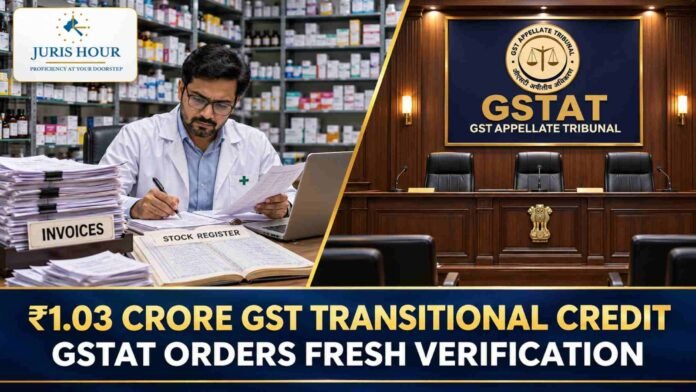
The Goods and Services Tax Appellate Tribunal (GSTAT), Kolkata Bench, has ordered fresh adjudication of two disputes involving ₹1.03 crore in GST transitional input tax credit claimed by a pharmaceutical retailer.
The bench of Satya Gopal Chattopadhyay (Judicial Member) and Anindya Mitra (Technical Member) has observed that the first appellate authority had allowed the credit after checking a limited sample of invoices without showing that it had reconciled the invoices with returns, stock records, ledgers and other financial documents. It also found that the original adjudicating authority had mechanically denied the claims without verifying the underlying records.
Buy Now: All 200+ GSTAT Judgements Till November 2026 | Comprehensive E-Magazine
The bench also held that Section 73 of the Central Goods and Services Tax Act, 2017 can be invoked to recover wrongly availed transitional credit claimed under Section 140(3).
The respondent/assessee trades in pharmaceuticals and related products through multiple retail outlets. In the lead appeal, the department issued a show-cause notice on April 21, 2023 seeking recovery of ₹65,90,636 in transitional credit claimed through TRAN-2. The notice invoked Rule 121 of the CGST Rules read with Section 73 of the CGST Act and proposed interest and penalty.
The retailer filed three replies and sought more time to reconcile the records, citing the volume of documents. It later emailed some purchase and sale invoices. The adjudicating authority considered those invoices insufficient to quantify the credit and, by an order dated December 14, 2023, confirmed the demand with interest and imposed a penalty of ₹6,59,064. The Tribunal described the lead dispute as covering 2017–18 to 2018–19. The connected appeal involved ₹36,88,297 for FY 2018–19, bringing the combined amount in dispute to ₹1,02,78,933.
The first appellate authority set aside the lead demand and allowed the transitional credit. It took into account the practical difficulty of producing all invoices from outlets across West Bengal. The retailer had submitted 17 binders containing invoices for a few days at some outlets.
The authority checked randomly selected sale invoices for goods shown in stock on the appointed day and sold between July 1 and December 31, 2017. It recorded an opening stock value of ₹24.59 crore and unsold stock of ₹46.75 lakh at the end of December 2017. It also tabulated particulars of sample invoices and concluded that the claim appeared genuine.
The Revenue argued before the GSTAT that the sample included lower-value invoices and provided an inadequate basis to allow the claim. The order records that the case involved about 14.16 lakh sales transactions and 94,500 purchase invoices. The Revenue also raised objections under Rules 117(2)(b) and 117(4)(b)(ii), including the need to verify procurement records.
The retailer argued that Section 73 could not be invoked to disallow transitional credit claimed under Section 140(3). The Tribunal rejected that argument after reading Rule 121 with Rule 117(3).
Rule 117(3) provides for credit specified in Form GST TRAN-1 to be entered in the taxpayer’s electronic credit ledger. Rule 121 permits verification of credit entered under Rule 117(3) and provides for recovery proceedings under Section 73, Section 74 or Section 74A, as applicable, where credit was wrongly availed in whole or in part. The bench held that these provisions permit a demand under Section 73 in respect of wrongly availed transitional credit under Section 140(3).
The Tribunal said the first appellate order did not show that the authority had fairly and reasonably verified the invoices against the periodic returns, stock and sales records, ledgers, trial balance and other financial documents for the relevant years. It also said the authority had to establish whether the conditions in Section 140(3) were satisfied. The deficiency was the lack of a documented reconciliation and eligibility assessment on the facts of these claims.
The Tribunal set aside both the original adjudication orders and the first appellate orders. It directed the original adjudicating authority to give the retailer a fair opportunity to produce invoices and other supporting documents, reconcile the records and issue a reasoned order. The bench asked the authority to make every effort to decide the cases preferably within four months. Both Revenue appeals were disposed of without an order as to costs.
Membership Required to Access Case Details & Order Copy
To view the complete Case Details and Download Order Copy, you must have an active membership. Please subscribe to continue.
Read More: Delhi High Court Quashes Income Tax Reassessment Notice Issued After 13-Day TOLA Deadline

