
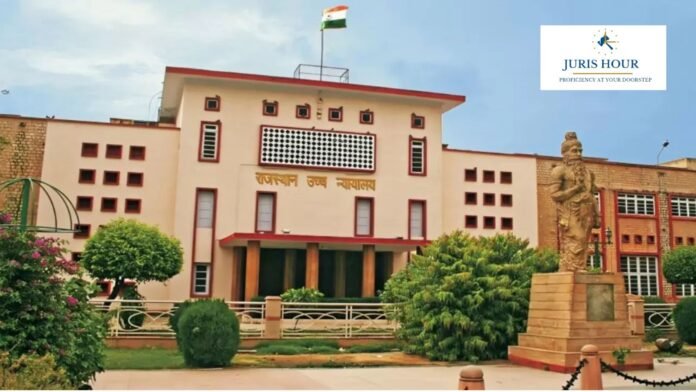
The Rajasthan High Court has exercised its extraordinary writ jurisdiction to condone the delay in filing GST appeal and directed the Appellate Authority to adjudicate the matter on merits within four months. The Court observed that there was no deliberate delay on the part of the petitioner and relied upon the principles laid down by the Supreme Court in Tecnimont Private Limited v. State of Punjab.
The Bench of Acting Chief Justice Sanjeev Prakash Sharma and Justice Baljinder Singh Sandhu passed the order while disposing of a writ petition filed against orders passed under the Rajasthan Goods and Services Tax Act, 2017. The petitioner had challenged both the original adjudication order as well as the subsequent order passed on a rectification application.
The petitioner argued that after receiving the original order, it had first pursued a rectification remedy. Upon disposal of the rectification application, it challenged both the original order and the rectification order. The delay that occurred in approaching the appellate forum was sought to be explained on the basis of the legal position recognized by the Supreme Court and various High Courts regarding the effect of pursuing rectification proceedings before filing an appeal.
The petitioner submitted that the matter could be finally decided at the present stage itself. The Court took note of the fact that the petitioner had first availed the remedy of rectification and thereafter proceeded to challenge the adverse orders. The Bench specifically referred to the Supreme Court’s judgment in Tecnimont Private Limited v. State of Punjab and Others reported in (2021) 12 SCC 477, wherein the apex court recognized the power of constitutional courts to grant relief in appropriate cases involving delay.
The High Court clarified that the Appellate Authority could not be faulted for rejecting the appeal on limitation grounds. The Bench observed that the authority functioning under Section 107 of the Rajasthan GST Act is bound by the statutory provisions governing appeals and does not possess powers beyond those conferred by the statute. Consequently, the appellate order could not be characterized as unjustified merely because the appeal had been filed beyond the prescribed period.
The Court distinguished the position of the statutory authority from that of the High Court exercising powers under Article 226 of the Constitution. Referring to the Supreme Court’s ruling in Tecnimont, the Bench emphasized that constitutional courts possess the authority to condone delay in appropriate circumstances where justice so demands.
The Court found that the petitioner’s conduct did not indicate any deliberate or intentional delay and that the circumstances justified exercise of the Court’s discretionary jurisdiction.
The High Court condoned the delay and directed the concerned Appellate Authority to decide the appeal on merits within a period of four months.
Case Details
Case Title: Indian Immunologicals Limited Versus State Of Rajasthan
Case No.: D.B. Civil Writ Petition No. 9387/2026
Date: 25/05/2026
Counsel For Appellant: Akshay Sharma
Counsel For Respondent: Mahi Yadav, AAG
Read More: S. 69 Customs Act: When Imported Goods Can Be Re-Exported Without Payment Of Import Duty

