
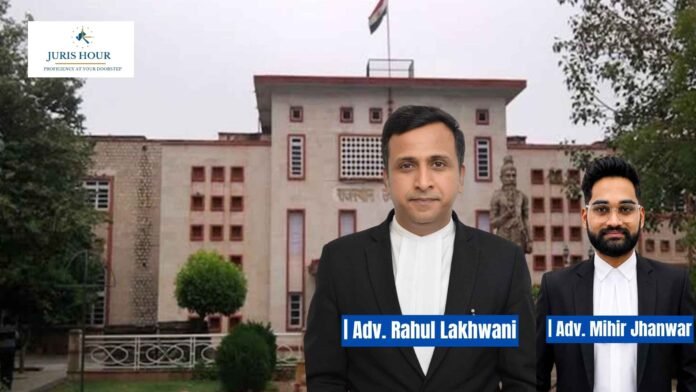
The Rajasthan High Court has set aside a GST order passed without granting the taxpayer an opportunity of hearing, reiterating that Section 75(4) of the Central Goods and Services Tax Act, 2017 requires a personal hearing where an adverse order is proposed.
The Bench of Chief Justice Sanjay K. Agrawal and Justice Baljinder Singh Sandhu observed that the impugned order violated the principles of natural justice and remitted the matter for a fresh hearing and disposal in accordance with law, while expressly leaving the merits of the tax dispute open.
Buy Now: 160+ GST E-Magazine September 2026
The disputed order was described in the judgment as having been passed under Section 74(A)(1), read with Section 74A(5)(i), of the Rajasthan Goods and Services Tax Act, 2017.
Rahul Lakhwani, the counsel on behalf of firm contended that the authorities had passed the order without providing an opportunity of hearing. Its counsel relied on the Delhi High Court’s decision in Rohit VIJ v. Commissioner of GST, which dealt with the requirement of a personal hearing under Section 75(4).
Significantly, Additional Advocate General Mahaveer Bishnoi, appearing for the respondents, acknowledged on instructions that the petitioner had not been afforded an opportunity of hearing before the impugned order was passed.
With the consent of both sides, the High Court heard the matter finally at the admission stage.
The central legal issue was whether the absence of a personal hearing rendered the GST order unsustainable when the statutory provision requires such an opportunity before an adverse decision.
The Bench reproduced the relevant reasoning from Rohit VIJ, which explained that Section 75(4) contains two separate circumstances requiring a personal hearing.
The first arises when the person chargeable with tax or penalty requests a hearing. The second arises when the proper officer proposes to pass an adverse order against that person.
As the Delhi High Court’s reasoning, reproduced in the judgment, explains: “The two contingencies are separated by the word ‘or’.”
This distinction means that the requirement to provide a hearing before an adverse order operates independently of whether the taxpayer has specifically requested one. A request from the taxpayer is therefore not the sole trigger for the statutory safeguard.
The precedent relied upon by the Rajasthan High Court also referred to the Madhya Pradesh High Court’s ruling in Technosys Security System (P.) Ltd. v. Commissioner, Commercial Taxes.
That decision recognised that Section 75(4) requires an opportunity of hearing where an adverse order is passed, irrespective of whether the taxable person has filed a reply.
The Rajasthan High Court’s order does not separately record whether the firm before it had filed a reply to the show cause notice. Its decision rests on the admitted failure to grant a hearing and the resulting violation of the statutory requirement and principles of natural justice.
The Bench held that the impugned order could not stand.
The Court observed that the order had been passed in violation of the principles of natural justice as provided under Section 75(4) of the CGST Act and accordingly set it aside.
In its operative direction, the Court remitted the matter to the Appellate Authority for hearing and disposal in accordance with law after providing the parties an opportunity of hearing.
Membership Required to Access Case Details & Order Copy
To view the complete Case Details and Download Order Copy, you must have an active membership. Please subscribe to continue.

