
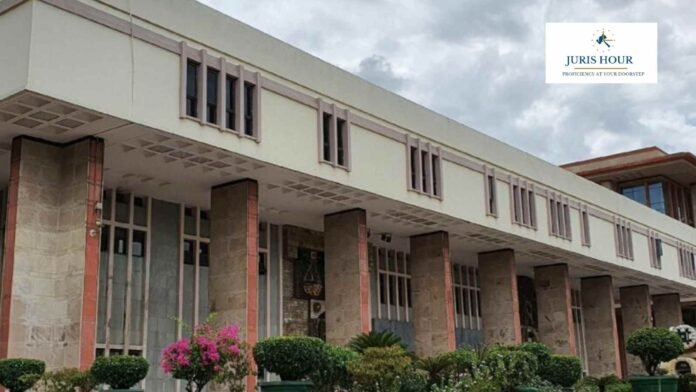
The Delhi High Court has declined to entertain a writ petition challenging a GST adjudication order, holding that the petitioners had an effective statutory remedy of appeal under Section 107 of the Central Goods and Services Tax Act, 2017 (CGST Act).
The bench of Justice Anil Khetarpal and Justice Shail Jain observed that the chronology of the proceedings did not disclose a jurisdictional infirmity under Section 6(2)(b) of the CGST Act that would justify bypassing the statutory appellate mechanism.
The petitioners/assessee had challenged an adjudication order and sought quashing of the consequential proceedings as well.
The petitioners approached the High Court under Articles 226 and 227 of the Constitution, seeking a writ of certiorari, mandamus or other appropriate directions to set aside the January 11, 2025 order. They also sought quashing of all consequential proceedings and requested that the relevant records be called for from the Revenue authorities.
Buy Now: 130 GST Judgments – E-Magazine July 2026
However, the Court noted at the outset that the petitioners had an available statutory remedy under Section 107 of the CGST Act against the impugned order. The existence of this appellate remedy was not disputed before the Bench.
The petitioners nevertheless advanced three principal grounds for invoking the High Court’s writ jurisdiction.
First, they contended that two simultaneous orders had been passed under Sections 74 and 73 of the CGST Act for the same period. Second, they argued that the proceedings initiated by the CGST authorities were barred by Section 6(2)(b) of the CGST Act. Third, they submitted that since the dispute involved a pure question of law, the High Court should exercise its writ jurisdiction notwithstanding the availability of the statutory appeal.
The department placed before the Court the chronology of the proceedings. According to the respondents, the petitioner’s premises had been searched on February 3, 2020, during which certain goods were seized after they were allegedly found without invoices.
Following the search, proceedings were initiated under Section 67(7) of the CGST Act through a notice dated September 6, 2022. Those proceedings were subsequently dropped.
The matter, however, subsequently proceeded on the basis of an investigation. The competent authority issued a show cause notice under Section 74 of the CGST Act on March 22, 2023, covering five financial years—2017-18 to 2021-22. The allegations included wrongful availment of Input Tax Credit (ITC) and evasion of tax.
The petitioner submitted its reply on February 16, 2024. After considering the matter, the adjudicating authority passed the impugned order on January 11, 2025.
A significant issue before the High Court concerned Section 6(2)(b) of the CGST Act, which deals with proceedings initiated by State and Central GST authorities on the same subject matter.
The provision stipulates that where a proper officer under the State GST law has initiated proceedings on a particular subject matter, a proper officer under the CGST Act should not initiate proceedings on the same subject matter.
The petitioners relied on this provision to contend that the CGST proceedings suffered from a jurisdictional defect.
The department however, relied upon the chronology of the proceedings to argue that the objection was misconceived. The CGST authorities had issued their Section 74 show cause notice on March 22, 2023. The first State GST notice relied upon by the petitioners was issued only later, on September 25, 2023.
The State GST authorities subsequently issued notices for financial years 2017-18, 2018-19 and 2019-20 on September 25, 2023, December 5, 2023 and March 29, 2024, respectively. Orders followed on December 29, 2023, January 23, 2024 and October 8, 2024.
The Bench rejected the petitioners’ attempt to invoke Section 6(2)(b) as a basis for bypassing the statutory appeal.
The Court specifically observed that the Section 74 show cause notice issued by the CGST authorities on March 22, 2023, preceded the State GST notices relied upon by the petitioners. Therefore, based on the chronology placed before the Court, the Section 6(2)(b) argument did not disclose a jurisdictional infirmity warranting exercise of writ jurisdiction.
The Court’s reasoning effectively turned on the sequence in which the proceedings were initiated. Since the CGST proceedings had commenced before the State GST notices cited by the petitioners, the statutory restriction contained in Section 6(2)(b) could not, on the facts presented, be used to invalidate the CGST proceedings at the writ stage.
The Bench also rejected the argument that the earlier proceedings concerning the seized goods and the subsequent GST adjudication amounted to parallel adjudication of the same subject matter.
The Court noted that the September 6, 2022 order related to proceedings concerning goods seized during the search. In contrast, the January 11, 2025 order was passed after investigation, issuance of the Section 74 show cause notice and consideration of the petitioner’s reply.
Consequently, the Court held that the two proceedings could not, merely on that basis, be treated as parallel adjudication of the same subject matter.
The petitioners had relied upon the Supreme Court’s decision in Godrej Sara Lee Ltd. v. Excise & Taxation Officer and another decision in Armour Security (India) Ltd. v. Commissioner, CGST, Delhi East Commissionerate and Anr. to contend that the existence of an alternative remedy does not prevent a High Court from exercising writ jurisdiction where a pure question of law or jurisdiction is involved.
The Delhi High Court acknowledged the legal proposition flowing from Godrej Sara Lee. It observed that the existence of an alternative remedy does not make a writ petition inherently non-maintainable. However, whether the writ petition should actually be entertained remains a matter of judicial discretion.
In the present case, the Bench found no jurisdictional infirmity in the proceedings. Therefore, it found no circumstance warranting exercise of writ jurisdiction in preference to the effective statutory appellate remedy available to the petitioners.
The High Court accordingly disposed of the writ petition and relegated the petitioners to the statutory remedy of appeal under Section 107 of the CGST Act.
The Court also protected the petitioners against prejudice on limitation. It directed that the period spent by the petitioners in prosecuting the writ petition before the High Court would be excluded while computing the limitation period for filing the statutory appeal.
Membership Required to Access Case Details & Order Copy
To view the complete Case Details and Download Order Copy, you must have an active membership. Please subscribe to continue.

