
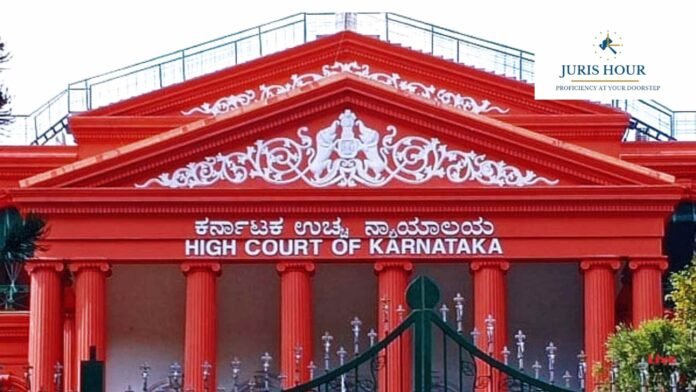
The Karnataka High Court has held that no GST on charges for sanctioning a building plan.
The bench of Justice R. Nataraj partly allowed a writ petition challenging the levy of various charges by the Bangalore Development Authority (BDA) for sanctioning a building plan, holding that the BDA lacked statutory authority to demand ground rent, scrutiny fee and security deposit in the circumstances of the case.
The bench ruled that the BDA could not collect CGST and SGST on the sanction of the building plan since there was no supply of goods or provision of services involved in the process.
Buy Now: JurisHour Ultimate Legal Research Combo – 4 Premium E-Magazines at an Unbeatable Price
The judgment is significant for developers and property owners dealing with building-plan approvals in Bengaluru, particularly on the question of whether statutory authorities can impose fees and taxes merely by adopting rates prescribed by another local authority.
The petitioners sought sanction of a development plan for construction of a multistoried building. In February 2022, the authorities issued a demand requiring payment of several amounts towards scrutiny fee, ground rent, development fee, plan paper fee, GST, labour welfare fund and security deposit.
The demand included ₹81.40 lakh towards scrutiny fee, ₹1.03 crore towards ground rent, ₹6.29 lakh towards development fee, ₹64,000 towards plan paper fee, ₹17.23 lakh each towards CGST and SGST, ₹1.26 crore towards labour welfare fund and ₹90.45 lakh towards security deposit.
The total amount payable under the demand notice came to approximately ₹4.43 crore.
Aggrieved by the demand, the petitioners approached the High Court under Articles 226 and 227 of the Constitution.
The central argument of the petitioners was that the BDA Act did not independently authorise the BDA to impose several of the charges demanded for sanctioning the building plan.
The petitioners contended that an earlier circular dated September 4, 2015, under which rates for ground rent and other charges had been prescribed, had already been quashed by the High Court in W.P. No. 4601 of 2020 and connected cases.
According to the petitioners, the BDA subsequently issued its own circular dated October 16, 2015, adopting the charges contained in the earlier circular. The petitioners argued that merely adopting charges imposed by another authority could not create statutory power in favour of the BDA.
The Court examined this contention in the context of the statutory powers available to the BDA.
The High Court noted that under Section 29 of the Bangalore Development Authority Act, 1976, the BDA could exercise the powers of a Commissioner of a Municipal Corporation under the Karnataka Municipal Corporations Act only after the requisite notification by the State Government.
The bench observed that there were no provisions under the BDA Act authorising the authority to collect ground rent, scrutiny fee or security deposit in the manner demanded.
The Court further noted that these charges appeared to have been imposed because the BBMP had imposed similar charges. However, the existence of such charges under the BBMP framework did not by itself confer corresponding statutory authority upon the BDA.
The Court relied upon the earlier decision in Mr. Sunderam Shetty and others v. State of Karnataka, where a coordinate Bench had held that there was no statutory power to impose ground rent, licence fee, building licence fee, scrutiny fee and security deposit without authority of law.
The principle of quid pro quo was also considered. A fee, the Court noted, must have a reasonable relationship with a service rendered and must be imposed with the authority of law.
The respondents relied upon the decision in M/s Sapthagiri Shelters and others v. State of Karnataka, pointing out that the judgment had been challenged before the Division Bench in W.A. No. 1226/2025, where an order of status quo was operating.
The High Court, however, noted that the coordinate Bench in Sapthagiri Shelters had quashed certain amendments made to the Karnataka municipal legislation that sought to justify the levies earlier struck down by the Court.
Importantly, the Court recorded that the appeal against the Sapthagiri Shelters judgment was still pending. In these circumstances, it concluded that if BBMP did not have the power to collect the relevant charges, the BDA could not demand them either.
Another important issue concerned the demand for labour welfare cess.
The petitioners argued that Section 3 of the Building and Other Construction Workers’ Welfare Cess Act, 1996 provides for levy and collection of cess at a prescribed rate on the cost of construction incurred by an employer.
They further relied on Rule 4 of the Building and Other Construction Workers’ Welfare Cess Rules, 1998, contending that where construction extends beyond one year, the cess is required to be paid in the manner and at the time prescribed by the Rules rather than being demanded as a lump-sum amount before construction begins.
The High Court accepted this distinction.
Referring to the earlier ruling, the Court held that the liability to pay labour cess itself was not eliminated. What was impermissible was demanding the entire cess upfront before construction had taken place.
The Court therefore directed that the labour welfare cess be collected in accordance with Rule 4 of the Cess Rules.
A significant tax issue before the Court was the levy of CGST and SGST on the charges demanded for sanctioning the building plan.
The petitioners argued that sanctioning a building plan did not involve any supply of goods or provision of services by the BDA. Consequently, the GST component included in the demand was challenged.
The High Court accepted the contention and expressly held that the BDA was not entitled to collect CGST and SGST because there was no supply of goods or provision of services in sanctioning the building plan.
This finding adds an important dimension to the judgment, as the Court did not merely examine the underlying authority to levy the municipal charges but also addressed the GST consequences attached to those charges.
In its operative order, the High Court partly allowed the writ petition and specifically quashed the February 18, 2022 demand insofar as it related to Scrutiny fee, Ground rent, Security deposit
The Court directed that the labour welfare cess be collected only in the manner prescribed under Rule 4 of the 1998 Cess Rules.
The Court also declared that the BDA could not collect CGST and SGST in relation to the sanctioning of the building plan.
The judgment did not end with quashing the disputed demands. The Court directed the BDA to raise a fresh demand for labour cess within one month from receipt of the order and to release the building plan after duly sanctioning it within the same period.
At the same time, the Court protected the position in the pending appeal. Its directions were made subject to the outcome of W.A. No. 1226/2025, which challenges the judgment in Sapthagiri Shelters.
The petitioners were also directed to file an undertaking that they would pay the charges if those charges were ultimately held to be constitutionally valid in the pending appeal.
Membership Required to Access Case Details & Order Copy
To view the complete Case Details and Download Order Copy, you must have an active membership. Please subscribe to continue.

