
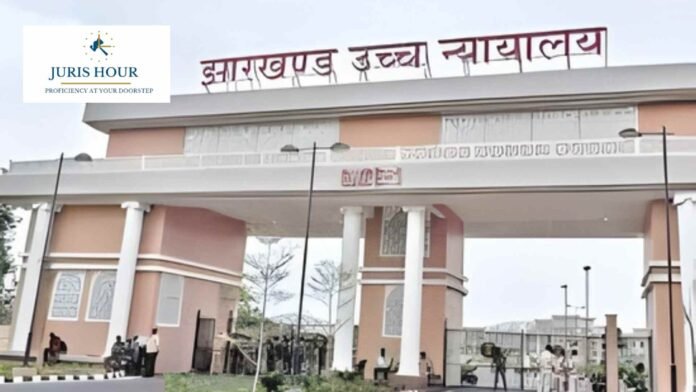
The Jharkhand High Court has dismissed a writ petition filed by two long-serving casual labourers engaged with the Central Goods and Services Tax (CGST) and Central Excise Department, holding that regularisation cannot be granted to employees who do not possess the minimum educational qualification prescribed under the applicable recruitment rules.
The Bench of Justice Sujit Narayan Prasad and Justice Sanjay Prasad affirmed the order of the Central Administrative Tribunal (CAT), Patna Bench, Circuit Sitting at Ranchi, which had earlier refused to direct the regularisation of the petitioners’ services.
The petitioners had been working as casual labourers in the office of the Principal Commissioner, CGST and Central Excise, Ranchi, since 1995 and 1999, respectively. They argued that despite rendering uninterrupted service for more than two decades, their claim for regularisation was rejected solely because they did not possess the prescribed educational qualification.
Buy Now: June 2026 Ultimate Legal & Taxation Combo
They challenged the rejection order dated July 14, 2022, contending that the CBIC Part-Time Casual Labourers (Regularisation) Scheme, 2020 did not prescribe any educational qualification for erstwhile Group-D posts and therefore the authorities had wrongly denied them regularisation.
The employees submitted that they had continuously served the department for nearly three decades without any interruption. Their appointments were directly made by the department and were acknowledged by official records. Their claim was for regularisation based on long and continuous service rather than fresh appointment. The authorities had incorrectly invoked educational qualification requirements applicable to Group-C posts. Since they sought regularisation against Group-D posts, matriculation should not have been insisted upon.
The Union Government opposed the plea, arguing that following the recommendations of the Sixth Central Pay Commission, the Group-D cadre had ceased to exist, having been merged into Group-C.
Accordingly, any regularisation could only be made against Group-C posts, for which matriculation is the minimum prescribed educational qualification under the applicable recruitment rules and the CBIC Regularisation Scheme, 2020.
Since both petitioners were only 8th/9th standard pass, they were held ineligible for regularisation.
The Court first reiterated the limited scope of judicial review while exercising jurisdiction under Article 226 over orders passed by the Central Administrative Tribunal, observing that interference is warranted only where there is an apparent error of law, perversity, or jurisdictional infirmity.
The Bench then examined the settled principles governing regularisation of irregular appointments, relying extensively on the Supreme Court’s landmark judgment in Secretary, State of Karnataka v. Uma Devi (2006) and subsequent decisions including: State of Karnataka v. M.L. Kesari; Narendra Kumar Tiwari v. State of Jharkhand; Jaggo v. Union of India; Bhola Nath v. State of Jharkhand.
The Court noted that while these judgments recognise the possibility of regularising certain irregular appointments, they do not permit regularisation where the employee lacks the essential eligibility qualifications prescribed for the post.
The Bench observed that such a defect strikes at the very root of eligibility and cannot be cured by long years of service.
According to the Court, once an employee enters service without possessing the minimum educational qualification, the defect remains incurable and cannot subsequently be validated through regularisation.
Rejecting the petitioners’ principal argument, the Court held that after abolition and merger of Group-D posts pursuant to the Sixth Pay Commission recommendations, there remained no Group-D cadre in which the petitioners could be regularised.
The Court observed that any regularisation could now only be against Group-C posts, which necessarily require matriculation as the minimum educational qualification under the applicable rules.
Since the petitioners admittedly did not possess matriculation certificates, they could not claim regularisation as a matter of right.
The High Court further relied upon several Supreme Court rulings, including State of M.P. v. Shyama Pardi, Mohd. Sartaj v. State of Uttar Pradesh, and Pramod Kumar v. U.P. Secondary Education Services Commission, to reiterate that appointments made without the requisite educational qualification are void ab initio and cannot be validated through subsequent regularisation.
The Court observed that while procedural irregularities may sometimes be regularised, an appointment contrary to statutory eligibility conditions cannot be cured by passage of time or continued service.
Finding no error in the CAT’s reasoning, the High Court held that the Tribunal had correctly considered: the abolition of Group-D posts; the applicability of the CBIC Regularisation Scheme, 2020; the requirement of matriculation for Group-C posts; and the petitioners’ admitted lack of the prescribed qualification.
The writ petition was dismissed, and the Tribunal’s order rejecting the claim for regularisation was upheld.
Membership Required to Access Case Details & Order Copy
To view the complete Case Details and Download Order Copy, you must have an active membership. Please subscribe to continue.

