
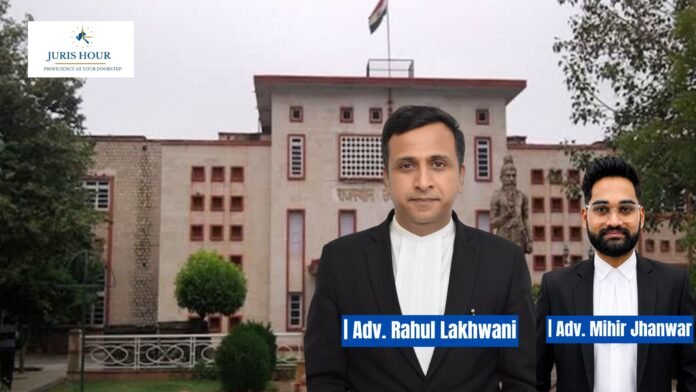
The Rajasthan High Court has directed the GST Appellate Authority to decide on merits an appeal against a demand of ₹23.48 lakh after condoning a delay of 22 days, observing that refusal to adjudicate the appeal would cause grave injury and prejudice to the taxpayer.
The Division Bench of Justice Arun Monga and Justice Ashutosh Kumar held that although the Appellate Authority remains bound by the limitation prescribed under Section 107 of the Rajasthan Goods and Services Tax Act, 2017, the High Court could grant relief where the delay occurred due to circumstances beyond the taxpayer’s control.
The petitioner challenged an appellate order dated January 6, 2026. Through that order, the Appellate Authority-II, State Tax, Jaipur-II, had rejected the company’s appeal solely on the ground that it had been filed beyond the condonable period prescribed under Section 107(4) of the RGST Act.
Buy Now: GSTAT E-Compilation For August 2026
The company had also challenged the Order-in-Original through which the State Tax department raised a GST demand of ₹23,48,740 for the financial year 2018-19 following an audit conducted under Section 65 of the RGST Act.
The dispute arose after the GST authorities conducted an audit of the company’s affairs for FY 2018-19. Following the audit, a show-cause notice dated December 18, 2023, was issued under Section 73 of the Central Goods and Services Tax Act, 2017, proposing a demand of ₹41,09,961.
Despite the short time available, the company submitted a detailed response on December 22, 2023. It also specifically requested an opportunity for a personal hearing.
The adjudicating authority subsequently passed the Order-in-Original. While the proposed demand relating to reversal of input tax credit on repair and maintenance expenses was dropped, the authority confirmed the remaining components of the demand, resulting in a liability of ₹23,48,740.
The company alleged that the adjudication order was passed without granting the personal hearing specifically requested by it. According to the petitioner, this amounted to a violation of Section 75(4) of the CGST and RGST Acts as well as the principles of natural justice.
Rahul Lakhwani, the counsel for the company contended that the Order-in-Original was merely uploaded on the GST common portal and was not effectively served upon it. The accountant or employee who had been entrusted with handling its GST compliances and monitoring the portal had ceased to be in its employment at the relevant time. Consequently, the company did not become aware of the adjudication order within the statutory period for filing an appeal.
After acquiring knowledge of the order, the company filed an appeal on August 1, 2024. The appeal was delayed by 22 days and was accompanied by an undertaking explaining the circumstances that had caused the delay.
The Appellate Authority, however, rejected the appeal on January 6, 2026, holding that it had no statutory power to condone a delay extending beyond the period permitted under Section 107(4).
The company then approached the Rajasthan High Court, seeking restoration of its appeal and adjudication of the dispute on merits.
The High Court acknowledged that an Appellate Authority constituted under the GST enactments is bound by the limitation expressly prescribed under Section 107 and cannot ordinarily condone a delay beyond the additional period permitted by the statute.
However, the Bench considered the explanation offered by the company and found that the circumstances preventing it from filing the appeal within time were beyond its control.
The Court observed that refusing to examine the appeal on merits in such circumstances would cause grave injury and prejudice to the petitioner.
The Bench also referred to its earlier Division Bench decisions in M/s M R Traders v. Union of India, M/s Molana Construction Company v. Central Goods and Service Tax Department, Man Singh Tanwar v. Commissioner, Central Goods and Services Tax Department and the decisions involving RPC PSIPL JV v. State of Rajasthan.
In those cases, the High Court had permitted delayed GST appeals to be entertained on merits after taking into account the circumstances responsible for the delay.
The Rajasthan High Court placed significant reliance on the Punjab and Haryana High Court’s ruling in Luxmi Traders v. Union Territory of Chandigarh and Others.
In that judgment, the Punjab and Haryana High Court held that service of a show-cause notice could not be treated as sufficient merely because it was uploaded on the GST portal, unless its receipt was acknowledged or a reply was filed by the taxpayer. The ruling further held that where an Order-in-Original passed after contest was served only by uploading it on the portal, the limitation period for filing an appeal would not be triggered.
It also directed that where appeals against orders served only through portal uploads had been dismissed on limitation, the appellate orders should be set aside and the appeals restored for adjudication on merits.
The Rajasthan High Court expressed its respectful agreement with the principles laid down in Luxmi Traders and held that there was no reason to deny the same benefit to Fruitful Buildcon.
Accordingly, the High Court allowed the writ petition to the extent of condoning the delay in filing the appeal.
The Court directed the Appellate Authority to entertain the company’s appeal and adjudicate it on merits, subject to the appeal being filed within 30 days from the date on which the High Court’s order was uploaded on its website.
Membership Required to Access Case Details & Order Copy
To view the complete Case Details and Download Order Copy, you must have an active membership. Please subscribe to continue.

