
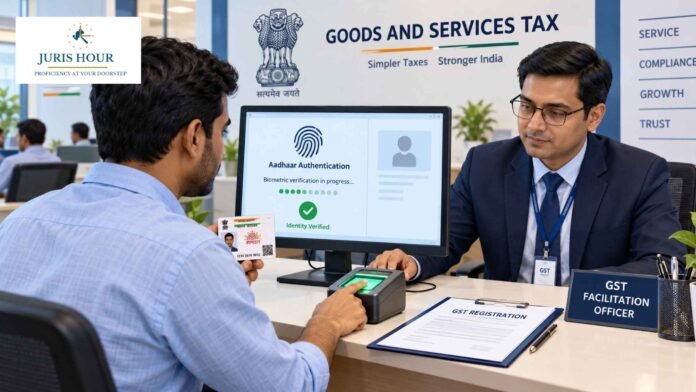
The Delhi High Court has directed authorities across the country not to grant any new Goods and Services Tax registration without biometric-based Aadhaar authentication, taking serious note of fraudulent GST registrations obtained by misusing the PAN and Aadhaar details of innocent citizens.
A Division Bench comprising Justice Anil Kshetrapal and Justice Shail Jain observed that fake registrations not only cause harassment to persons who have no connection with the registered businesses but also result in substantial revenue loss to the government.
The direction was issued while hearing two writ petitions involving allegations that GST registrations had fraudulently been obtained using the petitioners’ identity documents. The Court was informed that biometric Aadhaar authentication was presently undertaken only where an application was categorised as “risky” through prescribed parameters and data analytics.
Buy Now: E-Magazine: 1000+ Landmark GST Judgments (2017–2026)
“Directions are issued to all the authorities across the country not to allow any GST registration without biometric-based Aadhaar authentication henceforth,” the Court ordered.
The authorities have, however, been granted liberty to raise objections if they encounter any practical difficulty in implementing the direction.
During the proceedings, written submissions were produced on behalf of the Union authorities and the Commissioner of the Department of Trade and Taxes. The Delhi Police also placed a status report before the Court.
The government’s submissions included information given by the Minister of State for Finance in response to a question in the Rajya Sabha concerning fraudulent GST registrations.
According to the figures placed before the Court, 2,800 fraudulent GST registrations obtained through stolen or misused PAN and Aadhaar details were detected during the financial year 2023-24. These registrations allegedly involved tax evasion amounting to ₹15,085 crore.
During 2024-25, authorities detected another 1,654 fraudulent GST registrations involving alleged tax evasion of ₹13,109 crore.
The minister had stated that biometric Aadhaar-based authentication had been made mandatory for GST registration. However, the High Court observed that the assurance did not appear to have been fully implemented even after the passage of more than a year.
The lack of complete implementation, according to the Bench, had allowed fraudulent GST registrations using stolen or misused identity particulars to continue.
Expressing concern over the scale of the problem, the High Court said the competent authorities must “rise to the situation” as fake GST registrations were simultaneously causing government revenue losses and harassment to innocent citizens.
The Court recorded that counsel representing the respondents had been unable to point out any difficulty that would prevent the government from making biometric Aadhaar authentication compulsory for GST registration.
The Bench consequently issued the interim nationwide direction while allowing the authorities to place any practical implementation difficulties before it.
“The authorities are expected to take up the matter with all seriousness,” the Court observed.
In an earlier order passed on September 1, 2026, the High Court noted that fraudulent GST registrations obtained using the PAN and Aadhaar details of innocent persons had been a rampant problem since the enforcement of the Central Goods and Services Tax Act, 2017.
The Court observed that nearly nine years had elapsed since the implementation of the GST law, but the authorities had failed to effectively curb the malpractice.
The Bench had stated that the problem affected citizens who had no connection with the fraudulent registrations created in their names. At the same time, such registrations were allegedly being used to generate substantial tax liabilities and cause huge losses to the government.
The Court had granted a final opportunity to the Commissioner of Central GST, the Commissioner of Delhi GST and the Commissioner of Delhi Police to devise an effective solution. It warned that, in the absence of adequate measures, the Court would be compelled to pass appropriate and effective orders.
Senior Advocate Tarun Gulati, who was requested to assist the Court as amicus curiae, submitted a series of proposed measures to prevent the misuse of identity documents for GST registrations.
One of the primary suggestions was to make facial recognition against the Aadhaar database compulsory for every registration application.
It was also suggested that applicants be required to upload a 20-to-30-second verification video showing their face along with their original PAN and Aadhaar cards. Under the proposed mechanism, an applicant would hold each document before the camera and read aloud a system-generated prompt containing their name or other relevant particulars, together with a unique code generated by the GST common portal.
Another proposal involved recording and preserving the IP address and device location used for submitting a registration application. This information could then be retained by the GST portal and the jurisdictional authority granting the registration, enabling investigators to trace the origin of an application if the identity of the applicant was subsequently disputed.
The suggestions also included compulsory physical verification of the proposed principal place of business before granting GST registration.
Alternatively, randomly selected registered premises could be physically inspected twice a year based on a risk-evaluation system.
At present, physical verification is generally focused on cases identified as high-risk by the system’s risk analytics. Expanding such verification, it was suggested, could help authorities establish whether the declared business actually existed at the stated address.
The Court was also asked to consider a real-time information-sharing mechanism between the GST and Income Tax departments.
Under the proposed system, whenever a PAN is used for a GST registration application, the person holding that PAN would immediately receive an email and mobile alert. Data could also be cross-verified with Form 26AS and Form 16B generated for the taxpayer.
A similar alert could be sent through DigiLocker, where available, informing the individual that their PAN or Aadhaar number had been used to seek GST registration. The registration process could require the identity holder to confirm or deny consent.
Real-time confirmation from the Aadhaar holder was also suggested to establish that the person was aware of the business and the principal place of business being registered using their identity particulars.
Among the other recommendations was the introduction of a specific risk parameter by the Directorate General of Analytics and Risk Management for cases involving a PAN-Aadhaar mismatch or the first-time use of a particular PAN or Aadhaar number for GST registration.
The system could also flag registrations showing a sudden and substantial increase in turnover, allowing tax authorities to subject such cases to enhanced scrutiny.
Applicants could further be asked to nominate identifiable persons—such as business associates, employees, partners or family members—who could corroborate their identity and confirm the existence of the proposed business.
The High Court has asked the authorities to examine the recommendations placed before it. The matter will next be considered on September 22, 2026.
Membership Required to Access Case Details & Order Copy
To view the complete Case Details and Download Order Copy, you must have an active membership. Please subscribe to continue.

