
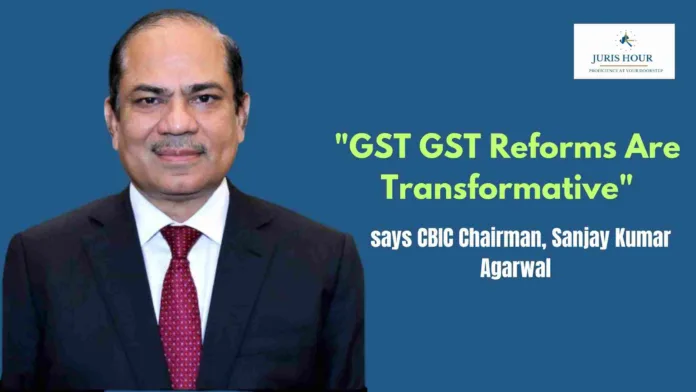
The recently announced Goods and Services Tax (GST) reform proposals are set to mark a turning point in India’s indirect tax system, with the Central Board of Indirect Taxes and Customs (CBIC) chairman Sanjay Kumar Agarwal describing the changes as “transformational” and crucial for providing long-term tax certainty.
In an exclusive interaction, Agarwal explained that while consumers and businesses may experience short-term adjustments, the reforms will stabilize the GST framework, enhance investor confidence, and reduce litigation. “The intent is not merely rationalisation but transformation,” he said, adding that the reforms will give clarity to businesses regarding their GST liabilities and obligations.
GST 2.0: Aimed at Simplification
The CBIC chairman highlighted that the reforms are designed to remove ambiguity and simplify classification disputes, particularly those involving goods and services. He admitted that confusion in classification and rate disputes had long created uncertainty for businesses.
“Uncertainty affects business confidence and investment. These reforms will settle classification disputes and provide a stable tax structure,” Agarwal remarked.
The reforms, being referred to as ‘GST 2.0’, are expected to bring relief by eliminating grey areas in the system. “All of these future disputes will be settled with these reforms,” he stressed.
Impact on Consumers and Businesses
The changes are also expected to stimulate economic activity by putting more disposable income into the hands of consumers. “When there will be more money in the hands of the common man, they will spend more. That will stimulate growth and lead to further collection of those additional sales of goods,” Agarwal explained.
The CBIC chief noted that while revenue collections might remain muted for the next two to three months, the true impact of the reforms will be visible from December 2025 onwards.
Industry Response
The reforms have been welcomed positively by industry stakeholders. Agarwal said business representatives appreciated the government’s move to provide clarity and certainty. They also agreed that benefits passed on to consumers would spur consumption and strengthen the economy.
He dismissed concerns raised in some quarters about revenue losses due to the rationalisation. “Such fears are based on assumptions. Real impact can only be assessed once the reforms are fully implemented,” he added.
On Revenue Collection
Addressing questions regarding GST collections, Agarwal said the government is prepared for a temporary dip. “We anticipate muted revenues for 2-3 months, but collections will stabilise with renewed momentum from December,” he assured.
He further explained that the reforms are not just about numbers but about creating a sustainable framework. “Once businesses and consumers adapt, the system will not only ensure certainty but also strengthen compliance,” he said.
Looking Ahead
The GST reforms are being seen as one of the most significant developments since the introduction of GST in 2017. Policymakers believe this round of reforms will cement GST as a predictable, transparent, and business-friendly tax regime.
With emphasis on stability, clarity, and growth, GST 2.0 is positioned as a milestone that could redefine India’s indirect tax landscape in the coming years.
Read More: Service Tax Not Payable on Freight Margin and Commissions: CESTAT

