
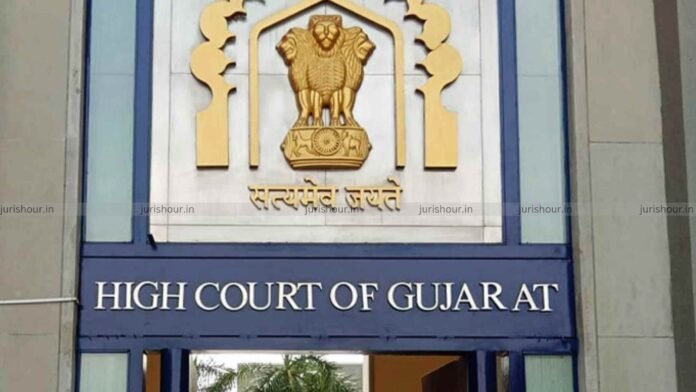
The Gujarat High Court has quashed GST show cause notices and a consequential demand order confirming a tax liability of ₹28.49 lakh after finding that the entire proceedings had been initiated and continued against a deceased sole proprietor.
The Bench of Justice A.S. Supehia and Justice Vaibhavi D. Nanavati observed that the petitioner, who was the wife of the deceased taxpayer, was a homemaker, had no involvement in the proprietorship business and was unaware of the notices uploaded on the GST portal.
The bench clarified that the State Tax Department would be at liberty to initiate appropriate proceedings against the legal heir in accordance with law for any outstanding demand.
Buy Now: 150 + Judgments On GST – E-Compilation For August 2026
“Since the proceedings are initiated against the dead person, we quash and set aside the show cause notices as well as the impugned orders passed thereafter,” the Bench held.
The deceased taxpayer carried on the business of trading in various goods under the name Shivam Trading Co., a proprietorship concern.
He died on May 3, 2021, at the age of 37 due to COVID-19. Following his death, the business was not continued by his wife, Ushaben Kalpeshbhai Patni.
The GST registration of the proprietorship concern was subsequently cancelled by the authorities through an order dated July 16, 2021, on account of failure to file GST returns continuously for six months. At the time of cancellation, the authorities reportedly assessed nil demand against the concern.
Nearly three years after the proprietor’s death, the State Tax Officer issued an intimation in Form GST DRC-01A dated June 14, 2024, under Section 73(5) of the Gujarat Goods and Services Tax Act, 2017. The intimation proposed a tax liability of ₹28,49,906, along with applicable interest and penalty, for the financial year 2020-21.
The intimation was issued in the name of the deceased proprietor and uploaded on the GST portal. According to the petitioner, she was unaware of the portal proceedings and, therefore, could not respond.
Thereafter, the tax authority issued a show cause notice dated July 2, 2024, under Section 73(1) of the GGST Act in Form GST DRC-01. The notice sought to recover ₹28,49,906, together with interest and penalty, from the deceased taxpayer.
The proposed demand was reportedly based on the difference in the taxable outward supplies disclosed in GSTR-1 and GSTR-3B.
The petitioner contended that the tax authority had not conducted any further verification regarding the actual supplies made by the deceased proprietor or the availability of input tax credit against the purported supplies.
Since the show cause notice was also uploaded on the GST portal in the name of the deceased proprietor, no reply was filed.
The department subsequently issued three notices dated October 19, 2024, November 8, 2024, and December 11, 2024, calling upon the deceased taxpayer to respond to the proceedings. Through the final notice, the deceased taxpayer was also asked to attend a physical hearing.
When no person appeared or submitted a response, the State Tax Officer passed an ex parte order dated February 1, 2025, in Form GST DRC-07, confirming the entire demand proposed in the show cause notice.
The petitioner claimed that she became aware of the proceedings only after the consultant who had handled the GST return filings for her late husband’s business informed her about the notice and demand order appearing on the GST portal.
Challenging the proceedings before the Gujarat High Court, the petitioner argued that the show cause notices and the final demand order were legally unsustainable because they had been issued against a person who had died more than three years before initiation of the proceedings.
Her counsel submitted that she was a homemaker and had no connection with the business activities undertaken by her late husband. She was consequently unaware of the GST proceedings and could not locate the records relating to the erstwhile business.
The petitioner relied upon an earlier judgment of the Gujarat High Court dated July 28, 2026, in Special Civil Application No. 10294 of 2026 to support the contention that proceedings initiated against a deceased person could not be sustained.
Opposing the writ petition, the State Government submitted that the department had issued three notices calling for a response. It was argued that the taxpayer was also granted an opportunity to attend a physical hearing but no one appeared before the authority.
The department further informed the Court that the notices had been affixed at the principal place of business of the deceased taxpayer. On that basis, the State urged the Court not to interfere with the demand order.
The High Court found that there was no dispute regarding the death of the proprietor on May 3, 2021, during the COVID-19 pandemic. His GST registration had also been cancelled on July 16, 2021.
Despite these facts, the department initiated proceedings almost three years later by issuing the pre-show cause notice intimation dated June 14, 2024, in the name of the deceased taxpayer.
The proceedings were thereafter continued against the deceased person, and the department ultimately passed the demand order because no reply was filed and no one appeared for the hearing.
The Bench acknowledged that the respondent authority might not have been aware of the proprietor’s death when it initiated the proceedings. However, it noted that the petitioner was merely the deceased taxpayer’s wife and was not remotely connected with the proprietorship concern.
The Court also took into account that the petitioner, being unfamiliar with the functioning of the GST portal, was unaware of the electronic notices issued against her deceased husband.
Holding that proceedings instituted against a dead person could not be sustained, the High Court quashed the show cause notices as well as the consequential demand order dated February 1, 2025.
The Court nevertheless protected the department’s right to proceed in a legally permissible manner. It clarified that the tax authority could initiate proper proceedings against the petitioner, as the legal heir of the deceased proprietor, for any outstanding demand, subject to the applicable statutory requirements.
Membership Required to Access Case Details & Order Copy
To view the complete Case Details and Download Order Copy, you must have an active membership. Please subscribe to continue.
Read More: CGST Demand Prima Facie Impermissible After State GST Settlement U/S 128A: Bombay High Court

