
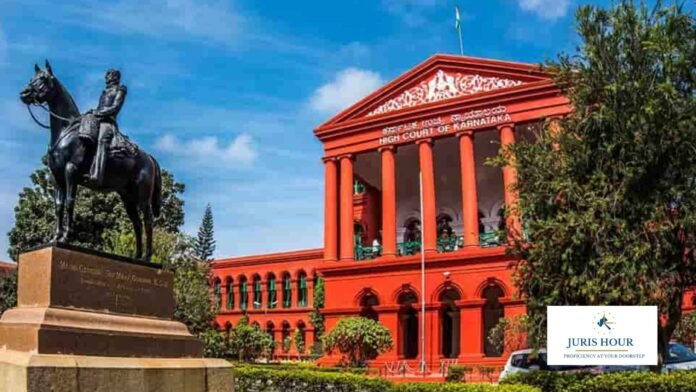
The Karnataka High Court has directed the Goods and Services Tax authorities to refund ₹53.97 lakh collected from a taxpayer during an investigation, holding that the payments could not be treated as voluntary when there was no prior ascertainment of tax liability and the mandatory acknowledgment in Form GST DRC-04 had not been issued.
The bench of Justice C.M. Poonacha observed that merely filing Form GST DRC-03 does not establish that a payment was voluntary. The Court noted that the payments were not supported by any material showing how the taxpayer or the proper officer had quantified the alleged tax liability.
Buy Now: E-Magazine: 1000+ Landmark GST Judgments (2017–2026)
The bench quashed the appellate orders rejecting the taxpayer’s refund claims and directed the authorities to refund ₹53,97,352 along with interest at 6% per annum from the respective dates of payment until the date of refund.
The petitioner/assessee is registered under the Central Goods and Services Tax Act, 2017, and the Karnataka Goods and Services Tax Act, 2017. It is engaged in supplying manpower to various government departments and public authorities.
The dispute arose after the GST authorities reportedly received intelligence regarding a discrepancy between the petitioner’s GSTR-3B returns and the information reflected in GSTR-7.
Acting on the intelligence, the Joint Commissioner of Commercial Taxes authorised an inspection of the petitioner’s premises. The inspection was conducted by the Commercial Tax Officer and other officials on January 20, 2024.
Following the inspection, the petitioner paid ₹20,97,352 and ₹15 lakh on March 27, 2024, making an aggregate payment of ₹35,97,352. The payments were made through Form GST DRC-03 by referring to Section 73(5) of the CGST Act.
The petitioner, however, maintained that the amounts had not been paid voluntarily and were deposited under pressure from the departmental authorities.
The department subsequently issued a notice dated May 8, 2024, followed by an endorsement dated May 13, 2024, requiring the petitioner to appear personally before the Commercial Tax Officer on May 16.
The endorsement warned that legal action under Section 70 of the Karnataka GST Act would be initiated if the petitioner failed to appear. Significantly, the High Court noted that the notice requiring personal appearance did not specify the statutory provision under which it had been issued.
An additional amount of ₹18 lakh was paid by the petitioner on May 14, 2024, through Form GST DRC-03. The petitioner alleged that this amount was also deposited under duress.
The three payments together amounted to ₹53,97,352.
A pre-show-cause intimation dated July 18, 2024, was thereafter issued under Section 74 of the GST enactments, proposing a demand of ₹3,21,870 along with interest and penalty.
The petitioner submitted its response on July 29, 2024. A further show-cause notice was issued on August 7, 2024, to which the petitioner replied on September 2, 2024.
In its reply, the petitioner specifically recorded that ₹53.97 lakh had been recovered involuntarily and under protest.
The taxpayer then filed two refund applications on September 12, 2024, claiming refunds of ₹38,97,352 and ₹15 lakh. It narrated the sequence of events and alleged that the departmental officers had resorted to coercive methods to secure the payments.
The applications were rejected on November 12, 2024. The appellate authority also rejected the taxpayer’s challenge through orders dated August 28, 2025, prompting it to approach the High Court.
The State disputed the allegation of coercion. It argued that the payments made on March 27, 2024, were deposited 68 days after the inspection conducted on January 20, 2024.
It further submitted that the subsequent payment was not made simultaneously with the first set of payments. According to the State, the time gap demonstrated that the amounts had been paid voluntarily and not under immediate pressure during the inspection.
The State also contended that an adjudication order had subsequently been passed under Section 74(9) of the GST law on February 6, 2025. Therefore, it argued, the question of refunding the amounts did not arise.
The High Court examined Section 73(5), under which a person chargeable with tax may, before service of a show-cause notice, pay tax and interest based either on their own ascertainment or on the ascertainment made by the proper officer.
The Court found that there was no material on record showing any assessment or ascertainment of the tax liability that could explain how the amounts deposited by the petitioner had been calculated.
It also noted that no proceedings were initiated against the petitioner immediately pursuant to the inspection conducted on January 20, 2024.
For a payment to qualify as voluntary under Section 73(5) or Section 74(5), it must be based on an identifiable exercise of self-ascertainment by the taxpayer or ascertainment by the proper officer. The mere payment of an amount through the GST portal, without supporting computation or particulars, was insufficient to establish voluntariness.
The Court also relied on Rule 142(2) of the CGST Rules, which requires the proper officer to issue an acknowledgment in Form GST DRC-04 when a taxpayer communicates payment through Form GST DRC-03.
In the present case, the department admittedly did not issue Form GST DRC-04 for the payments made by the petitioner.
The High Court held that this omission was a significant circumstance against the department’s assertion that the amounts had been deposited voluntarily in accordance with the statutory procedure.
The Court further noticed that the DRC-03 forms showed no payment towards interest or penalty. If the payments were truly made under Section 74(5), tax was required to be accompanied by the applicable interest and penalty. The relevant columns in the petitioner’s DRC-03 forms instead showed the interest and penalty components as nil.
The High Court placed particular emphasis on the payment of ₹18 lakh made on May 14, 2024.
The payment was made one day after the department issued the endorsement dated May 13, directing the petitioner to appear personally. The endorsement did not disclose the legal provision under which the taxpayer’s appearance had been demanded.
The sequence of events, according to the Court, supported the petitioner’s contention that the payment could not be accepted as an independent and voluntary deposit based on self-ascertainment.
The Court relied on the principles laid down in Bundl Technologies Private Limited and Sri J. Ramesh Chand, where payments obtained during search, inspection or investigation were examined in light of the statutory safeguards governing voluntary tax deposits.
It also referred to the Supreme Court’s decision in Radhika Agarwal v. Union of India and the departmental instructions dated May 25, 2022, concerning the deposit of tax during search, inspection or investigation.
These instructions clarify that officers should not use force or coercion to recover amounts during an investigation and that taxpayers remain free to make genuine voluntary payments after ascertaining their liability.
Rejecting another argument advanced by the department, the High Court held that the mere initiation of proceedings under Section 79 of the GST law would not establish that the earlier payments were voluntary.
The Court also declined to accept the contention that the subsequent adjudication order automatically defeated the refund claim. It noted that the adjudication order was separately under challenge before the High Court.
The legality of the show-cause notice and adjudication proceedings was, therefore, distinct from the question of whether the ₹53.97 lakh had been voluntarily paid before the liability was properly quantified.
Concluding that the refund applications had been erroneously rejected, the High Court allowed the writ petition and quashed the appellate orders dated August 28, 2025, relating to the financial years 2017-18 and 2018-19.
The GST authorities were directed to refund ₹53,97,352 to the petitioner together with interest at 6% per annum, calculated from the respective dates of payment until the actual date of refund.
The Court, however, clarified that all rival contentions concerning the allegations raised in the show-cause notice and the adjudication proceedings would remain open for determination in those proceedings.
Membership Required to Access Case Details & Order Copy
To view the complete Case Details and Download Order Copy, you must have an active membership. Please subscribe to continue.

