
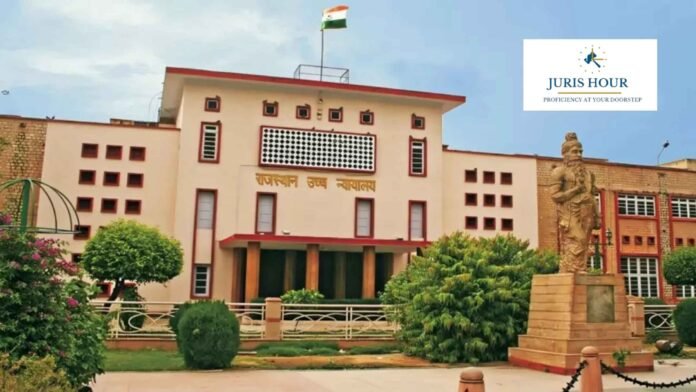
The Rajasthan High Court has upheld the constitutional validity of Section 16(2)(c) of the Central Goods and Services Tax Act, 2017, ruling that the entitlement to input tax credit is conditional upon the tax charged by the supplier actually being paid to the government.
The Bench of Justice Arun Monga and Justice Ashutosh Kumar held that Parliament has consciously placed the risk of a supplier’s default upon the recipient while providing a mechanism for restoration of credit after the supplier pays the tax.
BUY NOW: Input Tax Credit of the Purchasing Dealer: When It Can Be Claimed and When It Cannot
The central issue before the High Court was whether Section 16(2)(c), which makes actual payment of tax by the supplier a condition for allowing ITC to the recipient, was arbitrary and unconstitutional.
The Court held that Section 16(1) does not confer an unconditional or vested right to ITC. The entitlement is expressly made subject to the conditions and restrictions prescribed under the GST law.
Examining Section 16(2), the Bench observed that the provision begins with a non-obstante clause and is framed in negative language. It states that no registered person shall be entitled to credit unless all the specified conditions are fulfilled.
The conditions prescribed under clauses (a), (aa), (b), (ba), (c) and (d) are cumulative and not alternative, the Court said. Compliance with some of the conditions cannot dispense with the requirement that the supplier must have actually paid the tax to the government.
“If that submission were accepted, clause (c) would be rendered otiose,” the Bench observed while rejecting the contention that possession of invoices, receipt of goods and payment through banking channels were sufficient by themselves to establish the purchaser’s entitlement to ITC.
The Court noted that Section 16(2)(c) does not operate in isolation. It is expressly subject to Section 41 of the CGST Act.
Under Section 41(2), ITC claimed by a recipient must be reversed where the supplier has not paid the corresponding tax. The proviso, however, permits the recipient to re-avail the same credit once the supplier discharges the tax liability.
Accordingly, the Bench held that denial of credit due to the supplier’s default is contingent and reversible rather than final or confiscatory.
The statutory provisions indicate a deliberate allocation of risk under which Parliament has placed the consequences of supplier default upon the recipient while simultaneously allowing restoration of the credit once the default is cured, the Court said.
Whether such an allocation is wise or harsh is a matter of legislative policy and not a ground for declaring the provision unconstitutional, particularly because ITC is a contingent statutory entitlement and not a vested or constitutional right, it added.
The High Court also referred to Section 155 of the CGST Act, which places the burden of proving eligibility for ITC upon the person claiming the credit.
Relying on the Supreme Court’s decision in State of Karnataka v. Ecom Gill Coffee Trading Private Limited, the Bench said that merely producing invoices or establishing payment through cheques would not automatically prove the genuineness of a transaction.
The purchasing dealer must also establish the actual physical movement of goods and the genuineness of the underlying supplies.
The petitioner relied upon the decisions of the Tripura High Court in Sahil Enterprises v. Union of India, the Karnataka High Court in Instakart Services Private Limited v. Union of India and the Gauhati High Court in National Plasto Moulding v. State of Assam.
Those decisions had extended protection to bona fide recipients by reading down Section 16(2)(c).
The Rajasthan High Court, however, held that the issue was no longer open after the Supreme Court’s decision in Bhandari Scrap Traders v. Union of India.
In that case, the Supreme Court affirmed the Gujarat High Court’s ruling upholding Section 16(2)(c) and expressly agreed that no grounds existed either to declare the provision unconstitutional or to read it down.
The petitioner contended that the Supreme Court’s decision merely dismissed special leave petitions and, therefore, did not constitute a binding declaration of law.
Rejecting that argument, the High Court noted that the Supreme Court had passed a speaking order containing reasons. The Supreme Court had expressed “complete and respectful agreement” with the Gujarat High Court and had expressly affirmed and upheld its judgment.
The constitutional challenge to Section 16(2)(c), therefore, was “water under the bridge” and was no longer res integra, the Bench held.
The High Court also declined the petitioner’s alternative request to read down the provision to protect bona fide purchasers.
It noted that even under the Tripura High Court’s interpretation in Sahil Enterprises, protection was available only where the underlying transaction was found to be bona fide. It did not extend to transactions that were collusive, fraudulent or structured to defraud the revenue.
In the present case, the department had invoked Section 74 and alleged that the petitioner had claimed ITC through fake invoices, bogus supplies and multilayered paper transactions without any actual movement of goods.
The Court clarified that it had not determined whether those allegations were ultimately correct. However, the allegations placed the matter within the category of cases that would not automatically receive the protection claimed by the petitioner.
Whether the transactions were genuine and bona fide required examination of evidence and could not be decided on affidavits in writ proceedings, the Bench said.
Sumetco Alloys Private Limited is engaged in manufacturing pure lead and lead ingots. It procures raw materials from suppliers in Haryana, Delhi and Rajasthan, in addition to making imports.
State tax authorities inspected the company’s premises on March 20, 2024, and raised queries regarding purchases from certain suppliers whose GST registrations were subsequently cancelled.
During the proceedings, the company produced ledgers, financial statements, stock details, creditors’ details, ITC ledgers, bank statements, tax invoices, e-way bills, transport documents, payment records and weighment slips.
It also deposited ₹50 lakh through Form GST DRC-03, allegedly under protest and without admitting any liability.
The company’s director appeared in response to summons issued under Section 70 and his statement was recorded on April 22, 2024.
A show cause notice dated September 26, 2025, was thereafter issued under Section 74 for financial years 2020-21 to 2023-24, alleging wrongful availment of ITC on purchases from certain suppliers.
Despite the company’s detailed reply, the adjudicating authority passed an order on April 10, 2026, confirming a demand of ₹56,44,08,265.
The petitioner argued that the jurisdictional requirements for invoking Section 74 were absent because the show cause notice did not establish fraud, wilful misstatement or suppression of facts attributable to it.
The High Court agreed with the general proposition that Section 74 cannot be invoked mechanically. A bare recital of statutory language, unsupported by material, would not be sufficient.
However, the Court found that the 33-page show cause notice in the present case contained detailed allegations explaining how multilayered transactions had allegedly been routed between bogus suppliers and the suppliers dealing with the petitioner.
The notice alleged that credit was claimed on fake invoices and paper transactions without actual movement of goods. If established, such allegations would constitute fraud and suppression of facts to evade tax within the meaning of Section 74, the Court held.
The dispute raised by the petitioner was consequently not about the complete absence of jurisdiction. It concerned the sufficiency of the department’s evidence and whether the petitioner’s reply should have been accepted. These were issues on merits that could be examined in statutory appeal.
The petitioner also challenged the proceedings on the ground that the department had not issued a pre-notice intimation in Form GST DRC-01A.
The High Court noted that Rule 142(1A) was originally framed in mandatory terms. However, Notification No. 79/2020-Central Tax dated October 15, 2020, replaced the word “shall” with “may”.
Consequently, the issuance of a pre-notice intimation is now an enabling facility and not a mandatory condition precedent for issuing a notice under Section 74.
The Court further found that no prejudice had been caused to the petitioner. Its director had been summoned, a statement had been recorded, documents had been submitted, and the company was aware of the allegations before the show cause notice was issued.
Another argument raised by the company was that the officer who conducted the investigation could not subsequently act as the adjudicating authority because doing so violated the rule against bias.
The High Court rejected the contention, holding that the statutory scheme itself confers both functions upon the “proper officer”.
Sections 67 and 70 empower the proper officer to conduct inspections, searches and summon persons, while Section 74 authorises the officer to issue a notice and determine the amount payable.
Parliament had consciously placed investigation and determination within the competence of the same statutory office, the Court observed.
The Bench added that disqualification on the ground of bias requires a real likelihood of bias or a reasonable apprehension in the mind of a fair-minded person. No personal interest, animosity, closed mind or other material demonstrating bias had been alleged against the officer.
The mere fact that the same officer performed investigative and adjudicatory functions, as contemplated by the statute, was insufficient to invalidate the proceedings.
The company further alleged that its detailed response to the show cause notice had not been properly dealt with in the adjudication order.
The High Court observed that this was not a case where no notice was served, no opportunity to reply was provided, a personal hearing was refused or undisclosed material was used against the taxpayer.
A show cause notice had been issued, the petitioner had submitted a detailed reply, a hearing had been granted and a reasoned adjudication order had been passed.
The allegation that the response was not considered to the petitioner’s satisfaction amounted, at best, to an error within jurisdiction. Such a grievance could be fully examined by the appellate authority under Section 107, the Court held.
The High Court disposed of the writ petition after rejecting the challenge to the validity of Section 16(2)(c), the show cause notice and the adjudication order.
It granted the petitioner liberty to file an appeal under Section 107 within 30 days from the date on which the High Court’s judgment was uploaded.
The period spent pursuing the writ petition was directed to be excluded while calculating limitation. The appellate authority was instructed to decide the appeal on merits without raising any objection regarding limitation.
The Court further directed that the ₹50 lakh already deposited by the petitioner through Form GST DRC-03 must be credited and adjusted against the mandatory pre-deposit payable under Section 107(6).
Membership Required to Access Case Details & Order Copy
To view the complete Case Details and Download Order Copy, you must have an active membership. Please subscribe to continue.
Read More: UPI Payments Above Rs. 2,000 to Attract 0.4% MDR From 15 October, 2026

