
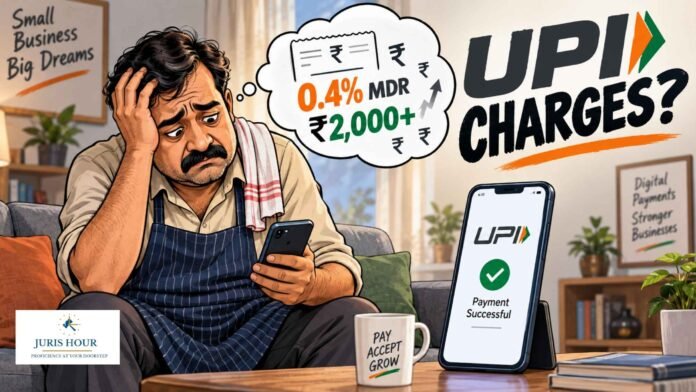
The National Payments Corporation of India (NPCI) has announced a Merchant Discount Rate (MDR) on select Person-to-Merchant (P2M) UPI transactions, marking a significant change in the commercial framework governing India’s digital-payment ecosystem.
Under the new structure, which will take effect from October 15, 2026, eligible merchants will be charged an MDR of 0.4% on UPI payments exceeding ₹2,000. The fee will be capped at ₹300 for transactions of ₹75,000 or more.
The charge will be borne entirely by merchants and cannot be passed on to customers. Consumers will therefore continue to pay only the listed price of goods or services, without any separate UPI transaction or platform fee.
Buy Now: E-Magazine: 1000+ Landmark GST Judgments (2017–2026)
The Ministry of Finance has also clarified that Person-to-Person transfers, merchant payments of up to ₹2,000 and payments received by eligible small merchants will remain free. The framework has been designed to keep the overwhelming majority of routine UPI transactions outside the MDR structure. Payments of up to ₹2,000 account for more than 95% of UPI’s P2M transaction volume, according to the official information released on the revised framework.
How New UPI MDR Will Be Calculated?
A merchant receiving a UPI payment of ₹3,000 will incur an MDR of ₹12 at the prescribed rate of 0.4%. Similarly, an eligible transaction of ₹50,000 will attract a charge of ₹200.
Once the transaction value reaches ₹75,000, the MDR will be restricted to ₹300. Consequently, a UPI payment of ₹1 lakh will attract a fee of ₹300 instead of ₹400, which would otherwise have been payable under a straight 0.4% calculation.
| UPI transaction value | Applicable merchant charge |
| Up to ₹2,000 | Nil |
| ₹3,000 | ₹12 |
| ₹50,000 | ₹200 |
| ₹75,000 | ₹300 |
| ₹1 lakh | ₹300 due to the cap |
The MDR applies only to qualifying merchant transactions and not to ordinary transfers between individuals.
Customers Will Not Pay Any UPI Charge
NPCI has clarified that merchants must absorb the MDR and are prohibited from recovering it separately from customers. UPI applications cannot impose a transaction fee or platform charge on individuals merely for making payments under the new framework.
All P2P transactions will continue to remain free, irrespective of the amount transferred. No fee can be imposed on an individual for sending or receiving money through UPI in a P2P transaction.
The revised structure does not, therefore, mean that customers making payments above ₹2,000 will automatically be charged. The liability rests with eligible merchants accepting such payments.
Small Merchants and Street Vendors Protected
Small merchants operating under the Person-to-Person-Merchant, or P2PM, framework will continue to receive protection from MDR.
This category includes street vendors and other small businesses receiving up to ₹1 lakh per month through UPI QR codes. Eligible merchants falling within this limit will not be required to pay MDR, including where an individual payment exceeds ₹2,000.
The exemption is intended to ensure that small vendors are not discouraged from accepting digital payments because of additional transaction costs.
Concessional ₹5 MDR for Essential Sectors
The framework provides concessional treatment to certain essential and low-margin sectors. UPI payments exceeding ₹2,000 in sectors such as railways, telecommunications, insurance and fuel will attract a flat MDR of ₹5 instead of the standard 0.4% rate.
The lower charge seeks to avoid imposing a disproportionate burden on sectors that process high-value payments but operate with regulated prices or relatively narrow margins.
Lower Rate for Capital-Market Payments
UPI transactions involving specified capital-market participants, including mutual funds, stockbrokers and securities dealers, will attract MDR at the concessional rate of 0.02%.
The MDR on such payments will also be capped at ₹300 per transaction. The differentiated rate recognises the nature of capital-market payments, where transaction values may be substantially higher than ordinary retail purchases.
NPCI Cites Cost of Maintaining UPI Infrastructure
Explaining the decision, NPCI said that operating UPI at its present scale requires substantial and continuous expenditure on servers, bandwidth, fraud prevention, cybersecurity, system upgrades and technical support.
Industry estimates cited in connection with the announcement place the annual cost of maintaining UPI operations at approximately ₹20,000 crore.
The revised commercial model is intended to reduce the ecosystem’s dependence on government subsidies, which have supported the expansion and adoption of digital payments but are not regarded as a permanent substitute for operating revenue.
Revenue generated through MDR is expected to support investment in payment infrastructure, customer service, cybersecurity and technological innovation.
UPI processed approximately 2,451 crore transactions valued at ₹29.9 lakh crore in August 2026 alone, illustrating the scale at which the payment network now operates.
₹22,000-Crore Revenue Opportunity Estimated
Bernstein has estimated that UPI could generate an annual revenue pool of nearly ₹22,000 crore by FY 2027-28 if a 40-basis-point MDR is levied on half of the transaction value.
According to the estimate, banks could receive approximately ₹14,000 crore, while payment applications may earn around ₹7,000 crore and the payment network could receive nearly ₹1,000 crore.
The actual distribution will depend on regulatory decisions and the commercial arrangements entered into between payment applications, banks and other participants in the UPI ecosystem.
Dedicated Fund Proposed for Small Merchants
NPCI has also proposed the creation of a dedicated fund to support small merchants and expand digital-payment infrastructure.
The initiative is expected to focus on Tier 3 to Tier 6 centres, including the northeastern states, Jammu and Kashmir, and Ladakh. It may also support notified government schemes in Tier 1 and Tier 2 centres.
The detailed structure of the fund is expected to be finalised in consultation with the Reserve Bank of India within three months.
What Will Remain Free?
Despite the introduction of MDR on selected large-value merchant payments, the following UPI transactions will continue to remain free:
- All P2P transfers, irrespective of the amount;
- P2M payments of up to ₹2,000;
- Payments made by consumers, as merchants cannot pass on the MDR;
- Payments received by eligible small merchants under the P2PM framework; and
- UPI QR-code receipts of up to ₹1 lakh per month by qualifying small merchants.
Read More: 1 Day Delay in GST Detention Notice Vitiates Entire Proceedings: J&K and Ladakh High Court

