
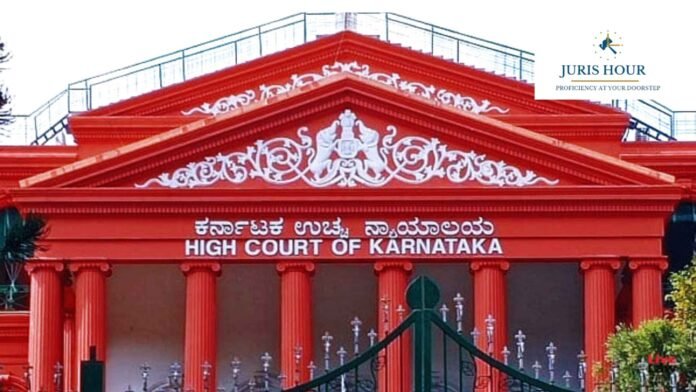
The Karnataka High Court has dismissed two writ petitions filed by JSW Steel Limited challenging the PMLA Appellate Tribunal’s refusal to remand attachment proceedings to the Adjudicating Authority, holding that the absence of an express reference to every written submission or synopsis does not, by itself, establish a violation of natural justice.
The Division Bench of Justice D K Singh and Justice T.M. Nadaf held that the company had received a fair opportunity to present its defence and remained entitled to raise all issues of fact and law in its pending statutory appeals and dismissed the petitions without costs, leaving the underlying merits of the attachment dispute for the statutory process.
Buy Now: Legal & Taxation Combo – 4 Premium E-Magazines
The dispute originated in a CBI FIR registered on October 1, 2011, concerning alleged illegal mining and related offences involving G. Janardhana Reddy, G. Lakshmi Aruna, Associated Mining Company and others.
According to the prosecution allegations recorded in the judgment, iron ore was illegally extracted or removed from mining areas and sold through Associated Mining Company. The investigation alleged that approximately 24 lakh metric tonnes of illegally obtained iron ore generated wrongful gains of around ₹480 crore.
These allegations formed the basis of an Enforcement Directorate investigation under the Prevention of Money Laundering Act, 2002, with an ECIR registered on September 25, 2012.
The ED alleged that JSW Steel had received 1,84,992 metric tonnes of illegally extracted iron ore and that ₹33,80,87,617 remained payable to the erstwhile partners of Associated Mining Company. The agency treated this unpaid consideration as receivables connected with the alleged proceeds of crime.
The judgment records an initial provisional attachment order dated March 27, 2015, covering amounts in the company’s bank accounts totalling approximately ₹24.37 crore. It also discusses a further disputed amount of approximately ₹9.44 crore and a provisional attachment order dated March 30, 2016.
By an order dated April 9, 2021, the Adjudicating Authority confirmed the latter provisional attachment order. JSW Steel subsequently filed appeals before the Appellate Tribunal.
Before the Appellate Tribunal, JSW Steel sought remand on the ground that the Adjudicating Authority had failed to consider its written submissions, synopsis and supporting documents.
On December 10, 2024, the Tribunal directed the ED’s counsel to obtain instructions regarding the remand request. It also gave both parties liberty to argue every issue, including matters allegedly left unaddressed by the Adjudicating Authority.
When the appeals were taken up on January 30, 2025, the Tribunal clarified that its earlier order had not expressed a concluded opinion in favour of remand. It stated that the issues could not be decided piecemeal and that the appeals had been listed for final arguments on all questions.
At the company’s request, the Tribunal adjourned the appeals to March 26, 2025, while preserving its liberty to raise all issues based on the pleadings and material on record.
JSW Steel challenged this January 30 order through the two writ petitions before the High Court.
Senior Advocate Gopal Jain, appearing for JSW Steel, argued that the Adjudicating Authority had ignored the company’s written submissions and synopsis, compromising its right to a fair hearing.
The company maintained that a violation of natural justice at the original adjudication stage could not be cured by allowing arguments before the appellate forum. It relied on the Supreme Court’s decision in Institute of Chartered Accountants of India v. L.K. Ratna and Others to support its request for remand.
The ED opposed the petitions, submitting that the statutory appeals were still pending and that the Tribunal had not passed a final decision on their merits.
Counsel Anuparna Bordoloi argued that the company had been permitted to advance every contention before the Tribunal and that the writ proceedings were an attempt to prolong the appellate process.
Rejecting the natural justice objection, the High Court found that the Adjudicating Authority had considered the material before it and heard the parties before confirming the attachment.
The bench held that an authority’s failure to specifically mention a synopsis or written submissions does not necessarily mean that those submissions were ignored. A court or adjudicating authority is not required to reproduce or separately address every point contained in written arguments.
At the same time, the court emphasised that meaningful consideration of the case remains essential. An order must demonstrate application of mind to the record and to substantial contentions bearing on the decision.
The bench explained that natural justice requires a real and effective opportunity to understand the case against the affected person and present a defence suited to the statutory framework and circumstances. It does not invariably confer a separate right to file a synopsis or require an express answer to every submission.
Referring to Union of India v. Jyoti Prakash Mitter and Union of India v. Amrik Singh, the court discussed the contextual nature of procedural fairness.
In the present case, the company had submitted a reply to the show cause notice and had been represented by counsel. The court also noted that the order sheet did not disclose that the Adjudicating Authority had invited a separate synopsis or written arguments.
It therefore concluded that the omission to mention the separately filed synopsis did not establish a denial of natural justice.
The bench found that the challenged Tribunal order caused no demonstrated prejudice to JSW Steel.
The statutory appeals remained pending, and the Tribunal had expressly allowed the company to make all submissions on facts and law. The High Court therefore held that an insistence on immediate remand did not justify intervention under Articles 226 and 227 of the Constitution or Section 482 of the Code of Criminal Procedure.
The court described the appellate proceedings as a continuation of the proceedings before the Adjudicating Authority. It stressed that no actual breach of natural justice had been established and that the company retained an opportunity to advance its complete case.
On those facts, the bench held that the writ petitions were not maintainable.
The High Court also referred to earlier litigation in which JSW Steel had challenged the institution of criminal proceedings and the taking of cognizance.
Those petitions were dismissed by the High Court on June 13, 2022. The Supreme Court subsequently dismissed the company’s criminal appeals on October 7, 2025, in JSW Steel Ltd. v. Enforcement Directorate.
Quoting that decision, the bench noted that the PMLA provides an adjudicatory mechanism comprising provisional attachment under Section 5, adjudication under Section 8 and an appeal under Section 26.
The Supreme Court passages reproduced in the judgment identified the disputed questions as whether the specific unpaid consideration of ₹33.80 crore could qualify as proceeds of crime and whether withdrawals after provisional attachment violated the law.
Those passages also distinguished the quantified dispute from any suggestion that the company’s entire banking operations or account balances were tainted.
The Supreme Court had favoured allowing the statutory process to reach its conclusion without prejudging matters within the Appellate Tribunal’s domain. Against that background, the High Court characterised the fresh writ petitions as a gross abuse of the court’s process.
The High Court concluded that the Tribunal’s refusal to order remand at the threshold did not warrant judicial interference when all factual and legal issues remained open for argument.
Membership Required to Access Case Details & Order Copy
To view the complete Case Details and Download Order Copy, you must have an active membership. Please subscribe to continue.

