
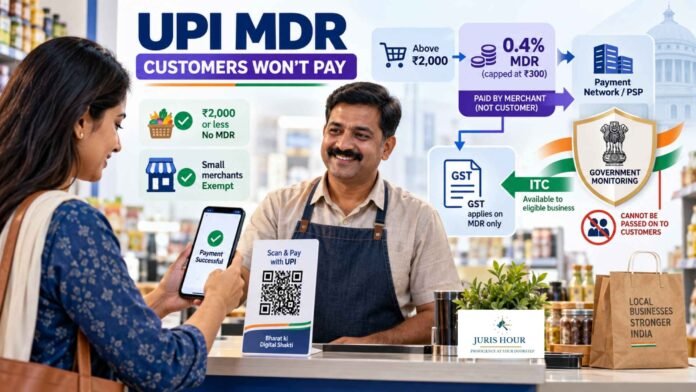
Government sources have also sought to clarify the tax treatment of the charge. They said there is no separate GST imposed merely because a customer makes a UPI payment. GST will, however, apply to the MDR charged as consideration for the payment-processing service.
This means the applicable GST will be calculated on the MDR amount and not on the entire value of the purchase. An eligible registered business may claim input tax credit for the GST paid on the MDR, subject to the conditions and restrictions prescribed under GST law.
The input tax credit mechanism could allow businesses to adjust the tax paid on the MDR against their output GST liability. The actual benefit will depend on whether the merchant is registered, makes taxable supplies, possesses the prescribed tax documentation and otherwise satisfies the statutory requirements for claiming credit.
Buy Now: E-Way Bill Judgements From 2020–2026 [Includes Orders of GSTAT]
Consequently, the cost implications may differ across businesses. Merchants eligible for full input tax credit may be able to neutralise the GST component, while unregistered traders, exempt suppliers or businesses facing credit restrictions may not receive the same benefit.
Customers should not be asked to pay the merchant discount rate imposed on specified Unified Payments Interface transactions, government sources have said, amid concerns that businesses may indirectly recover the new payment-processing cost by raising prices or adding a separate surcharge.
According to information attributed to official sources by news agency ANI, the government intends to closely supervise the implementation of the revised UPI framework and act on enforcement gaps so that the charge remains with merchants rather than being transferred to consumers.
The issue has already been taken up with payment aggregators, the sources said. The discussions assume significance because traders and consumers have expressed apprehension that businesses, particularly those operating on narrow margins, may seek to recover the MDR from buyers even if the framework formally places the liability on merchants.
No Direct MDR Liability for Customers
Under the announced structure, personal UPI transfers will continue to remain free irrespective of the amount involved. Consumers making payments to businesses are also not required to separately bear the merchant discount rate.
The revised framework provides for a 0.4% MDR on specified merchant payments exceeding ₹2,000, subject to a maximum charge of ₹300 per transaction. Merchant payments of ₹2,000 or less will remain outside the charge. Eligible small merchants will also continue to enjoy an exemption.
For certain essential sectors, payments above ₹2,000 will attract a fixed fee of ₹5 instead of the percentage-based MDR. The government has maintained that nearly 96% of merchant transactions will remain unaffected by the change.
Small vendors receiving less than ₹1 lakh a month through QR-code payments are also stated to be exempt. The measure is therefore expected to apply mainly to larger commercial transactions and specified categories of merchants.
Government Signals Stronger Enforcement
The government’s assurance shifts attention to enforcement at the retail level. Even where a merchant is legally responsible for the MDR, the economic burden could still reach consumers if businesses impose an explicit UPI surcharge, offer different prices based on the payment mode or increase product prices to recover the additional operating cost.
Officials have indicated that implementation will be monitored to prevent such practices. They have also acknowledged the need to address gaps that could allow merchants or intermediaries to pass the charge on to customers.
The precise monitoring mechanism, grievance-redressal process and consequences for non-compliance will be important in determining whether the consumer-protection assurance is effective in practice. Clear billing requirements and an accessible channel for reporting UPI surcharges could become central to enforcement.
Traders Flag Cost and Margin Concerns
Merchant organisations have voiced concern that the new charge may raise the cost of accepting digital payments, especially in sectors with thin profit margins. Some trader groups have reportedly discussed promoting cash payments for higher-value purchases to avoid MDR liability.
Larger businesses are also assessing the effect of the charge on operating costs and profitability. Although the ₹300 ceiling limits the cost on high-value payments, the cumulative burden could still be material for businesses processing a large number of transactions above the threshold.
Consumers, meanwhile, fear that merchants may respond by increasing prices or discouraging UPI payments for larger purchases. These concerns persist despite the government’s statement that customers will not be liable for the charge and that most merchant transactions will remain unaffected.
Political Opposition and Legal Challenge
Opposition parties have criticised the framework as burdensome and potentially harmful to household savings. The Congress has described it as a “Modi Tax”, while Rahul Gandhi has argued that larger commercial transactions, though a relatively small share of UPI transaction volume, represent a substantial proportion of the total value transacted through the platform.
The notification introducing the charges has also been challenged before the Supreme Court. The legal challenge adds another layer to the debate over the design, authority and consumer impact of the MDR framework.
The government has defended the decision and indicated that it does not plan to withdraw the measure. Officials have argued that a sustainable revenue mechanism is needed to support the digital-payments infrastructure after years of rapid expansion.
Consumer Protection Will Be the Key Test
The controversy now centres less on whether the framework formally charges customers and more on whether consumers can be insulated from its indirect effects. The government’s position is that person-to-person transfers will remain free, customers paying merchants will not bear MDR and the overwhelming majority of merchant transactions will see no change.
Whether those assurances translate into retail practice will depend on effective supervision of payment intermediaries and merchants. Any attempt to levy a separate UPI fee on customers or disguise the charge through differential pricing could test the strength of the proposed monitoring and enforcement system.
For consumers, the immediate position is that no separate MDR should be demanded when making a UPI payment. For businesses, the new framework introduces a payment-processing cost on specified transactions, with input tax credit potentially available against the GST charged on that cost.
Read More: Delhi High Court Upholds Delhivery’s Rs. 51.48 Crore ESOP Deduction

