
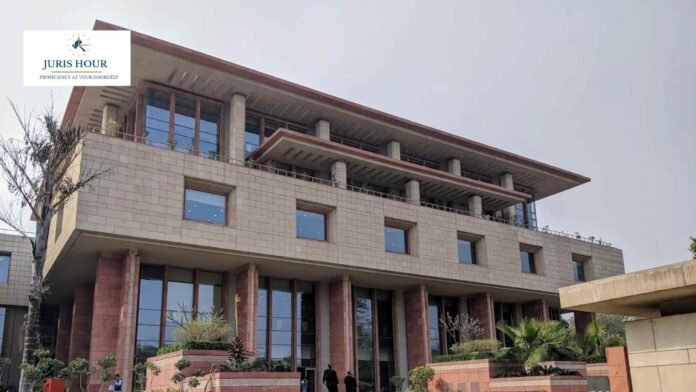
The Delhi High Court has dismissed a batch of writ petitions challenging GST adjudication orders arising from a common investigation by the Anti-Evasion Branch of the CGST Delhi North Commissionerate, holding that the petitioners had an efficacious statutory remedy under Section 107 of the Central Goods and Services Tax Act, 2017.
The bench of Justice Anil Khetarpal and Justice Shail Jain has observed that the grievances raised—including alleged denial of personal hearing, reliance on electronic records and handwritten “kachcha parchis”, absence of corroborative evidence, non-supply of relied-upon documents and denial of cross-examination—primarily involved disputed questions of fact and appreciation of evidence that could appropriately be examined by the appellate authority.
The investigation commenced with search proceedings at the residential and business premises of M/s Arora Communication, a proprietary concern of Kapil Arora, on October 22, 2024. The investigation was subsequently extended to several entities alleged to have purchased electronic goods from the concern. A Demand-cum-Show Cause Notice dated June 25, 2025 was issued under Section 74 of the CGST Act against Arora Communication and several other noticees, including the petitioners.
Vuy Now: 130 GST Judgments – E-Magazine July 2026
An earlier show cause notice dated April 17, 2025 had also been issued against Arora Communication and its proprietor, which culminated in an adjudication order dated December 9, 2025. The majority of the petitions challenged an Order-in-Original dated December 26, 2025 passed pursuant to the subsequent show cause notice.
According to the Department, the investigation was triggered by intelligence suggesting that Arora Communication was engaged in trading electronic goods without issuing proper tax invoices and without payment of applicable GST.
During the October 22, 2024 search, officers allegedly recovered electronic devices, including a Dell laptop, handwritten “kachcha parchis” and other documents. The Department claimed that analysis of data extracted from the laptop, together with the handwritten slips, disclosed large-scale unaccounted transactions.
The electronic data allegedly contained details of various entities to whom goods had purportedly been supplied without GST invoices. On this basis, the Department identified several alleged recipients and proceeded against them under Section 74 of the CGST Act.
The petitioners, however, disputed the evidentiary foundation of the proceedings. They contended that the case against them substantially rested upon unverified electronic records and handwritten slips recovered from a third party, without independent investigation or corroborative material establishing clandestine receipt or supply of goods or tax evasion.
They pointed out that invoices, transport documents, stock records, financial records or other contemporaneous material connecting them with the alleged transactions had not been produced.
A major plank of the petitions was alleged non-compliance with the principles of natural justice. The petitioners claimed that, despite filing replies and documentary evidence, the adjudicating authorities mechanically confirmed the proposed demands without adequately considering their defence.
They also relied upon Section 75(4) of the CGST Act, alleging that effective personal hearings had not been provided in several cases. According to the petitioners, some were not served with notices of personal hearing, while in other cases virtual hearings could not be effectively conducted because of technical difficulties on the Department’s side. Requests for physical hearings were also allegedly not accepted.
The petitioners further argued that electronic evidence could not be relied upon in the absence of the certificate contemplated under Section 63 of the Bharatiya Sakshya Adhiniyam, 2023. They also alleged that the electronic material lacked independent corroboration and that all relied-upon documents had not been supplied to them.
Some petitioners additionally alleged that amounts had been obtained during search proceedings under coercion and subsequently reflected as voluntary payments through DRC-03.
The department opposed the maintainability of the writ petitions, stressing that the Orders-in-Original were appealable under Section 107 of the CGST Act.
According to the respondents, the petitioners had been served with the show cause notices and given opportunities to file replies and participate in adjudication. The Department maintained that the adjudication orders were passed after consideration of the material available on record and that the petitioners were essentially seeking re-appreciation of evidence, which was within the jurisdiction of the statutory appellate authority.
The Department also pointed out that the petitioner in W.P.(C) 2179/2026 had already filed an appeal under Section 107 against the December 26, 2025 order. The Revenue argued that the petitioner could not simultaneously pursue the same grievance before the appellate authority and the High Court under Article 226 in the absence of exceptional circumstances.
The central question before the High Court was whether the petitioners had demonstrated circumstances justifying exercise of the Court’s extraordinary jurisdiction under Article 226 despite the availability of a statutory appeal under Section 107 of the CGST Act.
The Bench noted that the Orders-in-Original were appealable under Section 107, which provides a comprehensive statutory mechanism for challenging adjudication orders. The appellate authority has wide powers to examine questions of fact and law, re-appreciate material, scrutinise findings and determine the legality and correctness of the orders.
The Court therefore emphasised that constitutional courts ordinarily exercise restraint where the legislature has created a specialised adjudicatory and appellate framework.
At the same time, the High Court reiterated that availability of an alternative statutory remedy does not completely oust its writ jurisdiction.
Referring to the Supreme Court’s decision in Assistant Commissioner of State Tax and Others v. Commercial Steel Limited, the Court noted the recognised exceptions where a High Court may exercise Article 226 jurisdiction despite an alternative remedy. These include breach of fundamental rights, violation of natural justice, excess of jurisdiction and a challenge to the vires of a statute or delegated legislation.
However, the Court stressed that merely asserting one of these grounds does not automatically entitle a litigant to bypass the statutory appellate mechanism. The High Court must independently examine whether the facts actually disclose circumstances warranting interference under Article 226.
Applying these principles, the Court concluded that the batch did not disclose circumstances warranting interference under Article 226.
The Bench noted that although the petitions arose from a common investigation, allegations of violation of natural justice were not uniform. The procedural history differed from petitioner to petitioner. Consequently, determining whether a particular petitioner had received adequate notice, filed a reply, been given a hearing or suffered prejudice required examination of the individual adjudication record.
The Court specifically rejected the argument that alleged non-consideration of replies and documents, by itself, justified writ interference. Whether the adjudicating authority adequately considered the defence, whether its reasons were sufficient and whether its conclusions were sustainable were questions concerning the correctness of adjudication and could be examined in the statutory appeal.
The petitioners’ reliance on Section 75(4) of the CGST Act was similarly not accepted as a basis for bypassing the statutory remedy.
The Court observed that the competing claims—whether notices of personal hearing were properly served, whether petitioners participated, whether technical problems actually prevented effective hearing and whether any prejudice was caused—raised disputed questions of fact.
These issues, the Court held, were more appropriately considered by the appellate authority after examining the complete adjudication record.
Importantly, the Bench noted that the procedural position was not identical across the petitioners. In some cases replies had been filed and considered and opportunities of hearing had been provided. In others, replies were not filed or noticees did not appear despite opportunities. The Court therefore held that differing circumstances could not establish a common violation of natural justice across the entire batch.
The Court also declined to determine, at the writ stage, the petitioners’ challenge concerning the evidentiary value of electronic data and handwritten “kachcha parchis”.
The petitioners had questioned whether the requirements of Section 63 of the Bharatiya Sakshya Adhiniyam, 2023 were satisfied and whether the electronic material was properly authenticated. They also questioned whether the material was sufficient to establish the alleged transactions.
The High Court held that these issues directly concerned the merits of adjudication and would require examination of the original investigation and adjudication records and appreciation of the evidence.
Similarly, the Court declined to determine whether the electronic data, handwritten material, statements and other investigation records constituted sufficient corroboration. The question whether the Department had established the alleged transactions was left open for consideration by the statutory appellate authority.
The petitioners also alleged that complete copies of relied-upon material had not been supplied and that they had been denied an opportunity to cross-examine persons whose statements were relied upon.
The High Court acknowledged that such issues concerned the fairness of adjudication. However, it held that deciding whether particular documents were required to be furnished, whether statements formed the substantive basis of the orders, whether cross-examination was warranted and whether denial of cross-examination caused prejudice would require examination of the underlying records.
Accordingly, these questions were left for determination by the statutory appellate authority.
Some petitioners argued that they had been implicated solely on the basis of material recovered from Arora Communication even though their own premises had not been searched.
The Court held that this contention went to the sufficiency and evidentiary value of the Department’s material. Whether material recovered from a third party was sufficient to connect an individual petitioner with the alleged transactions was an evidentiary question requiring examination of the facts of each case.
The Court held that such a circumstance, by itself, did not demonstrate a patent lack of jurisdiction.
The allegation that amounts were obtained coercively during search proceedings and later reflected as voluntary DRC-03 payments was also treated as a disputed factual issue.
The Court held that determining whether the payment was actually voluntary, the circumstances in which it was deposited and its legal consequences would require examination of contemporaneous records. Such a grievance could appropriately be raised before the appellate authority and did not, on the facts presented, justify bypassing Section 107.
A significant aspect of the judgment is that the High Court expressly refrained from expressing any opinion on the merits of the rival contentions.
The Court clarified that it was not deciding the admissibility, authenticity or evidentiary value of the electronic material, handwritten “kachcha parchis”, statements or other material relied upon by the Department. It also did not rule on the correctness of the findings contained in the Orders-in-Original.
All these issues were expressly left open for determination by the statutory appellate authority independently and in accordance with law.
Concluding that none of the recognised exceptions to the alternative-remedy rule had been established, the Delhi High Court dismissed the writ petitions challenging the Orders-in-Original.
The Court left it open to the concerned petitioners to pursue statutory appeals under Section 107 of the CGST Act. The petition seeking interim protection against further proceedings was also dismissed in view of the Court’s conclusion.
The Bench, however, provided an important limitation-related safeguard. It clarified that if a petitioner chooses to file a Section 107 appeal, the petitioner may seek exclusion of the period during which the writ petition remained pending before the High Court. The appellate authority was directed to consider any limitation issue, including a request for exclusion of the period spent prosecuting the writ proceedings, in accordance with law and uninfluenced by the observations in the judgment.
Membership Required to Access Case Details & Order Copy
To view the complete Case Details and Download Order Copy, you must have an active membership. Please subscribe to continue.

