
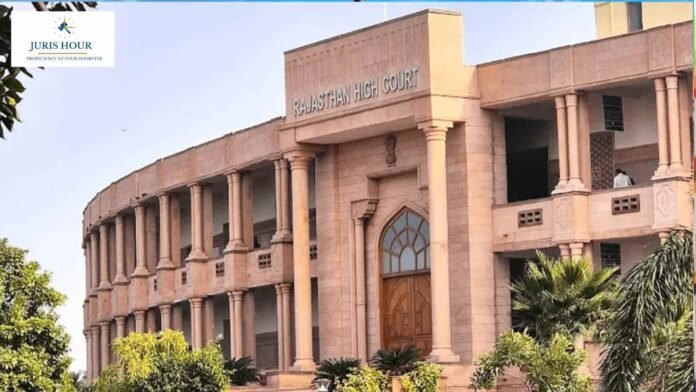
The Rajasthan High Court has directed the GST Department to refund ₹2.35 crore deposited by a contractor during a search operation, holding that the payment made through Form GST DRC-03 was not voluntary but was obtained during the course of search proceedings.
The Bench of Justice Arun Monga and Justice Sunil Beniwal has observed that merely filing Form GST DRC-03 during a search does not establish that the payment was voluntary. The voluntariness must be determined from the surrounding circumstances and compliance with the statutory safeguards prescribed under the Central Goods and Services Tax Act, 2017.
The petitioner/assessee challenged the recovery of ₹2,35,23,506, contending that the amount had been extracted under pressure during a search conducted by officers of the Directorate General of GST Intelligence (DGGI) on 11 July 2025.
According to the petition, DGGI officers conducted simultaneous searches at the firm’s business premises and the residences of its partners. During the search, the petitioner alleged that its partner was compelled to sign pre-printed statements and was forced to reverse input tax credit (ITC) and make additional cash payments through Form GST DRC-03 without any show cause notice or adjudication of tax liability.
Buy Now: GST Inspection, Search, Seizure and Arrest With Judgements: How To Defend?
The total payment comprised ₹1.08 crore through reversal of Input Tax Credit (ITC); and ₹1.26 crore through cash payments, including utilization of TDS, GST cash ledger balance, and bank transfers.
The petitioner subsequently wrote to the department stating that the statements had been recorded under pressure and that the payment had been made under protest. It also pointed out that Form GST DRC-04, acknowledging voluntary payment, had never been issued.
The GST Department opposed the petition, arguing that the payment was entirely voluntary.
According to the department, investigations had revealed that the petitioner had allegedly availed fraudulent ITC from another supplier without actual supply of goods. During the search, the partner allegedly admitted the wrongful availment of ITC amounting to over ₹2.04 crore and voluntarily deposited tax and penalty under Section 74(5) of the CGST Act.
The department further contended that the payment was made using the taxpayer’s own GST portal credentials and banking channels; Section 74(5) specifically permits voluntary payment before issuance of a show cause notice; non-issuance of Form GST DRC-04 did not invalidate the payment; and the investigation was still pending, making issuance of DRC-04 premature.
The High Court undertook an extensive examination of Section 74(5) of the CGST Act and Rule 142 of the CGST Rules governing voluntary payments before issuance of a show cause notice.
The Bench observed that the statutory framework indeed permits taxpayers to voluntarily discharge tax liability before formal adjudication. However, such payment must truly be voluntary and based upon the taxpayer’s own ascertainment or the proper officer’s ascertainment communicated in accordance with law.
The Court clarified that filing Form GST DRC-03 alone cannot automatically establish voluntariness.
The Division Bench also relied upon the Supreme Court’s observations in Radhika Agarwal v. Union of India, where the apex court recognized allegations of taxpayers being compelled to make payments during GST searches under the threat of arrest.
The Supreme Court had observed that Section 74(5) contemplates voluntary payment and not payment extracted through force, coercion or threat, and stressed that CBIC’s instructions must be implemented in both letter and spirit.
After examining the facts, the High Court found several circumstances indicating that the payment lacked voluntariness.
First, the entire payment was made while the search proceedings were still continuing.
Second, there had been no prior independent determination or self-ascertainment of liability by the taxpayer before filing Form GST DRC-03.
Third, the department failed to produce any contemporaneous material showing that the petitioner had independently calculated its tax liability before making the payment.
Fourth, Form GST DRC-04, which acknowledges voluntary payment under Rule 142, was admittedly never issued.
Fifth, the petitioner promptly protested the payment through written communications soon after the search, which was inconsistent with the department’s claim that the liability had been voluntarily accepted.
The Court further observed that even the declaration in Column 8 of Form GST DRC-03 merely stated that payment was made after initiation of departmental enquiry and did not establish independent self-ascertainment of liability.
The Bench also referred to CBIC Instruction No. 01/2022-23, issued following judicial directions in Bhumi Associate, which seeks to ensure that taxpayers are not subjected to recoveries during search proceedings.
The Court observed that where taxpayers wish to make voluntary payments, such payments should ordinarily be made after the search concludes and officers leave the premises, thereby eliminating any apprehension of pressure or coercion.
In the present case, however, the payment was admittedly obtained during the search itself, strengthening the petitioner’s allegation of coercion.
The Court identified five decisive factors.
Firstly, the payment was obtained during search proceedings.
Secondly, there was no prior ascertainment or determination of liability.
Thirdly, the department failed to establish any independent self-ascertainment by the taxpayer.
Fourthly, the petitioner promptly disputed the voluntariness of the payment.
Lastly, safeguards contained in judicial precedents and CBIC Instructions were not followed.
Accordingly, the Bench held that the amount deposited through Form GST DRC-03 could not be treated as a voluntary payment under Section 74(5) of the CGST Act.
The Rajasthan High Court partly allowed the writ petition and directed the respondents to refund ₹2,35,23,506 deposited by the petitioner through Form GST DRC-03.
However, the Court declined to grant interest on the refund at this stage, observing that the departmental investigation had not yet concluded and the ultimate tax liability remained to be adjudicated.
Membership Required to Access Case Details & Order Copy
To view the complete Case Details and Download Order Copy, you must have an active membership. Please subscribe to continue.

