
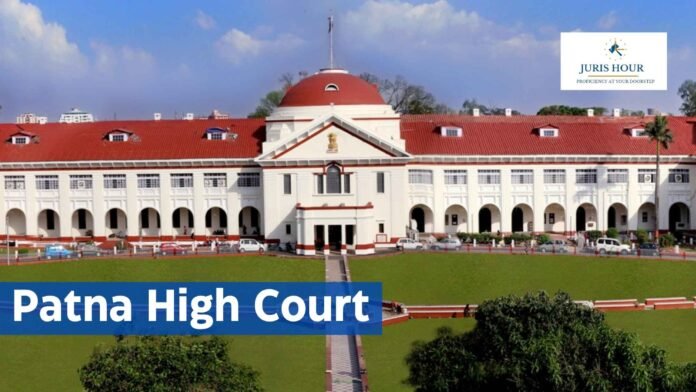
The Patna High Court has declined to entertain a writ petition challenging a GST demand order involving a total demand of ₹5.82 crore for the period July 2017 to March 2018, holding that the taxpayer has an effective statutory remedy of appeal under the CGST/BGST Acts.
The bench of Justice Rajeev Ranjan Prasad and Justice Sunil Dutta Mishra also rejected the challenge to CBIC circulars assigning functions of “proper officer” to Central Tax officers, relying on the reasoning adopted by the Bombay High Court on the issue.
Buy Now: E-Handbook: Draft Replies to GST Notices On 40+ Issues
The petitioner, a pharmaceutical goods supplier having its principal place of business in Patna, challenged proceedings initiated under the CGST and BGST Acts. The department alleged that the petitioner had made a non/short payment of GST amounting to ₹5,10,00,146 for FY 2017-18 by declaring an incorrect value of taxable supplies.
The proposed demand comprised CGST of ₹2,55,00,073 and SGST of ₹2,55,00,073. The department invoked Section 74(1) of the CGST/BGST Acts, along with interest under Section 50 and penalty provisions.
According to the proceedings, the discrepancy was detected on the basis of data received from the Assistant Audit Officer, DGA (Central), Lucknow at Patna. The taxpayer subsequently submitted its response, including a reply dated August 7, 2024, explaining the discrepancy reflected in GSTR-9C.
One of the principal legal issues before the High Court concerned the validity of Circular No. 3/3/2017-GST dated July 5, 2017, Circular No. 31/05/2018-GST dated February 9, 2018 and Circular No. 169/01/2022-GST dated March 12, 2022.
The petitioner argued that the CBIC lacked the authority to assign functions of a “proper officer” to Central Tax officers through these circulars. It was contended that the power to appoint an officer could not be equated with the power to assign statutory functions to that officer.
The petitioner relied upon the Supreme Court’s decision in Canon India Pvt. Ltd. v. Commissioner of Customs, arguing that the statutory requirement relating to a “proper officer” had to be strictly satisfied. According to the petitioner, there had to be both a valid appointment as a Central Tax officer and a valid assignment of the functions of the proper officer.
Patna High Court Follows Bombay High Court’s Reasoning
The Patna High Court noted that the same issue had previously been considered by the Bombay High Court in Fomento Resorts & Hotels Ltd. v. Union of India. Although an appeal against the Bombay High Court judgment was pending before the Supreme Court, the Patna High Court observed that there was no direction from the Supreme Court requiring High Courts to defer consideration of similar cases. The Bench therefore proceeded to decide the issue.
The Bombay High Court had distinguished the Supreme Court’s decisions in Canon India and Sayed Ali, which concerned the appointment of officers who were not “officers of customs” under the Customs Act. In the GST context, the relevant officers were admittedly officers of Central Tax. The Bombay High Court consequently held that assignment of functions to Central Tax officers through the impugned circulars could not be faulted on the basis of those Customs Act judgments.
The Patna High Court also considered the reasoning in Yasho Industries Ltd., where the Gujarat High Court had held that assignment of functions under Section 2(91) of the CGST Act was distinct from delegation of powers under Section 167. According to the reasoning reproduced in the judgment, the Board could assign officers functions as proper officers, and such assignment did not require a notification under Section 167.
The Court further noted that Section 3 read with Section 5 of the CGST Act had already been used by the Central Government to appoint Central Tax officers and vest them with powers under the CGST and IGST Acts. Section 4 additionally empowers the Board to appoint persons as officers under the CGST Act.
After examining the statutory framework and the Bombay High Court’s reasoning, the Patna High Court held that the challenge to the three circulars had no basis.
The Court recorded that the Central Government had issued the relevant notification dated June 19, 2017 under Sections 3 and 5 of the CGST Act. The Board had thereafter assigned functions under the statutory framework, including functions under Section 74 to subordinate Central Tax officers based on specified monetary limits. The impugned show-cause notice was issued pursuant to those assigned functions.
The High Court also examined the contents of the adjudication order. The order recorded that certain amounts reported as “consignment sales” in the reconciliation worksheet had not been subjected to GST under any of the four GSTINs held by the taxpayer.
The adjudicating authority noted that the consignment sales had not been declared in the annual GSTR-9 returns and formed part of an unreconciled turnover of ₹18,21,43,381 reported in Table 6 of GSTR-9C. On this basis, the authority treated ₹10,40,68,429 as suppressed taxable turnover and determined a tax liability of ₹2,91,39,160 for July 2017 to March 2018.
The adjudicating authority invoked the extended limitation period under Section 74, recording its finding that there had been suppression of turnover and misstatement of figures, including in relation to the VAT period of April 2017 to June 2017. It further recorded that information and documents had not been furnished when sought by the Range Superintendent.
Against the original proposed demand of ₹5,10,00,146, the adjudicating authority confirmed tax of ₹2,91,39,160, comprising CGST of ₹1,45,69,580 and SGST of ₹1,45,69,580.
The authority treated the remaining ₹2,18,60,986 as an amount liable to be paid towards interest under Section 50. It also imposed an equivalent penalty of ₹2,91,39,160 under Section 74(1) read with Section 122(2)(b) of the CGST/BGST Acts.
The adjudication order ultimately confirmed the tax of ₹2,91,39,160 with applicable interest and an equivalent penalty, while dropping the balance amount of ₹2,18,60,986 from the tax demand proposed in the show-cause notice.
A significant aspect of the judgment was the Court’s decision not to examine the factual merits of the tax demand in its writ jurisdiction.
The Court noted that the impugned adjudication order was appealable and that the petitioner had a statutory remedy available under the CGST/BGST framework. The Bench referred to the Supreme Court’s decision in CIT v. Chhabil Dass Agarwal, which reiterates the general principle that where legislation provides an effective statutory mechanism for redressal, a writ petition ordinarily should not be entertained merely by bypassing that mechanism.
The High Court observed that it was not sitting as a fact-finding authority for reappreciating the documents and material placed before the adjudicating authority. According to the Court, the First Appellate Authority would be in a position to reappraise those materials in the statutory appeal.
The Patna High Court granted liberty to the petitioner to pursue the statutory appellate remedy within 30 days from the date of the judgment.
The Court also addressed the limitation issue. It noted that the writ petition had originally been filed on March 7, 2025 and had remained pending before the High Court. Since the petition had been filed within 30 days after expiry of the three-month period prescribed for filing an appeal under Section 107(4) of the CGST/BGST Act, the Court expressed the view that the appellate authority should not reject the appeal merely on limitation.
Membership Required to Access Case Details & Order Copy
To view the complete Case Details and Download Order Copy, you must have an active membership. Please subscribe to continue.
Read More: Gujarat High Court Quashes GST Demand for Overlapping Periods

