
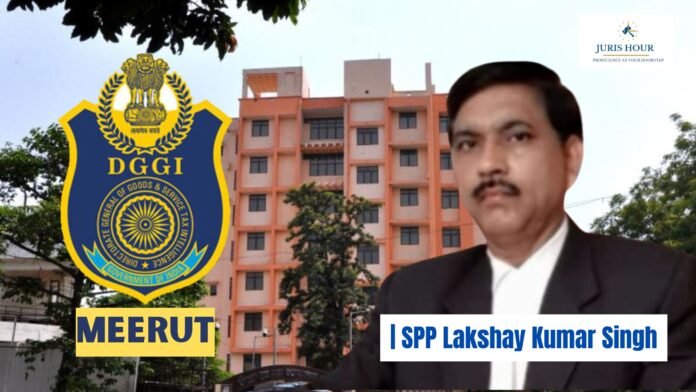
A Meerut Court has rejected the bail application of Mohd. Akib, accused in an alleged large-scale GST fraud involving fake Input Tax Credit (ITC) and fraudulent refund claims amounting to approximately ₹294.38 crore.
The Court observed that the allegations concern a serious economic offence involving an extensive network of shell entities and significant loss to the government exchequer, and held that releasing the accused at the present stage could result in witness intimidation and tampering with evidence.
The matter arose from allegations by the Directorate General of GST Intelligence (DGGI), Meerut Zonal Unit, that Mohd. Akib acted as a mastermind in concert with co-accused persons including Samyak Jain, Abhishek Jain and Ankur Jain in establishing and operating thirty-seven fake or shell firms.
According to the prosecution, these entities were allegedly used to fraudulently avail and pass on fake ITC worth ₹276.16 crore without any actual supply of goods or services and to claim GST refunds through fabricated export transactions. Out of the refund claims, approximately ₹18.22 crore was allegedly sanctioned by authorities based on fictitious export declarations.
The prosecution further alleged that searches conducted on 12 February 2026 led to the recovery of several digital devices, debit and credit cards, SIM cards, bank documents and other records. Analysis of these materials allegedly revealed that approximately ₹4.77 crore had been transferred from a refund-claiming entity into the bank account of the applicant’s proprietorship concern, M/s A to Z Solutions, after which the money was layered through various accounts and allegedly withdrawn through hawala channels.
Before the Court, the accused challenged the allegations and claimed that he had been falsely implicated. The defence argued that he had cooperated with investigating authorities after being summoned and that his statements had been forcibly recorded. It was further argued that the only allegation against him was the receipt of approximately ₹4.8 crore in his account, which had allegedly been routed through him on assurances of future business opportunities. The accused contended that he had no direct link with the alleged firms and that no substantial incriminating material had been recovered from him. The defence also submitted that the amount attributed to him individually was below ₹5 crore and therefore did not justify the stringent approach adopted by authorities.
The DGGI strongly opposed the bail application and maintained that the accused had voluntarily admitted his involvement during investigation. According to the prosecution, the evidence collected included bank records, electronic data, and statements of co-accused persons which allegedly established his active participation in the creation and operation of shell firms used for fake ITC transactions and refund claims. The department asserted that the accused played a larger role than merely receiving money and had participated in facilitating fake credit transactions worth hundreds of crores.
The Court extensively referred to judicial precedents dealing with economic offences. It noted Supreme Court observations emphasizing that economic offences stand on a distinct footing because of their impact on the nation’s financial structure and public interest. The Court cited authorities which held that white-collar crimes and financial frauds involving public revenue warrant a stricter approach while considering bail applications.
While examining the material placed on record, the Court observed that several documents and electronic records allegedly connected the accused with the broader operation of fictitious entities. The Court also noted statements of co-accused persons and alleged WhatsApp communications which, according to the prosecution, reflected discussions regarding creation of dummy firms, opening of bank accounts in names of fictitious persons, routing of funds and generation of fake invoices.
Rejecting the defence argument that the alleged amount attributable to the accused was less than ₹5 crore, the Court held that his role could not be viewed in isolation. It observed that the allegations indicated involvement in a larger conspiracy involving fake ITC transactions of approximately ₹276 crore and fraudulent refunds. Consequently, the Court concluded that the offence could not be treated as involving an amount below the statutory threshold.
The Court further found no prima facie illegality in the arrest process and recorded that grounds of arrest had been communicated to the accused and procedural safeguards had been complied with. It held that the investigation was still underway and that the possibility of influencing witnesses or tampering with evidence could not be ruled out if bail were granted.
Accordingly, the Additional Sessions Judge, Meerut, rejected the bail application filed under Sections 132(1)(b), 132(1)(c), 132(1)(f), 132(1)(l), and 132(1)(i) of the CGST Act, 2017.
Case Details
Case Title: Mohd. Akib Versus UOI
Case No.: First Bail application No. 1410 of 2026
Date: 22.04.2026
Counsel For Respondent: SPP Lakshay Kumar Singh

