
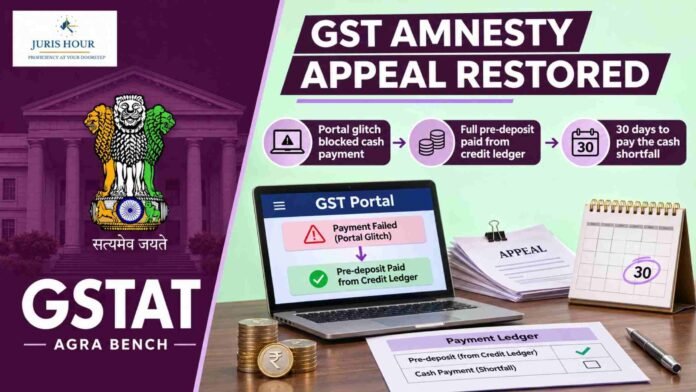
The Goods and Services Tax Appellate Tribunal (GSTAT), Agra Bench, has set aside an order dismissing a GST amnesty appeal as time-barred after the taxpayer paid the entire pre-deposit through its electronic credit ledger.
The bench of Ajeet Singh (Judicial Member) and Vivek Kumar (Technical Member) has observed that the shortfall in the mandatory cash portion was a curable defect and gave the taxpayer 30 days from receipt of the order to make the required payment.
Buy Now: 210+ GST Judgments E-Magazine – October 2026
The bench directed the first appellate authority to hear the case on merits once the taxpayer pays the cash portion. The corresponding excess debit from the electronic credit ledger is to be recredited in accordance with law.
The dispute arose from a demand order passed on 31 July 2021 by the Deputy Commissioner of State Tax, Division 6, Mathura. The taxpayer filed its first appeal under Section 107 on 31 January 2024, the last day of the special filing window under Notification No. 53/2023–Central Tax.
The notification covered eligible appeals against orders passed under Section 73 or Section 74 on or before 31 March 2023. It required taxpayers to pay any admitted tax, interest, fine, fee and penalty in full, along with a pre-deposit of 12.5% of the remaining disputed tax, capped at ₹25 crore. At least 20% of that pre-deposit had to come from the electronic cash ledger. Where the cap did not apply, the minimum cash portion worked out to 2.5% of the disputed tax.
The taxpayer said a technical issue on the GST portal prevented it from debiting the required amount from its cash ledger. It therefore paid the full 12.5% through its electronic credit ledger. The first appellate authority marked the appeal defective and scheduled a hearing. Neither the taxpayer nor its representative appeared, and the authority dismissed the appeal as time-barred.
The department argued that the cash component was a condition of the amnesty scheme and that the taxpayer could use the extended filing window only by meeting that condition. The tribunal held that a portal glitch that impedes compliance with the ledger requirement should not deprive a taxpayer of its statutory appeal remedy. It found that the first appellate authority should have given the taxpayer a reasonable opportunity to pay the cash shortfall or correct the ledger debits before rejecting the appeal.
The bench relied on the Patna High Court decisions in Friends Mobile and Raiyan Traders in support of allowing the appeal to proceed where the pre-deposit had been paid through the credit ledger. The department cited Flipkart Internet Pvt. Ltd. for a contrary view. The tribunal recorded that the Supreme Court had stayed the High Court ruling cited by the department.
The tribunal set aside the first appellate order dated 25 September 2024. It directed the taxpayer to pay the shortfall, equal to 20% of the pre-deposit, through the electronic cash ledger within 30 days of receiving the tribunal’s order. Once the taxpayer complies, the first appellate authority must admit the appeal and decide the underlying dispute after giving both sides a fair hearing.
Membership Required to Access Case Details & Order Copy
To view the complete Case Details and Download Order Copy, you must have an active membership. Please subscribe to continue.

