
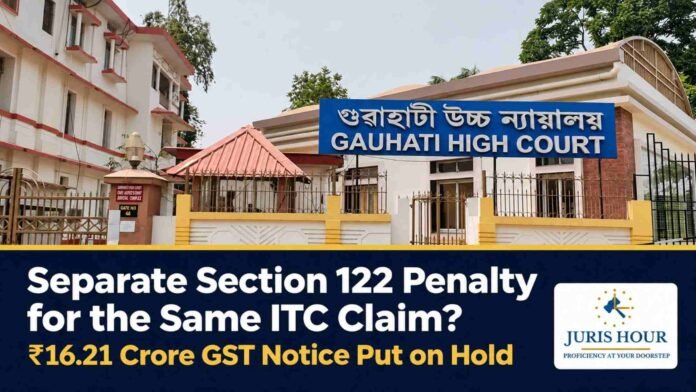
The Gauhati High Court has temporarily barred the GST department from taking further action on a show-cause notice seeking recovery of ₹16.21 crore in input tax credit (ITC) from an Assam coke manufacturer on the issue that can gst dept. impose separate penalty under Section 122 of the CGST Act, 2017 for the same ITC Claim.
The bench of Justice Soumitra Saikia observed that the proposed penalty under Section 122 of the Central Goods and Services Tax (CGST) Act conflicted with a Central Board of Indirect Taxes and Customs (CBIC) circular governing penalties for the same alleged wrongful availment or use of credit.
The court issued notice on the writ petition and directed the authorities to take no further action under the show-cause notice until the next returnable date. Notice on the firm’s interim application was made returnable on December 9, 2026.
Buy Now: 210+ GST Judgments E-Magazine – October 2026
DGGI alleged the firm claimed ITC without receiving goods from 17 suppliers
The petitioner/assessee is a partnership firm based in Barni in Assam’s Kamrup district, manufactures coke classifiable under HSN 2704. The Joint Director of the Directorate General of GST Intelligence (DGGI), Guwahati Zonal Unit, issued the demand-cum-show-cause notice on September 30, 2026.
DGGI alleged that the firm had claimed ITC on the strength of invoices and corresponding e-way bills from 17 suppliers without actually receiving the goods. The notice proposed recovery of ₹16,21,12,454 and gave the firm 30 days to respond. Clauses 25.1(VII) and (VIII) also proposed penalties equivalent to the credit allegedly availed and used, invoking Sections 122(1)(viii) and 122(2)(b) of the CGST Act, corresponding Assam GST provisions and the Integrated GST Act.
CBIC circular addresses duplicate penalties for the same act
Senior advocate Dr. Ashok Saraf, appearing for the manufacturer, relied on CBIC Circular No. 171/03/2022-GST, dated July 6, 2022. The circular addresses a scenario in which a recipient claims ITC on an invoice without receiving the underlying goods or services and then uses that credit to pay GST on genuine outward supplies.
For that scenario, the circular provides for recovery and penal action under Section 74, along with applicable interest under Section 50. It explains that Section 75(13) bars a further penalty under Section 122 or another CGST provision for the same fraudulent availment or use of credit when penal action is taken under Section 74.
The manufacturer argued that the circular bound the tax authorities and asked the High Court to set aside the notice. DGGI’s counsel submitted that the authorities would decide whether to proceed with recovery after considering the firm’s response. Counsel for the respondents sought time to obtain instructions.
High Court finds a conflict with the circular and pauses proceedings
After examining the penalty clauses, Justice Saikia observed that the proposed Section 122 penalty conflicted with the circular. The court referred to the Supreme Court’s decision in Commissioner of Customs v. Indian Oil Corporation Ltd.(267 ITR 272) on the binding effect of Board circulars on revenue authorities.
The court gave the respondents time to obtain instructions and file affidavits. Its interim direction covers further action under the entire show-cause notice. The validity of the notice and the allegation that the firm claimed credit without receiving the goods remain open for adjudication.
Membership Required to Access Case Details & Order Copy
To view the complete Case Details and Download Order Copy, you must have an active membership. Please subscribe to continue.

