
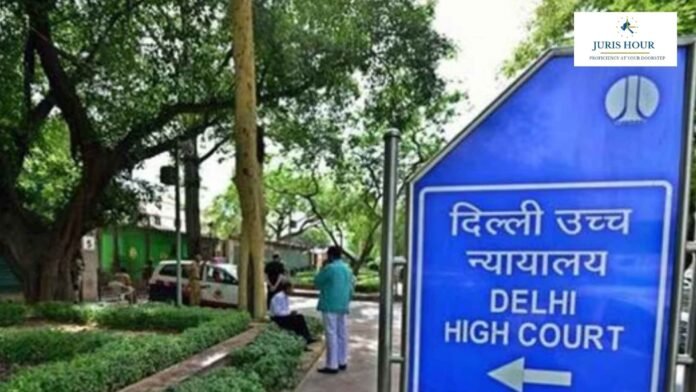
The Delhi High Court has quashed an income tax order treating a developer as an assessee in default for failing to deduct tax at source on External Development Charges paid to the Haryana Urban Development Authority (HUDA), holding that the demand was contrary to an issue already settled by the Court.
The Bench of Justice Dinesh Mehta and Justice Aditi Choudhary also set aside the Assessing Officer’s subsequent order rejecting the developer’s rectification application and declined to direct the company to pursue a statutory appeal, observing that such a course would be a “redundant formality and inefficacious remedy” when the substantive issue stood covered by its earlier judgment.
Buy Now: Direct tax (Income Tax) E-Magazine September 2026
The appellant/assessee is in default under Sections 201(1) and 201(1A) of the Income Tax Act, 1961. The officer alleged that the company had failed to deduct tax under Section 194-I on External Development Charges paid to HUDA.
Similar orders had also been passed against the company for financial years 2013–14 and 2014–15. The company had challenged those orders through writ petitions before the Delhi High Court.
Two days after the order concerning the financial year 2015–16, the High Court delivered its judgment dated March 24, 2023, in DLF Homes Panchkula (P.) Ltd. v. Joint Commissioner of Income Tax (OSD). That judgment allowed a batch of petitions, including those filed by the present petitioner, and held that the developers concerned could not be treated as assessees in default for non-deduction of tax under Section 194-I on the payments in question.
Following the March 2023 judgment, the company submitted several letters requesting the Assessing Officer to drop the demand for financial year 2015–16.
According to the factual account recorded in the judgment, the demand was not dropped and the Assessing Officer continued to insist on its recovery.
The company consequently filed a formal rectification application under Section 154 on February 23, 2026. The Assessing Officer rejected that application on August 31, 2026.
The rejection proceeded, among other grounds, on the basis that the Delhi High Court’s judgment had been delivered after the original assessment-related order and therefore did not fall within the scope of rectification under Section 154.
The company challenged that rejection before the High Court.
Senior Advocate Kavita Jha, appearing for the company, argued that the substantive issue had already been decided in the company’s favour by the Delhi High Court. She also relied on the Supreme Court’s order dated February 23, 2024, in Joint Commissioner of Income Tax (OSD) v. DLF Homes Panchkula (P.) Ltd., which she submitted had affirmed the High Court ruling.
The company further relied on ACIT v. Saurashtra Kutch Stock Exchange Ltd., reported in [2008] 305 ITR 227 (SC), to contend that failure to consider a decision of the jurisdictional High Court or the Supreme Court constitutes a mistake apparent from the record.
Counsel specifically referred to paragraph 41 of that judgment in support of the argument that even a subsequent judicial decision could provide a basis for rectification.
Reliance was also placed on CBDT Circular No. 68 dated November 17, 1971, which, according to the company’s submissions, recognised that a subsequent Supreme Court judgment could establish a mistake apparent from the record.
The company argued that, with the relevant judgments placed before the Assessing Officer, the demand should have been removed instead of the rectification application being rejected on a technical ground.
The Revenue defended the rejection, arguing that the application did not fall within the parameters of Section 154.
Its counsel also submitted that the company could appeal against the August 31, 2026 order and that the High Court should not entertain a writ petition directly against the Assessing Officer’s decision.
However, the Court recorded that the Revenue was unable to dispute the substantive legal position: under the earlier Delhi High Court judgment, the company could not be held to be an assessee in default for failing to deduct tax under Section 194-I on the payments concerned.
The Bench expressly declined to decide whether the subsequent judgment in DLF Homes Panchkula constituted a mistake apparent from the record warranting rectification of the March 22, 2023 order.
Addressing the reliance on paragraph 41 of Saurashtra Kutch Stock Exchange, the Court observed that the passage referred to the Gujarat High Court’s decision in Suhrid Geigy Ltd. v. Commissioner of Surtax. In the Bench’s view, it did not contain a specific approval of that position by the Supreme Court.
The Court therefore left the question open for determination in an appropriate case.
The present judgment consequently does not settle the broader question of whether a subsequent judicial ruling, by itself, permits rectification under Section 154.
Despite leaving the rectification question open, the Court held that the substantive tax issue had already been settled by its earlier judgment.
It found that both the original order dated March 22, 2023, and the rectification rejection dated August 31, 2026, were contrary to the law laid down in DLF Homes Panchkula and were therefore illegal.
Rejecting the Revenue’s request to send the company to the appellate authority, the Bench stated, “We do not deem it appropriate to ask the petitioner to undertake the formality of going before the Appellate Authority.”
The Court considered an appeal unnecessary in the circumstances because the legal issue underlying the demand was already covered by its binding judgment.
The High Court quashed and set aside both the order treating the company as an assessee in default and the order rejecting its rectification application. The pending applications were also disposed of.
Membership Required to Access Case Details & Order Copy
To view the complete Case Details and Download Order Copy, you must have an active membership. Please subscribe to continue.

