
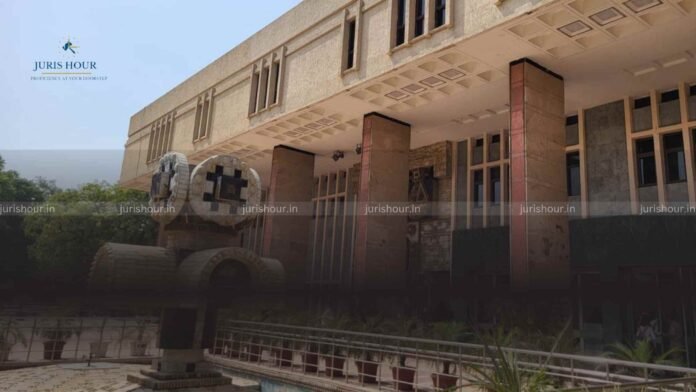
The Delhi High Court has rejected the Income Tax Department’s appeal against an order of the Income Tax Appellate Tribunal (ITAT), holding that an amount received by an assessee as far back as Financial Year (FY) 2006-07 could not be brought to tax under Section 68 of the Income Tax Act, 1961 in Assessment Year (AY) 2016-17 merely on the allegation that the transaction was structured to obtain a tax advantage.
The Bench of Justice Dinesh Mehta and Justice Rajneesh Kumar Gupta has observed that even if the transaction amounted to a colourable device, there were other and better statutory measures available to the Assessing Officer to address such conduct. Resorting to Section 68 in the circumstances of the case was not permissible.
Buy Now: 130 GST Judgments – E-Magazine July 2026
The case arose from an assessment for AY 2016-17 in which the Assessing Officer (AO) made an addition of ₹10 crore under Section 68 of the Income Tax Act, treating the advance received by the assessee in connection with the proposed sale of land as a colourable device.
According to the factual background recorded by the High Court, the assessee had shown receipt of ₹10 crore in FY 2006-07 as an advance towards consideration for the sale of land. The proposed transaction had not initially culminated in a sale deed.
Subsequently, a sale deed was executed by the assessee’s power of attorney holder during FY 2013-14. The assessee claimed that he became aware of the execution of the sale deed only during FY 2015-16 because the power of attorney holder had not informed him about the transaction.
After learning about the sale, the assessee reflected the transaction in the relevant return of income and disclosed the resulting capital gain. Since the assessee had suffered a capital loss, the long-term capital gain was set off against that loss.
The dispute intensified during the assessment proceedings when the AO questioned the purchaser about the land transaction. The purchaser disclosed that the sale deed had actually been executed in FY 2013-14 and that the transaction had also been recorded in its books during that financial year.
The AO consequently took the view that the assessee had deliberately structured the transaction so that the capital gain would be recognized in AY 2016-17, when the assessee had a capital loss of approximately ₹16 crore available for set-off.
On that reasoning, the AO treated the ₹10 crore advance as unexplained and made an addition under Section 68 in AY 2016-17.
The appellate authority, however, deleted the addition. The ITAT subsequently affirmed that decision, observing that the AO could not make the addition in AY 2016-17 when the amount had actually been received by the assessee in FY 2006-07.
The department argued that the assessee had adopted a device or ploy to structure the transaction in a manner that enabled the capital gain to be set off against the capital loss.
The Department contended that the assessee had intentionally failed to disclose the sale transaction for two years and that the AO was therefore justified in invoking Section 68 and adding ₹10 crore in AY 2016-17.
The Revenue’s central argument was therefore not merely about the existence of the ₹10 crore receipt, but about the alleged timing and structuring of the transaction and the tax benefit obtained through the set-off of capital gains against capital losses.
The High Court acknowledged that the assessee may have adopted a device to avoid or indirectly obtain the benefit of setting off the capital loss against capital gain. However, the Bench made an important distinction between identifying a potentially tax-avoidant arrangement and invoking Section 68 in a year in which the money had not been received.
The Court particularly emphasized that the ₹10 crore had admittedly been received in FY 2006-07. Consequently, using Section 68 to bring the same amount to tax in AY 2016-17, nearly a decade later, could not be sustained within the statutory framework.
The Bench noted that the ₹10 crore had been received by the assessee in FY 2006-07, whereas the AO sought to add the amount in AY 2016-17. The Court held that such an addition was fundamentally unsustainable.
In clear terms, the High Court observed that adding the amount in the year under consideration, despite its admitted receipt in FY 2006-07, was beyond comprehension and therefore could not be sustained.
The Delhi High Court found no error or infirmity in the orders passed by the appellate authorities, including the ITAT.
Accordingly, the Court rejected the Revenue’s appeal under Section 260A of the Income Tax Act, 1961.
The judgment therefore leaves intact the deletion of the ₹10 crore addition made under Section 68 for AY 2016-17.
Membership Required to Access Case Details & Order Copy
To view the complete Case Details and Download Order Copy, you must have an active membership. Please subscribe to continue.
Read More: Deputy Commissioner Competent to Issue GST Penalty Notice U/s 122: Allahabad High Court

