
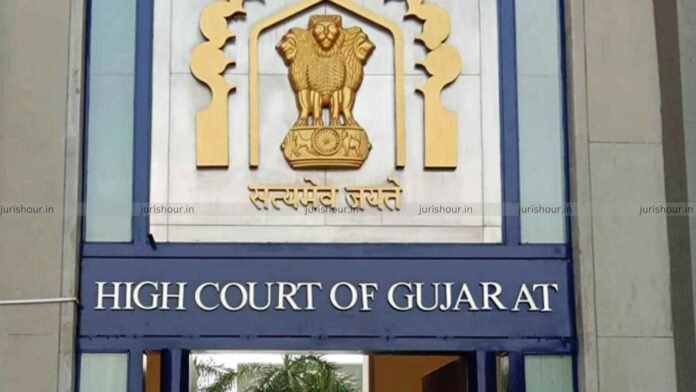
The Gujarat High Court has held that the Principal Commissioner of Income Tax (PCIT) cannot revise an assessment order merely because he disagrees with the Assessing Officer’s view, particularly in cases selected for limited scrutiny under the Computer Aided Scrutiny Selection (CASS) mechanism.
The bench of Justice Bhargav D. Karia and Justice Pranav Trivedi upheld the Tribunal’s findings. The Court noted that the Tribunal had recorded a factual finding that the Assessing Officer had examined the relevant materials and that the assessee had disclosed the survey income during assessment proceedings. The Court emphasized that even though the survey issue was not part of the original limited scrutiny, the assessee had voluntarily placed the relevant information before the Assessing Officer.
The dispute arose from Assessment Year 2017-18, where the assessee, a builder and developer, had filed its return declaring income of approximately ₹16.95 lakh. The case was selected under CASS for limited scrutiny relating to verification of cash deposits. During the assessment proceedings, the Assessing Officer sought various details and ultimately accepted the return without making any additions, passing an order under Section 143(3) of the Income Tax Act.
Subsequently, the PCIT exercised revisionary jurisdiction under Section 263 and set aside the assessment order. The Revenue authority noted that a survey had been conducted on the assessee in September 2016 during which undisclosed income of about ₹1.24 crore was declared. According to the PCIT, this disclosed income should have been taxed under Section 115BBE at a special rate of tax and should not have been adjusted against current-year and brought-forward losses. The PCIT concluded that the Assessing Officer had failed to properly examine the issue, rendering the assessment order erroneous and prejudicial to the interests of the Revenue.
The assessee challenged the revision order before the Income Tax Appellate Tribunal. The Tribunal observed that the case had been selected only for limited scrutiny concerning cash deposits and that the issue relating to survey disclosure was not part of the scrutiny mandate. It further found that the assessee had nevertheless disclosed the survey income and relevant facts during the assessment proceedings. Accordingly, the Tribunal held that the twin conditions required for invoking Section 263—namely that the assessment order must be both erroneous and prejudicial to the interests of the Revenue—were not satisfied. The revision order was therefore set aside.
Before the High Court, the Revenue argued that CBDT Circular No. 20/2015 required the Assessing Officer to convert the limited scrutiny into a complete scrutiny after obtaining approval from the competent authority because the survey disclosure raised significant tax issues. The Revenue further contended that the undisclosed income declared during the survey ought to have been subjected to taxation under Section 115BBE and that failure to do so justified revision under Section 263. To support its case, the Revenue relied heavily on the Kerala High Court’s decision in Sahyadri Agencies Ltd. v. Principal Commissioner of Income Tax, which recognized the Commissioner’s supervisory powers even in cases originating from limited scrutiny assessments.
The assessee, on the other hand, contended that the Assessing Officer had undertaken detailed inquiries through notices issued under Section 142(1) and had examined all material placed on record, including details concerning the survey disclosure. It was argued that the assessment order was a conscious decision based on available facts and could not be treated as erroneous merely because the PCIT preferred a different interpretation of the law. The assessee relied on several judicial precedents supporting the proposition that revisionary jurisdiction cannot be exercised to substitute one possible view with another.
The Bench relied upon the landmark Supreme Court judgment in Malabar Industrial Co. Ltd. v. CIT, which established that Section 263 can be invoked only when an assessment order is both erroneous and prejudicial to the interests of the Revenue. The Court reiterated that every loss of revenue does not automatically render an assessment order prejudicial. Where two views are legally possible and the Assessing Officer adopts one such view, the Commissioner cannot invoke Section 263 simply because he prefers another view.
The Court further referred to its earlier decision in Commissioner of Income Tax v. Arvind Jewellers, where it was held that revisionary powers cannot be used to correct every perceived mistake. An order becomes amenable to revision only when there is an incorrect assumption of facts or an incorrect application of law that renders the assessment unsustainable.
Applying these principles, the High Court concluded that the Assessing Officer had considered the material available on record and arrived at a definite conclusion. Merely because the PCIT disagreed with that conclusion did not authorize revision under Section 263. The Court observed that allowing such revision would effectively permit the Commissioner to replace the Assessing Officer’s view with his own, contrary to the settled legal framework governing Section 263 proceedings.
Finding no substantial question of law arising from the Tribunal’s order, the Gujarat High Court dismissed the Revenue’s appeal. The ruling reinforces judicial safeguards against expansive use of revisionary powers and underscores that Section 263 cannot be employed merely as a tool to revisit completed assessments where the Assessing Officer has taken a legally sustainable view after examining the material on record.
The Gujarat High Court has reaffirmed that in a limited scrutiny assessment, Section 263 revision cannot be invoked simply because the PCIT holds a different opinion on the tax treatment of disclosed income. Unless the assessment order is demonstrably erroneous and prejudicial to the Revenue, revisionary jurisdiction remains unavailable.
Membership Required to Access Case Details & Order Copy
To view the complete Case Details and Download Order Copy, you must have an active membership. Please subscribe to continue.
Read More: Telangana High Court Restores GST Appeal Withdrawn Due to Alleged Filing Error

