
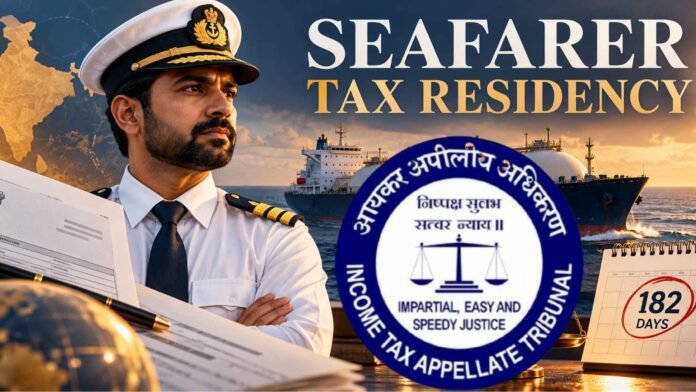
The Jaipur Bench of the Income Tax Appellate Tribunal (ITAT) examined whether a ship captain’s salary earned outside India could be taxed after the Income Tax Department treated him as a resident under the 60-day rule.
The dispute concerns a salary of ₹48,86,295 earned during assessment year 2015–16. The taxpayer argued that he was a non-resident because he had spent fewer than 182 days in India during the relevant financial year and had left India for employment abroad.
Buy Now: Direct tax (Income Tax) E-Magazine September 2026
The attached copy of the order ends midway through the discussion of a cited judgment and does not contain the Tribunal’s final findings or decision. It is therefore not possible to say from the available document whether the appeal was allowed or the salary addition was deleted.
The taxpayer was a licensed master or ship captain engaged as a seafarer on LPG tankers through Selendia Ship Management and VR Ship Management companies.
The order records that he earned ₹48,86,295 as salary for services outside India. The taxpayer’s counsel submitted that he was in India for 158 days during financial year 2014–15, corresponding to assessment year 2015–16.
The Assessing Officer treated him as a resident of India and included the salary in his taxable income. The National Faceless Appeal Centre upheld the assessment in an ex parte order dated December 2, 2025.
Before the ITAT, the taxpayer challenged both the determination of his residential status and the taxation of his salary. He also raised a jurisdictional objection, contending that the notice under Section 148 had been issued by an officer who did not have jurisdiction over him.
The Tribunal identified residential status as the central issue in the appeal. It recorded that there was no dispute that the salary accrued outside India.
The taxpayer’s case was that, as a non-resident, income that accrued and was received outside India was not liable to tax in India. The department’s assessment proceeded on the basis that he was a resident and that the foreign salary was therefore taxable.
Under Section 6(1)(a) of the Income Tax Act, an individual is ordinarily treated as resident if present in India for 182 days or more during the relevant previous year.
Section 6(1)(c) provides another test: an individual may be treated as resident if present in India for 60 days or more in the relevant year and for 365 days or more in the preceding four years.
The Tribunal recorded that the taxpayer had not met the 182-day test under Section 6(1)(a). However, his stay exceeded 60 days in the relevant year and 365 days in the preceding four years. The Assessing Officer applied Section 6(1)(c) and treated him as resident.
The taxpayer argued that the authorities had failed to consider Explanation 1 to Section 6(1). His principal submission was that, as an Indian citizen who had left India for employment outside India, he was entitled to have the 60-day requirement under Section 6(1)(c) read as 182 days.
His counsel submitted that Explanation 1(a) contained separate provisions for an Indian citizen leaving India as a crew member of an Indian ship and for an Indian citizen leaving for employment outside India. Since the taxpayer had served on foreign ships, counsel relied on the latter part.
The taxpayer also argued, alternatively, that the provision applicable to an Indian citizen or person of Indian origin visiting India applied to his circumstances.
According to the submissions recorded in the order, although the taxpayer had spent more than 365 days in India during the preceding four years, his 158-day stay during financial year 2014–15 was below the 182-day threshold he claimed was applicable.
The taxpayer’s counsel referred to decisions concerning the taxation of seafarers’ income, including the Karnataka High Court’s decision in DIT v. Prahlad Vijendra Rao and the Calcutta High Court’s decision in Utanka Roy v. DIT.
The taxpayer relied on those decisions in support of his argument that remuneration for services rendered outside India was not taxable in the circumstances considered by those courts.
Counsel also referred to Rajeev Biswas v. Union of India. The attached document ends while reproducing a passage from that decision, before the ITAT’s own conclusion appears.
Membership Required to Access Case Details & Order Copy
To view the complete Case Details and Download Order Copy, you must have an active membership. Please subscribe to continue.
Read More: Gift From Grandmother Can’t Be Rejected Solely for Lack of Gift Deed: ITAT Deletes Addition

