
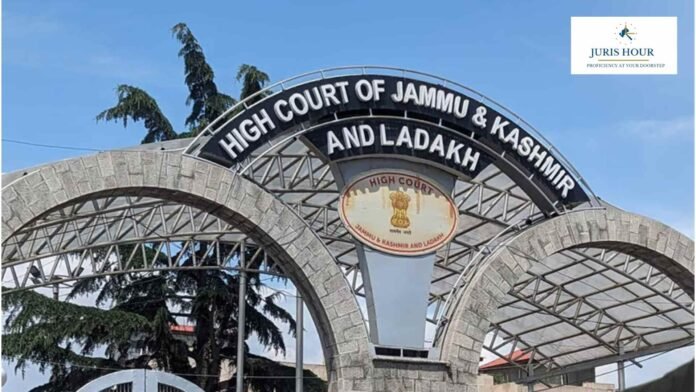
The High Court of Jammu & Kashmir and Ladakh has held that the appellate authorities had violated the mandatory requirements of Rule 46A of the Income Tax Rules by accepting additional evidence from the assessee without granting the Assessing Officer an opportunity to examine or rebut the same.
The bench of Justice Sanjeev Kumar and Justice Sanjay Parihar has found no indication that the CIT(A) had passed a reasoned order explaining why the additional evidence was being admitted.
The bench also found no evidence showing that the Assessing Officer had been granted an opportunity to verify or challenge the documents produced by the bank during appellate proceedings.
Buy Now: INCOME TAX E-COMPILATION – JUNE 2026
The controversy relates to Assessment Year 2006-07. Assessee had filed its income tax return declaring an income of ₹5.19 crore. During scrutiny proceedings, the Assessing Officer (AO) found that the bank had paid interest on term deposits amounting to approximately ₹7.96 crore but had allegedly failed to deduct tax at source (TDS) as required under Section 194A of the Income Tax Act.
According to the department despite being asked to furnish relevant details, the bank failed to provide complete information regarding interest payments exceeding ₹10,000, the threshold beyond which TDS obligations would arise. Consequently, the AO invoked Section 40(a)(ia) of the Act and disallowed the entire expenditure of ₹7.96 crore, resulting in a substantial tax demand against the bank.
The bank challenged the assessment before the CIT(A). During appellate proceedings, it produced additional documents purportedly demonstrating that only ₹24.18 lakh of the interest payments attracted TDS obligations because the remaining payments were below the statutory threshold. Based on these documents, the CIT(A) drastically reduced the disallowance from ₹7.96 crore to ₹24.18 lakh.
The Revenue contended that these documents had never been produced before the Assessing Officer and were accepted by the CIT(A) without complying with Rule 46A, which governs the admission of additional evidence at the appellate stage. The ITAT subsequently upheld the CIT(A)’s decision, prompting the Revenue to approach the High Court.
The principal question before the High Court was whether the CIT(A) could admit and rely upon fresh evidence without recording reasons for its admission and without giving the Assessing Officer an opportunity to verify or rebut that evidence as mandated under Rule 46A of the Income Tax Rules.
The Revenue argued that Rule 46A lays down strict conditions under which additional evidence can be accepted during appellate proceedings and that those conditions had been completely ignored in the present case.
The Court undertook a detailed examination of Rule 46A and emphasized that an assessee is ordinarily prohibited from producing evidence before the appellate authority that was not produced before the Assessing Officer, except in specified circumstances. Even in such situations, the appellate authority must record reasons in writing explaining why the additional evidence is being admitted.
The Bench observed that Rule 46A further mandates that any additional evidence admitted at the appellate stage cannot be relied upon unless the Assessing Officer is given a reasonable opportunity to examine the material, cross-examine witnesses if necessary, and produce rebuttal evidence. The Court stressed that these requirements are mandatory and not merely procedural formalities.
According to the Court, compliance with Rule 46A is also rooted in the fundamental principle of natural justice, particularly the doctrine of audi alteram partem—the right of a party to be heard before an adverse decision is taken.
While the Tribunal had referred to a remand report allegedly obtained from the Assessing Officer, the High Court noted that no such order or report could be traced from the appellate record. The Revenue had also specifically denied the existence of any such remand proceedings.
The Bench concluded that the Tribunal had committed an error in law by affirming the CIT(A)’s order. It held that both appellate authorities had overlooked the mandatory safeguards prescribed under Rule 46A.
Allowing the Revenue’s appeal, the High Court set aside both the ITAT’s order and the CIT(A)’s order. The matter has been remanded back to the Commissioner of Income Tax (Appeals), Jammu, for fresh consideration.
The Court directed the CIT(A) to first pass a speaking order deciding whether the bank should be permitted to produce additional evidence under Rule 46A. If such permission is granted, the Assessing Officer must be given a full opportunity to examine the evidence and submit rebuttal material before any fresh decision is taken.
The Bench also directed that no coercive action should be taken against Assessee until the matter is reconsidered and a fresh order is passed by the appellate authority.
Membership Required to Access Case Details & Order Copy
To view the complete Case Details and Download Order Copy, you must have an active membership. Please subscribe to continue.
Read More: What Happens to GST Officers Caught Taking Bribes?

