
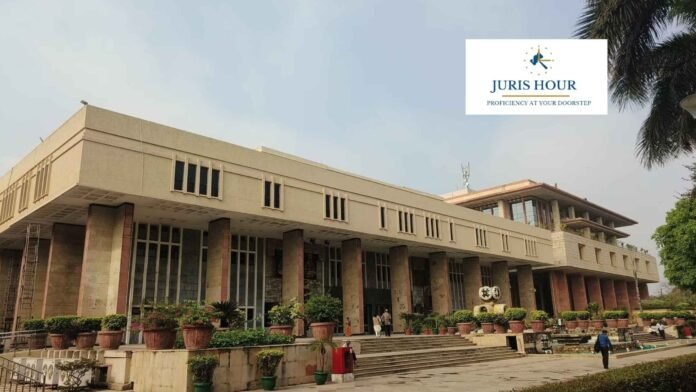
The Delhi High Court has set aside an Income Tax reassessment order after finding that the Assessing Officer curtailed the statutory time available to the taxpayer and failed to consider a reply that had already been uploaded before the order was passed.
A Division Bench of Justice Dinesh Mehta and Justice Rajneesh Kumar Gupta observed that the Assessing Officer’s approach suffered from irregularity and resulted in a violation of the principles of natural justice.
Buy Now: Recovery Of Tax Dues And Penalty Against Legal Heirs Of A Deceased Assessee : Case Compilation
The writ petition was filed by J J Foods Private Limited challenging the order dated March 18, 2024, passed under Section 148A(d) of the Income Tax Act, 1961, and the consequential reassessment notice issued under Section 148 of the Act.
The dispute arose after the Income Tax Department issued a notice under Section 148A(b) to the company on February 22, 2024. The notice required the company to furnish its reply by March 3, 2024.
On March 3, the company sought an adjournment of 15 days. The Assessing Officer adjourned the proceedings to March 8. On that date, the company again requested two weeks’ time to respond. However, the Assessing Officer granted only two additional days and directed the company to file its reply by March 10, 2024.
According to the company, its accountant was out of station and the reply could not be filed within the shortened period. On March 9, a day before the deadline, the company sent an email requesting 15 days’ additional time. It ultimately uploaded its reply on March 15, 2024.
Despite the reply being available on the record, the Assessing Officer passed the order under Section 148A(d) on March 18 without considering it. A consequential notice under Section 148, seeking to reopen the assessment, was issued on the same date.
Counsel for the company argued that once the reply had been uploaded before the reassessment order was passed, the Assessing Officer was required to consider it. Ignoring the response, it was contended, violated the principles of natural justice and caused serious prejudice to the taxpayer.
The Income Tax Department opposed the petition, contending that the company had already been granted two opportunities to respond. The Department argued that the final deadline was March 10 and, since the company failed to submit its reply by that date, the Assessing Officer was justified in disregarding the belated response.
The Department further submitted that when taxpayers expect Assessing Officers to adhere strictly to statutory timelines, taxpayers must also comply with the time granted to them.
The High Court, however, noted that the statute provided the taxpayer a period of 30 days to file its reply to the notice. As the original notice was issued on February 22, 2024, the Assessing Officer had sufficient time—at least until March 22—to receive and consider the company’s response.
The Court held that there was no pressing urgency that justified restricting the company’s right to submit its reply by March 10.
“It is noteworthy that a period of 30 days is available to an assessee for filing the reply as per the statute,” the Bench observed.
The Court found that reducing the response period from the statutorily available 30 days to approximately 15 days seriously prejudiced the company’s rights. It also took note of the email sent by the company on March 9 seeking further time.
The Bench said that, in these circumstances, the Assessing Officer ought to have granted the company reasonable additional time in the interest of justice.
Significantly, the Court held that the company’s reply was already available to the Assessing Officer before the order under Section 148A(d) was passed. Therefore, even if the reply had been filed after the deadline fixed by the officer, it could have been examined and considered before deciding whether reassessment proceedings should be initiated.
“The petitioner’s reply had already been uploaded, hence, the Assessing Officer could very well see and consider the reply so filed before passing an order, but he has chosen not to do so,” the Court stated.
Holding that the Assessing Officer’s conduct violated the principles of natural justice, the High Court set aside the March 18, 2024 order passed under Section 148A(d) and the consequential notice issued under Section 148.
The Court directed the Assessing Officer to pass a fresh order under Section 148A(d) after considering the company’s reply dated March 15, 2024. The fresh decision must be taken in accordance with law and without being influenced by the earlier order.
The Bench clarified that it had not expressed any opinion on the merits of the taxpayer’s case. The Assessing Officer would remain free to independently determine whether the jurisdictional requirements for initiating reassessment proceedings were satisfied.
Membership Required to Access Case Details & Order Copy
To view the complete Case Details and Download Order Copy, you must have an active membership. Please subscribe to continue.
Read More: No Detailed SCN or Reasoned Order Issued: Madras High Court Stays Tax Demand

