
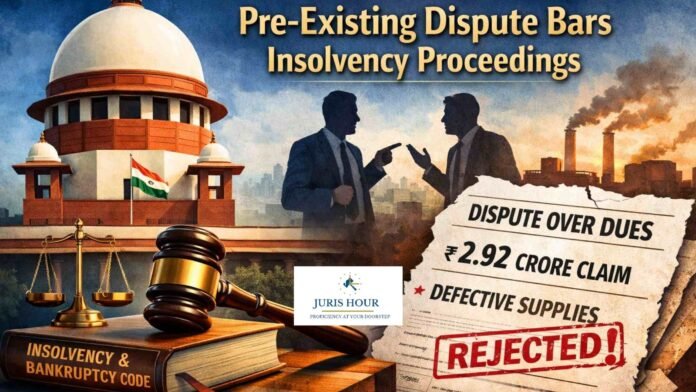
The Supreme Court of India has set aside an order of the National Company Law Appellate Tribunal (NCLAT) and restored the decision of the National Company Law Tribunal (NCLT), holding that the existence of a pre-existing dispute bars initiation of corporate insolvency resolution process (CIRP) under Section 9 of the Code.
The bench of Justice Sanjay Kumar and Justice R. Mahadevan while relying on established precedents such as Mobilox Innovations Pvt. Ltd. v. Kirusa Software Pvt. Ltd. and subsequent rulings, reiterated the adjudicating authority must only determine whether a plausible dispute exists, not whether it will succeed. Even a dispute requiring investigation is sufficient to reject a Section 9 application. Insolvency proceedings cannot be used as a substitute for debt recovery.
The issue raised was whether the operational creditor’s claim could trigger insolvency despite ongoing disputes between the parties.
The operational creditor had filed an application under Section 9 of the IBC before the NCLT, claiming dues of approximately ₹2.92 crore for chemical supplies. A demand notice had been issued prior to initiating insolvency proceedings.
However, the corporate debtor disputed the claim, alleging that the materials supplied were defective across multiple consignments and had caused substantial financial losses. The debtor had also issued debit notes and sought reconciliation of accounts, asserting that after adjustments, the creditor was actually liable to pay it money.
The NCLT, after examining the record, dismissed the application, holding that there was a plausible pre-existing dispute between the parties that required detailed adjudication beyond the summary jurisdiction of insolvency proceedings.
On appeal, the NCLAT reversed the NCLT’s decision and directed admission of the insolvency application. It held that earlier disputes had been resolved through a credit note. The debtor failed to raise timely objections regarding defective supplies. The defence raised was a “moonshine” argument lacking substance.
The NCLAT also excluded subsequent events and proceedings from consideration while assessing the existence of a dispute.
The Supreme Court disagreed with the NCLAT’s approach and undertook a detailed examination of the factual matrix and legal principles.
The Court noted several critical factors:
Firstly, documented Correspondence Prior to Demand Notice: Communications between the parties dating back to December 2020 demonstrated ongoing disputes regarding defective supplies.
Secondly, police Complaint Before Demand Notice: The corporate debtor had lodged a complaint months before the demand notice, indicating serious disputes.
Thirdly, ledger Discrepancies and Unclear Claims: The creditor’s accounts reflected inconsistencies, including conflicting demand figures (₹4.60 crore vs ₹2.92 crore).
Fourthly, questionable Interest Claims: Interest demands at 24% per annum were raised belatedly and retrospectively, raising doubts about their legitimacy.
Lastly, admissions by Creditor’s Director: Statements made in related civil proceedings revealed lack of documentation and issues in supply quality.
The Court emphasized that these elements clearly established the existence of disputes requiring adjudication.
The Court stressed that as long as the dispute is not spurious, hypothetical, or illusory, the insolvency process must not be triggered.
The Supreme Court set aside the NCLAT’s order dated 11.02.2025; restored the NCLT’s order dated 16.12.2022 dismissing the Section 9 application; and held that there was no clear consensus on liability or quantum of debt between the parties.
Thhe Court concluded that the insolvency application was not maintainable in the presence of genuine disputes.
Case Details
Case Title: GLS Films Industries Private Limited Versus ]Chemical Suppliers India Private Limited
Citation: JURISHOUR-714-SC-2026
Case No. Civil Appeal No. 4019 of 2025
Date: 09/04/2026

