
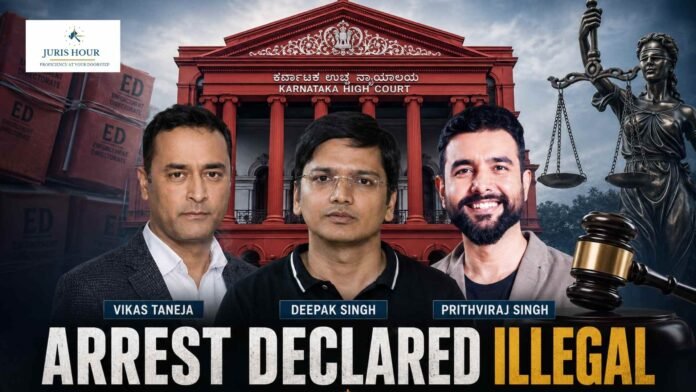
The Karnataka High Court declared the arrest of three founders of gaming platform GamesKraft—Vikas Taneja, Deepak Singh, and Prithviraj Singh—as illegal and directed that they be released from custody forthwith.
The bench of Justice M. Nagaprasannaheld that the arrests were contrary to law and ordered prison authorities to release the petitioners without delay.
Allowing the writ petitions filed by the founders, the Court observed: “The writ petitions are allowed…and arrests of the petitioners are declared to be contrary to law… In consequence thereof, the petitioners shall be set at liberty forthwith… registry directed to intimate the prison authorities to release the petitioners from jail…”
A detailed copy of the judgment is awaited and is expected to provide the Court’s reasoning on the legality of the arrests and the ED’s exercise of powers under the Prevention of Money Laundering Act (PMLA).
The three founders were arrested by the ED on May 7, 2026, in Gurgaon in connection with a money laundering investigation linked to allegations against GamesKraft Technologies Pvt. Ltd. Following their arrest, they were produced before the competent court and subsequently remanded to ED custody.
Later, on May 19, a Sessions Court remanded the founders to judicial custody until June 2, 2026.
Challenging both their arrest and the subsequent remand orders, the founders approached the Karnataka High Court, contending that the ED’s action lacked legal basis and was contrary to earlier judicial orders.
The controversy traces back to proceedings before the Karnataka High Court earlier this year.
On January 22, 2026, the High Court had stayed the ED’s investigation against GamesKraft Technologies after a closure report was filed in relation to the Bengaluru FIR that formed the predicate offence for the money laundering case.
The Court had then observed that once the underlying FIR had been closed, the very foundation for the Enforcement Case Information Report (ECIR) registered by the ED in November 2025 appeared to disappear.
This observation was crucial because under the PMLA framework, a money laundering investigation is generally dependent upon the existence of a scheduled offence.
During the January proceedings, the ED argued that even if one predicate offence had been closed, the agency could continue its investigation if other scheduled offences emerged during the course of inquiry.
The Additional Solicitor General had informed the Court that there were at least six similar FIRs concerning the alleged activities of the gaming platform and that the agency could update or modify the ECIR based on fresh material.
Subsequently, the ED maintained that the ongoing ECIR was linked to three FIRs registered in Telangana and not solely to the Bengaluru case.
During hearings in May, the founders strongly challenged the manner in which the ED exercised its arrest powers.
They argued that the agency had failed to identify any new tangible material warranting their arrest and questioned why summons could not have been issued instead of taking them into custody.
According to the petitioners, the arrests were a predetermined exercise aimed at circumventing the earlier stay granted by the High Court in relation to a substantially similar money laundering investigation.
The founders contended that the ED had effectively sought to achieve indirectly what it could not achieve directly due to the subsisting judicial protection granted in earlier proceedings.
The ED has alleged that GamesKraft manipulated game outcomes and induced users to make substantial monetary deposits on its online gaming platforms.
GamesKraft Technologies Pvt. Ltd., incorporated in June 2017, operates technology platforms facilitating skill-based online games, including real-money rummy contests. The company reportedly has more than ten lakh users across India and is headquartered in Bengaluru.
The agency has been investigating whether the platform’s operations involved offences that could trigger money laundering proceedings under the PMLA.
Membership Required to Access Case Details and Download Order Copy
To view the complete Case Details and Download Order Copy, you must have an active membership. Please subscribe to continue.
Read More: Candidates Can’t Be Denied Government Jobs Due to Delay in Workshop Approval Renewals: Supreme Court

