
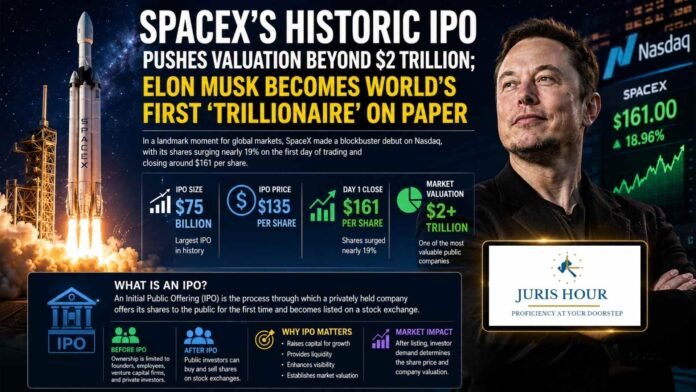
SpaceX made a blockbuster debut on the Nasdaq stock exchange, with its shares surging nearly 19% on the first day of trading and closing around $161 per share. The stellar market debut propelled the aerospace and technology company’s valuation beyond $2 trillion, placing it among the largest publicly traded corporations in the United States.
The listing has also had a dramatic impact on the wealth of SpaceX founder Elon Musk. Following the successful public offering and subsequent rally in the company’s share price, Musk became the first individual in history to cross the trillion-dollar wealth mark on paper, owing largely to his substantial ownership stake in the company.
A Record-Breaking Public Offering
The SpaceX IPO is being described as one of the most significant stock market events in recent history. Reports indicate that the company raised approximately $75 billion through the offering, making it the largest IPO ever recorded. Investor demand was exceptionally strong, with institutional orders reportedly exceeding available shares by a substantial margin before listing.
The company’s shares were priced at $135 during the IPO and opened strongly before ending the trading session at approximately $161, reflecting robust investor confidence in SpaceX’s future growth prospects.
Understanding an IPO: Why It Matters
An Initial Public Offering (IPO) is the process through which a privately held company offers its shares to the public for the first time and becomes listed on a stock exchange.
Before an IPO, ownership of a company is typically restricted to founders, employees, venture capital firms, and private investors. Once listed, members of the public can buy and sell the company’s shares through stock exchanges.
An IPO generally serves several purposes:
- Raising capital for expansion and future projects.
- Providing liquidity to early investors and employees.
- Enhancing corporate visibility and credibility.
- Establishing a market-driven valuation of the company.
The share price determined during an IPO becomes a critical benchmark. After listing, the market decides the company’s value based on investor demand. If investors believe the company has strong growth potential, the share price may rise significantly, increasing the company’s market capitalization.
This phenomenon was clearly visible in SpaceX’s debut, where the rise in share price after listing added hundreds of billions of dollars to the company’s market value within a single trading session.
Buy Here: Study Material Combo For Customs Brokers Licensing Examination (CBLR) 2026
What Drove Investor Enthusiasm?
Market analysts attribute the extraordinary investor interest to SpaceX’s diversified business model. While the company is globally known for reusable rockets and commercial space launches, investors are also betting on the long-term growth potential of satellite communications, space infrastructure, artificial intelligence, and related technology ventures associated with the company.
The IPO attracted widespread attention not only because of its size but also because it represented one of the rare opportunities for public investors to gain direct exposure to a company that has played a transformative role in the commercial space industry.
The Wealth Effect
The surge in SpaceX shares significantly increased the value of Elon Musk’s holdings. Since much of his wealth is tied to stock ownership rather than cash, the trillionaire milestone reflects the market value of his assets rather than liquid funds available for spending.
Financial experts often describe such wealth as “paper wealth,” meaning it is based on the prevailing market price of shares and can fluctuate depending on market conditions. A decline in share prices could reduce net worth calculations just as quickly as a rally can increase them.
Debate Over Valuation and Wealth Concentration
The IPO’s success has also reignited discussions about corporate valuations and wealth inequality. While supporters view the listing as a testament to innovation and entrepreneurial success, critics have questioned whether such massive valuations can be sustained over the long term.
Economists and policymakers are likely to continue debating the broader implications of unprecedented wealth concentration, particularly as the gap between asset owners and ordinary wage earners continues to widen.
A Defining Moment for Global Markets
Regardless of differing opinions on valuation, SpaceX’s public debut will be remembered as a defining moment in financial history. The IPO not only established a new benchmark for public offerings but also demonstrated the immense investor appetite for companies operating at the intersection of space exploration, advanced technology, and artificial intelligence.
Read More: CESTAT Quashes Confiscation and Penalty on Excess Imported Soybean Oil

