
The filing of Income Tax Returns (ITRs) for Assessment Year (AY) 2026-27 has brought significant changes for taxpayers who participated in share buyback programmes of listed companies such as Infosys and other corporates. Following amendments introduced by the Finance (No. 2) Act, 2024, the tax treatment of buyback proceeds has undergone a complete shift for buybacks undertaken on or after 1 October 2024.
Under the revised framework, the amount received by shareholders on account of a buyback is no longer taxed under the capital gains mechanism. Instead, it is treated as deemed dividend under Section 2(22)(f) of the Income-tax Act, 1961.
Buy Now: Customs Notifications & Circulars (January – May 2026)
Buyback Proceeds to Be Reported as Dividend
For AY 2026-27, taxpayers must report the entire buyback consideration received from companies under the head “Income from Other Sources” as dividend income.
This marks a departure from the earlier regime where shareholders computed capital gains by deducting the acquisition cost from the buyback consideration.
Cost of Acquisition Can Be Claimed as Capital Loss
Although the buyback proceeds are taxable as dividend, shareholders are not deprived of the cost of acquisition of their shares.
The law provides that, for capital gains computation, the full value of consideration is deemed to be nil. Consequently, the original purchase cost of the shares becomes a capital loss, which may be classified as:
- Short-Term Capital Loss (STCL) if the holding period qualifies as short-term; or
- Long-Term Capital Loss (LTCL) if the shares were held for the prescribed long-term period.
This capital loss can be carried forward or set off in accordance with the provisions of the Income-tax Act.
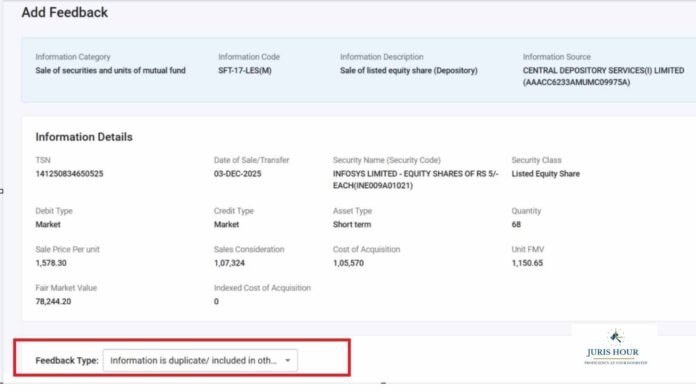
What If AIS Shows Buyback as Sale of Securities?
Many taxpayers may notice that the Annual Information Statement (AIS) continues to display the buyback transaction as a Sale of Securities.
Experts advise that this should not be reported again as a sale transaction if the buyback amount has already been disclosed as dividend income.
Instead, taxpayers should submit feedback in AIS by selecting the option:
“Information is duplicate/included in other information”
and indicate that the transaction has already been reported as Dividend Income. This helps avoid duplication of income in the return and reduces the possibility of mismatches during processing.
Effective Date of the New Tax Regime
The revised tax treatment applies to buyback of shares undertaken on or after 1 October 2024.
The Finance (No. 2) Act, 2024 amended the Income-tax Act to shift the tax incidence from the company to the shareholder. As a result:
- Buyback proceeds are taxable as deemed dividend under Section 2(22)(f).
- For capital gains purposes, the sale consideration is treated as nil.
- The cost of acquisition becomes a capital loss, subject to the normal rules governing set-off and carry forward.
Key Takeaways for AY 2026-27
- Report buyback proceeds as dividend under Income from Other Sources.
- Claim the acquisition cost as STCL or LTCL, depending on the holding period.
- Do not report the buyback amount again as a sale merely because it appears in AIS.
- Provide AIS feedback stating that the information is duplicated and already included as dividend income.
- The revised provisions apply only to buybacks completed on or after 1 October 2024.
The new regime significantly changes the reporting requirements for shareholders. Taxpayers should carefully reconcile their broker statements, dividend disclosures, and AIS entries while filing ITRs for AY 2026-27 to ensure accurate reporting and avoid unnecessary notices due to duplication of income.
Read More: Customs Refunds Without Prior Bill of Entry Re-Assessment to Be Treated as Incomplete: JNCH

