
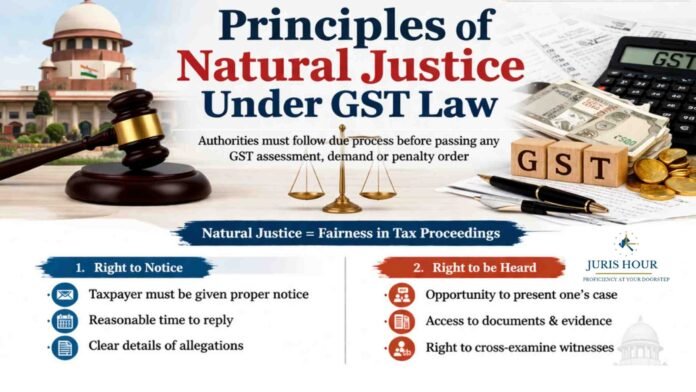
The Principles of Natural Justice form the bedrock of fair adjudication in taxation laws, including the GST regime. These principles are implicitly embedded in the CGST Act, 2017 and have been consistently upheld through judicial pronouncements. PNJ ensures that quasi-judicial actions are carried out in a fair, transparent, and unbiased manner.
Table of Contents
Meaning and Scope of Principles of Natural Justice
The Principles of Natural Justice primarily comprises two fundamental rules: Audi alteram partem (hear the other side), and Nemo judex in causa sua (no one should be a judge in their own cause).
These principles aim to prevent arbitrariness and ensure that no person is condemned unheard or subjected to biased decision-making.
Applicability of Nemo Judex in GST Context
While nemo judex in causa sua is a well-recognized principle, its strict application may not always be feasible under GST law. The statutory scheme under Sections 73 and 74 of the CGST Act and other provisions like Section 127 contemplates that the “proper officer” is empowered both to issue the show cause notice and to adjudicate the matter.
Thus, the same authority acting as notice issuer and adjudicator does not, by itself, violate the principle of bias, as this is a legislatively sanctioned mechanism, and proceedings under GST are quasi-judicial in nature.
However, the requirement of fairness, absence of pre-determination, and objective consideration of submissions must still be ensured. If actual bias or pre-judgment is demonstrated, the proceedings may still be vitiated.
Statutory Recognition under GST Law
Section 75(4) of the CGST Act, 2017 explicitly incorporates the principle of audi alteram partem. It provides that “an opportunity of personal hearing shall be granted where a request is received in writing from the person chargeable with tax or penalty, or where any adverse decision is contemplated against such person”.
Thus, personal hearing (PH) is mandatory when requested by the taxpayer, and obligatory even without request, if an order detrimental to the interest of the taxpayer is contemplated.
Judicial Recognition of PNJ
Courts have consistently emphasized the importance of PNJ in any matter that adversely affects a person, not merely confined to tax proceedings:
In Maneka Gandhi v. Union of India, the Supreme Court held that fairness in action is a part of Article 21, thereby elevating natural justice to a constitutional mandate.
In State of Orissa v. Dr. (Miss) Binapani Dei, it was held that even administrative orders affecting rights must comply with natural justice.
In Mohinder Singh Gill v. Chief Election Commissioner, the Court reiterated that fair hearing is an indispensable requirement unless expressly excluded.
In GST jurisprudence, High Courts have repeatedly set aside orders passed without granting proper opportunity of hearing, treating such lapses as violations of Section 75(4) and PNJ.
Personal Hearing: A Substantive Right
Personal hearing is not a mere procedural formality but a substantive safeguard. It enables the taxpayer to present oral arguments, clarify factual ambiguities, rebut allegations effectively.
Even where no request is made, it is advisable to grant personal hearing, especially when an adverse view is proposed, so as to uphold the spirit of natural justice.
Consequences of Violation
Violation of PNJ may result in: Orders being declared invalid or unsustainable, remand for fresh adjudication, and increased litigation and administrative inefficiency.
Courts have consistently held that denial of reasonable opportunity strikes at the root of the proceedings.
Conclusion
Principles of Natural Justice constitutes the soul of GST adjudication. While the principle of nemo judex operates in a limited manner due to the statutory role of the proper officer under Sections 73 and 74, the essence of fairness remains paramount. Section 75(4) reinforces the right to be heard, ensuring that no adverse order is passed without due opportunity. Authorities may therefore adopt a fair, transparent, and judicious approach to uphold the integrity of the GST framework.

