
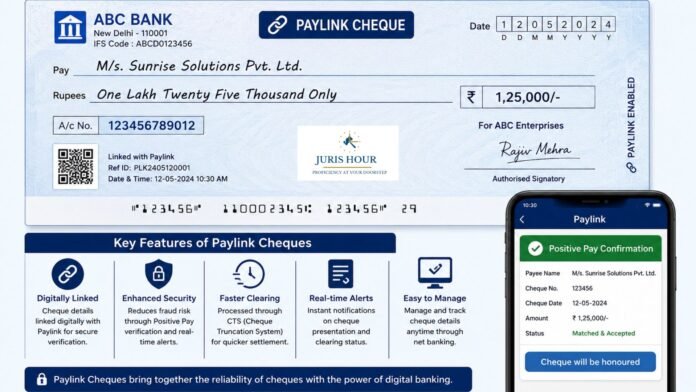
The banking and payments ecosystem in India has undergone significant digitisation over the last decade. Alongside traditional paper cheques, banks and financial institutions have increasingly adopted technology-driven solutions to facilitate secure cheque transactions. One such concept gaining attention is the Paylink Cheque, which generally refers to a cheque transaction where payment instructions, cheque details, or cheque-related authentication are linked through a digital platform or banking channel.
While the term “Paylink Cheque” is not specifically defined under the Negotiable Instruments Act, 1881, its legal validity depends upon whether the underlying instrument satisfies the legal requirements of a cheque and whether it is processed through the banking system in accordance with RBI regulations and the Cheque Truncation System (CTS).
The legal enforceability of such instruments must therefore be examined through the framework of the Negotiable Instruments Act, RBI guidelines, and judicial principles governing cheque transactions.
Legal Definition of a Cheque
Section 6 of the Negotiable Instruments Act, 1881 defines a cheque as a bill of exchange drawn on a specified banker and payable on demand. The provision also recognises electronic images of truncated cheques and cheques in electronic form. The law has evolved to accommodate technological advancements and electronic processing of cheque transactions.
A cheque remains a legally valid negotiable instrument if it contains the essential characteristics prescribed under the Act, namely:
- It must be in writing.
- It must contain an unconditional order to pay.
- It must be drawn upon a banker.
- It must specify a certain sum of money.
- It must be signed by the drawer.
- It must be payable on demand.
The recognition of electronic cheque processing has ensured that legal validity is not lost merely because the instrument is processed digitally rather than through physical movement.
Understanding Paylink Cheques
In banking practice, a Paylink Cheque is generally understood as a cheque linked with a digital payment instruction, online verification process, or electronic authentication mechanism. The cheque itself continues to be a cheque under law, but the supporting processes surrounding issuance, verification, presentation, and clearing are facilitated through electronic channels.
Examples include:
- Digital cheque issuance through internet banking.
- Cheques accompanied by electronic payment instructions.
- Cheque transactions integrated with bank payment portals.
- Cheques verified through Positive Pay or similar digital authentication systems.
The legal validity of such cheques depends not on the digital interface used but on compliance with statutory requirements and banking regulations.
Recognition of Electronic Cheques Under Indian Law
The Negotiable Instruments Act was amended to recognise:
- Cheque in electronic form, and
- Truncated cheque.
A truncated cheque refers to a physical cheque whose further movement is stopped after it is converted into an electronic image for clearing purposes. The electronic image is treated as legally valid for clearing and settlement. This legal recognition forms the foundation of modern cheque processing in India.
Consequently, a Paylink Cheque processed through digital channels does not become invalid merely because the physical cheque is converted into an electronic image during the clearing process.
RBI’s Cheque Truncation System (CTS)
The Reserve Bank of India introduced the Cheque Truncation System (CTS) to eliminate the physical movement of cheques and facilitate image-based clearing. Under CTS:
- Cheque images are captured electronically.
- MICR data is transmitted digitally.
- Physical cheques need not travel between banks.
- Clearing is faster and more secure.
The RBI has stated that only CTS-compliant cheques are accepted in CTS clearing. The system operates on the legal recognition of electronic cheque images and has become the standard cheque clearing mechanism across India.
Therefore, a Paylink Cheque routed through CTS enjoys the same legal status as a traditionally presented cheque, provided all statutory requirements are satisfied.
Positive Pay System and Paylink Cheques
The RBI introduced the Positive Pay System (PPS) to enhance cheque security. Under this mechanism, the issuer submits key cheque details such as:
- Cheque number,
- Date,
- Payee name,
- Amount,
through electronic channels including internet banking, mobile banking, SMS, or ATM facilities.
When the cheque is presented for clearing, the information is cross-verified with the data submitted earlier. Any discrepancy may result in enhanced scrutiny or rejection.
Many Paylink Cheque arrangements operate in conjunction with such authentication mechanisms. The use of Positive Pay strengthens the evidentiary value and security of cheque transactions but does not alter the fundamental legal nature of the cheque.
Validity Period of Paylink Cheques
Like any other cheque, a Paylink Cheque remains subject to RBI-prescribed validity rules.
Presently, a cheque is generally valid for three months from the date mentioned on the cheque. Presentation beyond this period renders the cheque stale and incapable of normal banking clearance.
Where a Paylink Cheque contains a future date, it operates as a post-dated cheque and becomes payable only on or after the date specified therein.
Dishonour of Paylink Cheques and Section 138
A crucial question concerns whether dishonour of a Paylink Cheque attracts Section 138 of the Negotiable Instruments Act.
The answer is generally yes.
If the Paylink Cheque satisfies the statutory definition of a cheque and is dishonoured due to:
- Insufficient funds,
- Exceeding arrangement,
- Account closure,
- Other legally recognised reasons,
the payee may invoke the remedies available under Section 138 subject to compliance with statutory notice requirements and limitation periods. The fact that the cheque was issued or authenticated through a digital platform does not dilute the liability of the drawer.
Thus, a digitally linked cheque enjoys the same legal enforceability as a conventional cheque.
Evidentiary Value in Court Proceedings
Modern banking systems generate extensive digital records, including:
- Transaction logs,
- Positive Pay confirmations,
- Electronic cheque images,
- Clearing records,
- Authentication trails.
These records can be produced in judicial proceedings as electronic evidence, subject to compliance with the provisions of the Indian Evidence Act regarding electronic records.
In fact, the digitisation of cheque processing often strengthens evidentiary reliability because transaction histories and electronic verification logs create a detailed audit trail.
Potential Legal Risks
Despite their validity, Paylink Cheques may face certain legal and operational issues:
Authentication Errors
Incorrect payee details, cheque number mismatches, or amount discrepancies may lead to rejection under Positive Pay verification procedures.
Cybersecurity Concerns
Digital platforms must ensure adequate security to prevent unauthorised alteration of cheque-related information.
Signature Issues
Even where digital verification exists, the underlying cheque must satisfy applicable signature requirements.
Expiry and Staleness
Digital linkage cannot extend the statutory validity period of a cheque.
Fraudulent Use
Where digital credentials are compromised, disputes may arise regarding authorisation of the transaction.
Judicial Approach
Indian courts have consistently recognised technological developments in banking while preserving the fundamental legal character of negotiable instruments. The legislative amendments recognising truncated cheques and electronic cheque processing demonstrate a clear policy intention to facilitate digital banking without undermining legal certainty.
Consequently, courts are likely to evaluate Paylink Cheques based on compliance with the Negotiable Instruments Act, RBI regulations, and evidence demonstrating authenticity and authorisation.
Conclusion
A Paylink Cheque is legally valid in India provided it satisfies the requirements of a cheque under the Negotiable Instruments Act and is processed in accordance with RBI regulations governing cheque clearing. The introduction of electronic cheque processing, the Cheque Truncation System, and the Positive Pay System has not altered the legal nature of cheques; rather, these mechanisms enhance efficiency, security, and traceability.
Accordingly, a Paylink Cheque enjoys the same legal status as a traditional cheque. It can be presented for payment, cleared through CTS, relied upon in court proceedings, and, if dishonoured, may give rise to remedies under Section 138 of the Negotiable Instruments Act. The digital elements associated with such cheques supplement the transaction process but do not diminish their enforceability under Indian law.
Read More: 5% GST Payable On Biodegradable Bags: AAR

