
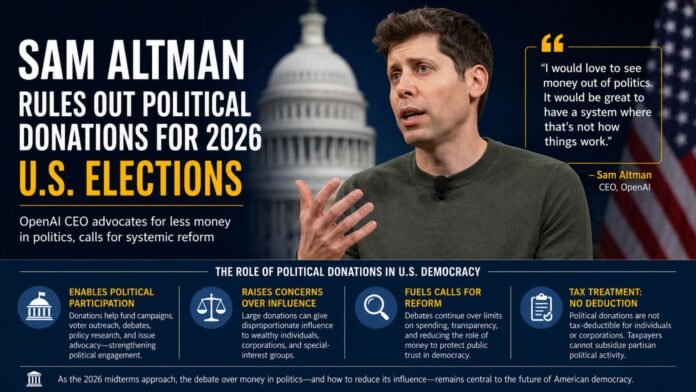
OpenAI Chief Executive Officer Sam Altman has stated that he does not intend to make financial contributions to political campaigns during the 2026 United States midterm elections, while simultaneously advocating for broader reforms to reduce the role of money in American politics.
Speaking during a visit to Capitol Hill, Altman said he would prefer a political system where financial influence plays a significantly smaller role in shaping electoral outcomes. His remarks come at a time when political spending by technology executives and Silicon Valley investors has become a major point of debate in the United States.
Altman acknowledged that several leaders in the technology industry have chosen to make substantial political donations, particularly as artificial intelligence policy and regulation emerge as central issues in the upcoming congressional elections. However, he clarified that he currently has no plans to personally fund election campaigns.
The OpenAI chief indicated that while companies and industry leaders often feel compelled to participate in political financing when competitors are doing the same, he believes systemic reforms would be preferable. According to Altman, an ideal solution would involve reducing the overall influence of money in politics rather than encouraging an escalation in political spending among competing interests.
Growing Debate Over AI and Political Influence
Altman’s comments arrive amid heightened political scrutiny of the artificial intelligence sector. Policymakers across the political spectrum are increasingly examining issues ranging from AI regulation and data-center expansion to employment displacement and competition policy. As a result, technology companies and industry advocates have intensified their engagement with lawmakers and political organizations.
The discussion has gained additional attention following reports that prominent technology figures, including some associated with OpenAI, have contributed millions of dollars to political action committees supporting AI-friendly policies and candidates. OpenAI itself has publicly stated that it does not donate to political campaigns or super PACs and does not maintain an employee-funded political action committee. The company has emphasized transparency and ethical engagement in public policy discussions.
The Role of Political Donations in US Democracy
Political donations occupy a unique and often controversial position in the American democratic system.
Under US law, individuals, corporations, political action committees (PACs), and super PACs can contribute funds to support political campaigns, advocacy efforts, and issue-based political messaging. While direct contributions to candidates are subject to legal limits, independent expenditure groups known as super PACs can raise and spend unlimited amounts of money, provided they do not directly coordinate with candidates. This framework has evolved significantly following landmark judicial decisions such as Citizens United v. Federal Election Commission, which expanded protections for political spending under the First Amendment.
Supporters of political donations argue that campaign financing enables citizens, businesses, and advocacy groups to participate in the democratic process by supporting candidates and causes that reflect their interests. Political contributions can help fund voter outreach, public debates, policy research, and election campaigns.
Critics, however, contend that large donations may grant disproportionate influence to wealthy individuals, corporations, and special-interest groups. They argue that excessive political spending can undermine public trust by creating perceptions that policymakers are more responsive to major donors than to ordinary voters. This concern has fuelled recurring calls for campaign finance reform, increased transparency, and stricter limits on election-related spending.
The debate has become particularly relevant in the technology sector, where AI regulation, data governance, competition law, and national security considerations are increasingly shaping public policy. As governments seek to regulate rapidly evolving technologies, industry leaders face growing pressure to engage with policymakers while avoiding perceptions of undue political influence.
Looking Ahead
With the 2026 midterm elections expected to determine control of the US Congress, issues surrounding artificial intelligence, technology regulation, and campaign finance are likely to remain prominent. Altman’s decision to refrain from political donations may add another dimension to the broader conversation about how influential technology leaders should participate in democratic processes.
His remarks also highlight a question that continues to resonate across the American political landscape: whether democracy is best served by greater political spending and advocacy, or by reforms designed to reduce the influence of money altogether.
Tax Treatment of Political Donations in the United States
Notably, unlike charitable giving, political donations in the United States are generally not eligible for federal tax deductions, a policy designed to prevent taxpayers from indirectly subsidizing partisan political activity.
Unlike charitable contributions made to qualified non-profit organizations, political donations in the United States generally do not qualify for federal income tax deductions. Individuals and corporations contributing to political candidates, political parties, campaign committees, political action committees (PACs), or super PACs cannot claim such contributions as deductible expenses on their federal tax returns.
The prohibition stems from the principle that taxpayers should not indirectly subsidize political activity through tax benefits. The Internal Revenue Code expressly disallows deductions for contributions made for political purposes, including donations intended to influence elections or legislation.
However, certain organizations involved in public policy advocacy may enjoy tax-exempt status under specific provisions of the tax code. For example, organizations registered under Section 501(c)(4) of the Internal Revenue Code—commonly known as social welfare organizations—are exempt from federal income tax on their own income. While these organizations may engage in some political activities, donations made to them are generally not tax-deductible for contributors.
The distinction between tax exemption and tax deductibility often creates confusion. A tax-exempt organization may not pay taxes on its income, but donors to that organization do not necessarily receive any tax benefit for their contributions.
The US approach differs from that of several other democracies that provide varying forms of public funding, tax credits, or tax incentives to encourage political participation. Supporters of the American model argue that it prevents the public treasury from indirectly financing partisan political activity. Critics, however, contend that the absence of tax incentives and the growing influence of large private donors have contributed to an increasingly expensive electoral system dominated by well-funded interests.
As debates over campaign finance reform continue, questions surrounding transparency, donor influence, and the appropriate role of tax policy in democratic participation remain central to discussions on the future of American elections.
Read More: Customs Can’t Reject Declared Value of Used Garments Without Proof of Undervaluation: CESTAT

