
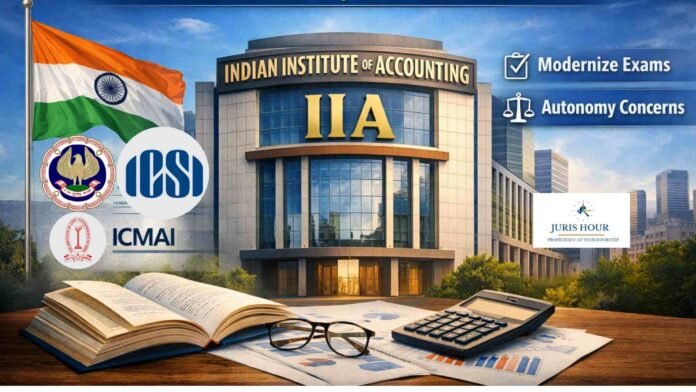
In a significant development that could reshape India’s professional education landscape, the Ministry of Corporate Affairs (MCA) is reportedly considering the establishment of a centralized academic authority, tentatively called the “Indian Institute of Accounting” (IIA). The proposed body is expected to oversee and conduct examinations for the country’s three premier professional institutions — Institute of Chartered Accountants of India, Institute of Company Secretaries of India, and Institute of Cost Accountants of India.
According to emerging reports and discussions circulating across professional forums and social media platforms, the MCA has constituted a committee of experts to evaluate the feasibility and structure of such an authority. The proposal, if implemented, could mark one of the most far-reaching reforms in India’s accounting and corporate governance education system.
The central objective behind the move is to modernize the examination framework, streamline processes, and bring greater efficiency and uniformity in the evaluation of professional candidates. By introducing a unified academic authority, the government appears to be exploring the possibility of standardizing examinations and curricula across the three bodies, potentially reducing redundancies and enhancing consistency in professional standards.
One of the key structural changes under consideration is the merger of the Boards of Studies (BoS) of ICAI, ICSI, and ICMAI into a single consolidated academic wing. Such a move could lead to a bifurcation or restructuring of the syllabus, enabling a more integrated and interdisciplinary approach to accounting, corporate law, and cost management education. Experts believe that this may also open avenues for cross-functional learning and broader skill development among future professionals.
However, the proposal has also sparked debate within the professional community. Critics have raised concerns about the possible dilution of domain-specific expertise that currently distinguishes Chartered Accountants (CAs), Company Secretaries (CSs), and Cost and Management Accountants (CMAs). Each of these professions is governed by its own Act of Parliament and has evolved specialized knowledge systems tailored to its respective domain. A centralized examination authority, stakeholders fear, may undermine this specialization and blur the professional boundaries that are critical for regulatory and industry roles.
At present, there is no formal notification or legislative amendment indicating an immediate transition. The existing institutions — ICAI, ICSI, and ICMAI — continue to function independently under their respective statutory frameworks. Any move toward establishing the proposed Indian Institute of Accounting would likely require significant legal changes, including amendments to the governing Acts and extensive consultation with stakeholders.
The development remains at a preliminary stage, with the expert committee expected to examine the practical, legal, and academic implications of such a transformation. While the proposal reflects the government’s intent to modernize and rationalize professional education, its eventual shape and acceptance will depend on how effectively it balances efficiency with the preservation of institutional autonomy and professional identity.
As discussions progress, the proposal is likely to attract close scrutiny from students, professionals, and regulatory bodies alike, given its potential to redefine the future of accounting and corporate governance education in India.
Read More: Deferred Payment of Customs Duty Facility Extended to Eligible Manufacturer Importers Till 2028

