
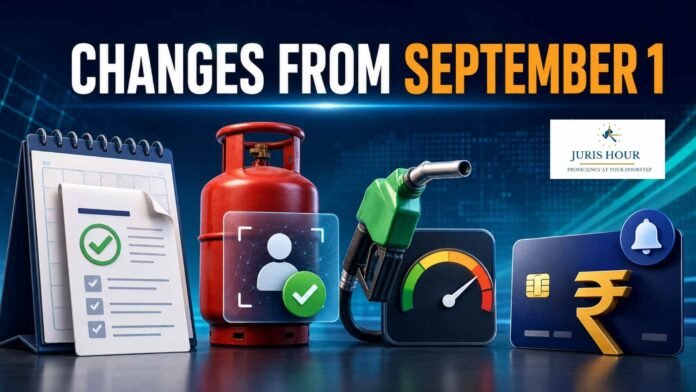
Several financial deadlines, price revisions and regulatory developments are set to affect taxpayers, households, businesses and travellers as August draws to a close. From income tax return filing and LPG verification to possible changes in cooking gas and aviation fuel prices, consumers should review the applicable requirements to avoid penalties or disruptions.
Among the most immediate matters are the August 31 deadline applicable to certain income tax return filers and the completion of Aadhaar-based e-KYC by domestic LPG consumers. Meanwhile, oil marketing companies are expected to conduct their customary monthly review of LPG and aviation turbine fuel prices from September 1.
Buy Now: 80+ Income Tax Judgments | E-Magazine July 2026
August 31 ITR Deadline for Certain Taxpayers
Taxpayers earning income from a business or profession and not required to undergo a tax audit have until August 31 to submit their income tax returns for the relevant assessment year under the revised filing schedule.
The deadline does not apply uniformly to all taxpayers. The due date for individual taxpayers who did not fall within any special category had already expired on July 31. Taxpayers must therefore verify the deadline applicable to them based on the nature of their income and audit requirements.
Those who miss their applicable due date may still submit a belated income tax return. For the current assessment year, such a return can generally be filed until December 31, 2026, or before the completion of assessment, whichever is earlier.
However, filing after the original deadline may attract a late fee. The fee can be ₹1,000 where the taxpayer’s total income does not exceed ₹5 lakh and ₹5,000 where the total income is above ₹5 lakh. Interest and other consequences may also arise depending on the taxpayer’s circumstances and outstanding liability.
Taxpayers covered by the August 31 deadline should not treat September 1 as an extension. They have been advised to complete filing and verification of their returns within the prescribed period.
LPG Consumers Asked to Complete e-KYC
The August 31 deadline is also significant for domestic LPG customers who have yet to complete the prescribed Aadhaar-based biometric authentication.
Oil marketing companies have been requesting customers to complete e-KYC through the digital facilities offered by their LPG providers or by visiting their authorised distributors. Consumers with pending verification should check the procedure specified by their respective service provider.
The consequences of failing to complete e-KYC may vary according to the customer’s category and the applicable subsidy or supply conditions. It should not automatically be assumed that an LPG booking will be blocked immediately after the deadline. Consumers should instead verify the latest instructions issued by their oil marketing company or distributor.
Completing the process on time can help avoid possible complications relating to subsidy transfers, customer authentication or continued access to applicable benefits.
LPG Prices May Be Revised From September 1
Domestic and commercial LPG prices will also be in focus at the beginning of September. Oil marketing companies generally review cylinder prices at the start of every month.
The monthly exercise does not necessarily result in an increase. Prices may be raised, reduced or kept unchanged depending on prevailing pricing decisions, international energy conditions, exchange-rate movements and other relevant factors.
Any revision in domestic cylinder prices directly affects household expenditure because cooking gas is a recurring necessity. Commercial cylinder prices are equally important for restaurants, hotels, catering establishments and other businesses that rely heavily on LPG.
An increase in commercial LPG rates can raise operating costs for these establishments and may eventually influence the prices charged to consumers. Customers should check the officially announced rate applicable in their city instead of relying on unofficial reports.
Aviation Fuel Review May Affect Airline Costs
Aviation turbine fuel prices may also undergo revision from September 1 as part of the periodic pricing exercise.
ATF represents a substantial component of an airline’s operating expenditure. A sharp increase can add pressure to airline finances and influence decisions concerning fares, routes and capacity. However, an increase in aviation fuel prices does not necessarily translate into an immediate or proportionate rise in passenger ticket prices.
Airfares are determined by several factors, including seasonal demand, seat availability, competition among carriers, airport charges and the timing of the booking. Travellers planning journeys during September should consequently monitor fares rather than presume that an ATF revision will automatically produce a corresponding change in ticket prices.
Customers Should Watch for Bank Charge Revisions
Bank customers should also check whether their lender has revised any service charges from September. Banks periodically change fees relating to ATM transactions, cash handling, account maintenance and other services.
Such revisions are institution-specific and do not take effect across the entire banking sector on the same date. Customers should consult the latest schedule of charges published by their bank.
The issue is particularly relevant for account holders who frequently exceed the permitted number of free ATM transactions, make regular cash deposits or withdrawals, or hold accounts subject to specific balance and service conditions.
Reviewing account-related communications can help customers understand whether any new fee, transaction limit or service condition will apply to them.
Bulk Fixed Deposit Rules to Take Effect in October
Fixed deposit investors should distinguish the financial developments beginning in September from the Reserve Bank of India’s revised framework concerning bulk deposits, which is scheduled to take effect from October 1, 2026.
Under the revised framework, banks will be required to publish interest rates applicable to bulk deposits of ₹3 crore or more on their websites on every business day. They will also have to offer a uniform rate across branches for deposits accepted on the same day and falling within the same applicable category.
The framework is principally relevant to large depositors and is intended to enhance transparency and uniformity in bulk deposit pricing. It does not mean that existing retail fixed deposits will automatically be repriced.
For ordinary depositors, the change is unlikely to have an immediate impact. Large depositors, however, may find it easier to compare rates and assess available options after the disclosure requirements take effect.
Important Tax and GST Deadlines in September
Apart from the changes affecting households, September contains several important tax and GST compliance dates for businesses and professionals.
The deadline for depositing tax deducted at source and tax collected at source for August falls on September 7. Eligible monthly filers are generally required to furnish GSTR-1 by September 11, while the second instalment of advance tax is due on September 15.
Monthly GSTR-3B filers are generally required to submit their returns by September 20. September 30 is also relevant for various tax-audit and other statutory compliance requirements, depending on the category of taxpayer and the applicable legal provisions.
Taxpayers and registered businesses should independently confirm their deadlines because due dates can vary according to the type of return, filing frequency, place of registration and any extension subsequently announced by the government.
For households, the immediate priorities are to determine whether the August 31 income tax return deadline applies to them, complete pending LPG e-KYC, and monitor the official revision of cooking gas prices. Customers should also examine communications from their banks and avoid confusing the October bulk fixed-deposit framework with the financial changes taking effect from September.

