
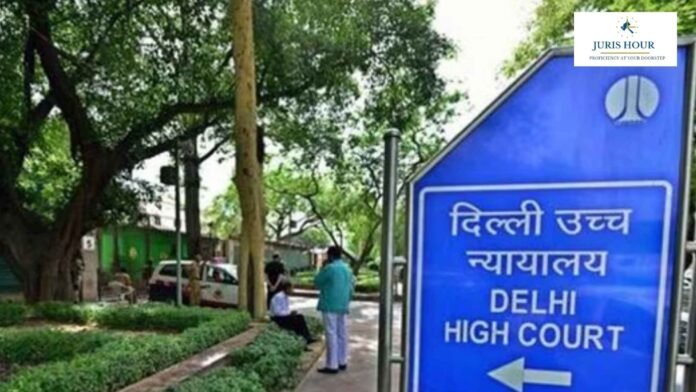
The Delhi High Court has quashed an income tax assessment raising a demand of approximately ₹3.91 crore against a contractual security guard and cook, holding that the department could not rely solely on Form 26AS and portal information without investigating his claim that someone had misused his Permanent Account Number (PAN).
The Bench of Justice Dinesh Mehta and Justice Aditi Choudhary found that the Assessing Officer had neither supplied the material relied upon nor conducted an independent inquiry to establish the taxpayer’s connection with the disputed transactions.
The bench criticised the officer for adding the gross and net figures relating to the same transaction, effectively doubling the alleged turnover.
Buy Now: Direct tax (Income Tax) E-Magazine September 2026
The case concerned Lalit, who stated that he had worked as a contractual security guard at Ashoka Hotel and subsequently as a cook at Vigyan Bhawan through employment agencies. According to him, his income had never been taxable, and he had obtained a PAN card as a government-issued identity document.
On February 26, 2024, he received a notice under Section 148A(b) of the Income Tax Act, 1961, alleging cash payments of ₹24,86,63,500 to Montage Enterprises Pvt. Ltd. The notice also reflected a cash sale figure of ₹24,62,01,485 against his PAN.
Denying any involvement, Lalit lodged complaints with the police and the Cyber Cell. He informed the Assessing Officer that his PAN credentials had been misused and sought particulars and supporting records concerning the transactions.
However, an assessment order dated March 17, 2025, treated ₹49,48,64,985 as his turnover for assessment year 2017–18 and determined income at eight per cent of that amount. A demand of approximately ₹3,91,06,511 followed, along with the recording of satisfaction for initiating several penalty proceedings.
The Court found that the assessment rested solely on information available through the risk management system, Form 26AS and the annual summary. The department could not identify any independent inquiry or other evidence connecting Lalit with the transactions.
The Bench observed that, at a minimum, the Assessing Officer should have issued a notice under Section 133(6) to Montage Enterprises and sought transaction details or recorded its statement.
Lalit had produced bank statements and material supporting his employment as a security guard and cook. He had also explained that he had withdrawn provident fund money to meet financial needs, obtained an economically weaker section certificate and sought waiver of his children’s school fees.
The Court held that these circumstances called for objective scrutiny of his identity theft defence. Once he had denied the transactions and rebutted the presumption against him, the burden lay on the Assessing Officer to establish that he had actually undertaken them.
The Bench identified a further flaw in the computation. The officer had added ₹24,86,63,500 to ₹24,62,01,485—the net figure after collection of tax at one per cent—to arrive at turnover of ₹49,48,64,985.
The Court found that this reflected a failure to understand the nature of the transaction and had resulted in the demand being doubled.
Rejecting the department’s objection that Lalit should pursue a statutory appeal, the Court considered his financial position and the size of the demand.
It noted that the standard 20 per cent deposit condition under the cited CBDT guidelines would require a sum approaching ₹78 lakh for interim protection. Given his limited means, the Bench considered the appellate remedy illusory and ineffective in the circumstances.
The Court also held that withholding adverse material and failing to consider his response violated natural justice. It connected the avoidable anxiety and fear of coercive recovery arising from the demand with the protections under Articles 14 and 21 of the Constitution.
The Court set aside the assessment order. It nevertheless permitted the department to initiate fresh proceedings if it found other cogent and incriminating material linking Lalit with the disputed transactions, subject to the limitation prescribed by law.
Membership Required to Access Case Details & Order Copy
To view the complete Case Details and Download Order Copy, you must have an active membership. Please subscribe to continue.
Read More: Rs. 8.12 Crore VAT–Income Tax Turnover Mismatch Justifies Reopening Beyond Four Years: Delhi HC

