
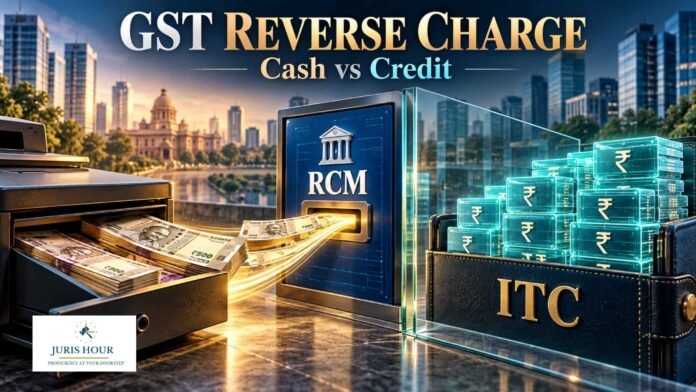
Businesses have urged the government to allow accumulated input tax credit (ITC) to be used for paying GST under the reverse charge mechanism (RCM). They say the current requirement to pay reverse charge tax in cash strains working capital even when substantial credit is available in their electronic credit ledgers.
Under the usual GST arrangement, a supplier collects tax from the customer and pays it to the government. Reverse charge shifts the responsibility for paying tax to the recipient. It applies to specified goods and services, including certain domestic supplies and imports of services. CBIC guidance states that reverse charge liability must be paid through the electronic cash ledger; ITC cannot be used to discharge it.
Buy Now: E-Magazine: 1000+ Landmark GST Judgments (2017–2026)
Why businesses say cash is getting tied up
ITC represents eligible GST paid on business purchases that can generally be used against output tax. A company may therefore have a sizeable credit balance but still need fresh cash to pay tax on a reverse charge transaction.
The problem is more pronounced when credit builds up faster than the company can use it. For example, a business with unused ITC that imports a taxable service must fund the applicable reverse charge payment in cash. The credit balance remains available for eligible use, but it does not meet that immediate payment obligation.
Prashanth Agarwal, partner at PwC India, said cash payment of reverse charge tax has long been onerous for some businesses because it can block working capital while unused credit continues to accumulate. He said the pressure has intensified for sectors that made substantial capital investments and then experienced GST rate cuts under the rate changes commonly called GST 2.0. FMCG, pharmaceuticals, footwear and automobiles are among the sectors he identified.
A rate reduction can leave some businesses with a mismatch between tax paid on purchases and tax due on sales. The extent of credit accumulation depends on each business’s purchases, sales and applicable rates; a rate cut does not produce the same result for every company.
What industry wants changed
The industry’s principal request is to let taxpayers use eligible balances in their electronic credit ledgers to pay reverse charge liabilities. Agarwal said allowing this across RCM transactions would help businesses put capital currently tied up in accumulated credit to productive use.
Abhishek Jain, indirect tax head and partner at KPMG, described credit use for reverse charge payments as a longstanding demand dating back to the service tax era. He said it is especially pressing for businesses with an inverted duty structure that incur an 18% cash outflow on imported services while holding credit they cannot use for that payment.
Jain suggested two possible responses: permit credit to be used for the liability, or reduce the tax rate on reverse charge supplies where the mismatch is structural. Agarwal also called for broader measures to help businesses use accumulated GST credit.
The proposal would require a change to the present treatment of reverse charge payments. Until such a change is made, taxpayers must continue to pay those liabilities through the cash ledger, even if they hold unused ITC.
Read More: Copper Producers Seek GST Cut to 5% as Record Prices Strain Working Capital

