
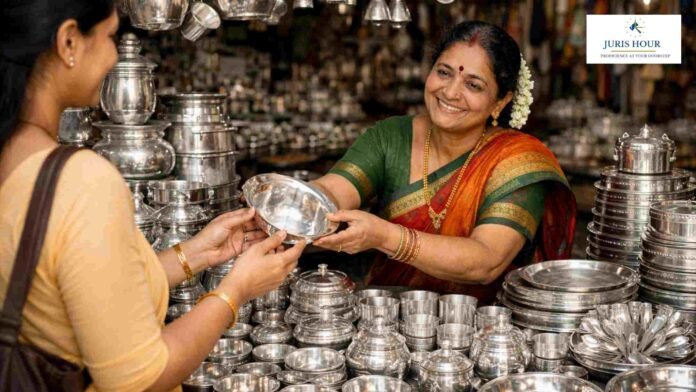
Silver utensils have traditionally been owned by Indian households for personal, cultural, and religious purposes. Many such utensils are acquired through inheritance, family gifts, or long-term personal savings. When these silver utensils are sold, especially due to rising silver prices, taxpayers often face uncertainty regarding whether such sale attracts income tax and, if so, how it should be computed. The Income-tax Act, 1961 provides clear guidance on this issue, which is analysed in detail below.
Whether Silver Utensils Are Treated as Capital Assets
Under Section 2(14) of the Income-tax Act, a capital asset includes property of any kind held by an assessee, whether or not connected with business or profession, unless specifically excluded. Although personal effects are excluded from the definition of capital assets, this exclusion does not apply to jewellery or items made of precious metals.
Silver is a precious metal, and utensils made of silver are therefore not regarded as exempt personal effects. As a result, silver utensils are treated as capital assets under the Act, and any gain arising from their sale is subject to capital gains tax.
Taxability of Sale of Silver Utensils
The charge of tax on capital gains arises under Section 45 of the Income-tax Act. When silver utensils are sold, the difference between the sale consideration and the cost of acquisition, after permissible deductions, is taxable as capital gains. The head under which such income is taxed is “Capital Gains” and not “Income from Other Sources”.
Period of Holding and Nature of Capital Gains
The classification of capital gains as short-term or long-term depends on the period for which the silver utensils were held. If the silver utensils are held for more than thirty-six months before sale, the gains are treated as long-term capital gains. If the holding period is thirty-six months or less, the gains are considered short-term capital gains.
Silver utensils do not qualify for the reduced twenty-four-month holding period applicable to certain assets, and therefore the thirty-six-month threshold continues to apply.
Tax Rates Applicable on Capital Gains
Long-term capital gains arising from the sale of silver utensils are taxable at the rate of twenty percent after allowing the benefit of indexation. Indexation adjusts the cost of acquisition for inflation using the Cost Inflation Index notified by the Central Government, which often substantially reduces the taxable gain.
Short-term capital gains on sale of silver utensils are taxed at the normal slab rates applicable to the assessee. No concessional tax rate is available in such cases.
Cost of Acquisition of Silver Utensils
Where silver utensils have been purchased by the assessee, the purchase price along with any incidental expenses such as making charges or valuation expenses constitutes the cost of acquisition.
In cases where silver utensils are received by way of gift or inheritance, Section 49 of the Income-tax Act applies. The cost of acquisition in such cases is deemed to be the cost for which the previous owner acquired the asset. Additionally, the period for which the previous owner held the silver utensils is also included while determining whether the gains are long-term or short-term.
If the previous owner acquired the silver utensils before 1 April 2001, the assessee has the option to substitute the fair market value as on 1 April 2001 as the cost of acquisition.
Availability of Exemptions
There is no specific exemption provided under the Income-tax Act for capital gains arising from the sale of silver utensils. While Section 54F may technically apply since silver utensils are capital assets other than residential property, the exemption is subject to stringent conditions, including restrictions on ownership of residential houses and mandatory reinvestment in a residential house. In practice, such exemption is rarely availed for sale of silver utensils.
Disclosure in Income Tax Return
Capital gains arising from the sale of silver utensils must be disclosed in the Income Tax Return under the Schedule for Capital Gains. Taxpayers are advised to retain supporting documents such as purchase bills, inheritance records, valuation reports, and sale receipts, as these may be required in the event of scrutiny or assessment proceedings.
Applicability of GST on Sale of Silver Utensils
Goods and Services Tax does not apply where silver utensils are sold by an individual in a personal capacity and not in the course or furtherance of business. However, if the sale is carried out by a trader or jeweller dealing in silver utensils, GST provisions may apply depending on the nature of the transaction.
Consequences of Non-Disclosure
Failure to disclose capital gains arising from the sale of silver utensils may attract interest for delayed payment of tax and penalties for under-reporting or misreporting of income. Proper computation and timely disclosure are therefore essential to avoid adverse tax consequences.
Conclusion
Silver utensils are treated as capital assets under Indian income tax law, and gains arising from their sale are taxable as capital gains. The tax treatment depends on the period of holding and the mode of acquisition. Taxpayers should carefully compute the gains, apply indexation wherever applicable, and ensure proper disclosure in their income tax returns to remain compliant with the law.

