
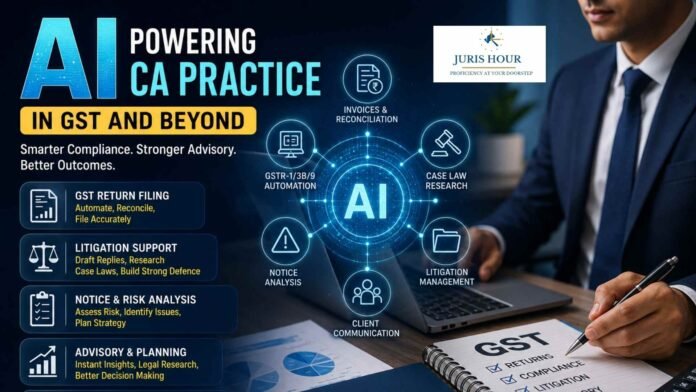
Artificial Intelligence (AI) is no longer a futuristic concept for Chartered Accountants. It is rapidly becoming an indispensable professional assistant capable of handling repetitive compliance tasks, analyzing large volumes of data, identifying litigation risks, and assisting in drafting legal documents.
While AI cannot replace the professional judgment of a Chartered Accountant, it can significantly improve efficiency, accuracy, and productivity across the GST lifecycle—from registration to assessments, audits, investigations, appeals, and litigation.
Buy Now: INCOME TAX E-COMPILATION – JUNE 2026
AI in GST Return Filing
Automated Invoice Verification
AI can instantly compare:
- Purchase Register vs GSTR-2B
- Sales Register vs GSTR-1
- GSTR-1 vs GSTR-3B
- E-Way Bills vs GST Returns
- E-Invoices vs Books of Accounts
Instead of manually checking thousands of invoices, AI can identify:
- Missing invoices
- Duplicate invoices
- Wrong GSTIN
- Incorrect tax rate
- Incorrect Place of Supply
- Incorrect HSN/SAC
- Mismatch in taxable value
This substantially reduces human errors before filing returns.
Intelligent ITC Reconciliation
One of the most time-consuming GST activities is Input Tax Credit reconciliation.
AI can automatically identify:
- ITC available but not claimed
- ITC claimed in excess
- Blocked credits under Section 17(5)
- Vendor non-compliance
- GSTR-2B mismatches
- Reversal requirements
- ITC eligible after supplier uploads invoices
Instead of spending days in Excel, AI can complete reconciliation within minutes.
GST Return Review Before Filing
AI can perform a comprehensive review of:
- GSTR-1
- GSTR-3B
- GSTR-9
- GSTR-9C
It can highlight:
- Possible tax short payment
- Incorrect classification
- Reverse charge omissions
- Export inconsistencies
- LUT errors
- SEZ reporting mistakes
- Interest liability
- Late fee exposure
Essentially, AI acts as a pre-filing quality control system.
AI in GST Advisory
AI can instantly analyze:
- Whether GST applies
- Applicable rate
- Exemptions
- Place of Supply
- Time of Supply
- Composite vs Mixed Supply
- Classification disputes
- Reverse Charge applicability
Rather than manually searching hundreds of notifications and circulars, AI can narrow down the relevant legal framework within seconds.
AI in GST Litigation
This is where AI offers perhaps the greatest value.
Drafting Replies to GST Notices
AI can prepare the first draft of replies to:
- DRC-01
- ASMT Notices
- REG Notices
- MOV Notices
- INS Notices
- Audit observations
- Investigation notices
- Summons
The draft can include:
- Relevant statutory provisions
- Judicial precedents
- Circulars
- Notifications
- Legal arguments
- Structured factual responses
The CA can then refine and finalize the draft based on the specific facts.
AI-Powered Case Law Research
Instead of spending hours searching legal databases, AI can:
- Identify relevant judgments
- Distinguish favorable and unfavorable precedents
- Compare High Court rulings
- Summarize Supreme Court decisions
- Trace legal evolution on specific issues
- Explain why a case is relevant
Research that previously took several hours can often be completed in minutes.
Notice Risk Assessment
Before responding to a notice, AI can evaluate:
- Strength of the department’s case
- Strength of the taxpayer’s defense
- Evidentiary gaps
- Procedural defects
- Limitation issues
- Violation of natural justice
- Jurisdictional defects
- Chances of success
This enables professionals to formulate more effective litigation strategies.
Drafting Appeals
AI can assist in preparing:
- Appeals before Appellate Authority
- GSTAT appeals
- High Court writ petitions
- Supreme Court SLP drafts (initial structure)
It can generate:
- Grounds of appeal
- Questions of law
- Statement of facts
- Chronology
- Legal submissions
- Prayer clauses
The drafts still require review by experienced professionals but save considerable time.
AI During GST Audit
AI can instantly identify:
- High-risk transactions
- Reconciliation issues
- ITC risks
- RCM defaults
- Classification disputes
- Stock discrepancies
- Vendor risks
- Suspicious transactions
It can also prepare audit working papers automatically.
AI for GST Investigations
During DGGI or departmental investigations, AI can help organize:
- Invoice-wise summaries
- Transaction chronology
- Bank statement analysis
- Vendor mapping
- E-mail analysis
- Contract review
- Evidence indexing
- Cross-referencing documents
This makes responding to investigations faster and more systematic.
AI for Drafting Legal Documents
AI can generate initial drafts of:
- Legal opinions
- GST memos
- Client advisory notes
- Compliance reports
- Due diligence reports
- Representation letters
- Reply letters
- Written submissions
Professionals can then review and customize the drafts for accuracy and strategy.
AI in Contract Review
AI can examine contracts to identify GST implications, including:
- Place of Supply clauses
- Tax liability provisions
- Indemnity clauses
- Composite supply issues
- Cross-border transaction risks
- Valuation concerns
- Reimbursement clauses
It can also suggest areas where GST wording should be strengthened.
AI as a GST Knowledge Assistant
Instead of searching through hundreds of pages of:
- GST Act
- Rules
- Notifications
- Circulars
- Advance Rulings
- Judicial decisions
Professionals can simply ask questions in natural language and receive structured answers with relevant references, subject to independent verification.
AI for Client Communication
AI can quickly prepare:
- GST updates
- Monthly newsletters
- Advisory emails
- Compliance reminders
- Presentation decks
- Webinar notes
- Social media content
- FAQs
This enables firms to maintain regular client engagement with significantly less effort.
AI for Office Productivity
AI can assist with:
- Meeting summaries
- Email drafting
- Document summarization
- OCR of GST documents
- Workflow automation
- Task prioritization
- Calendar management
- Client query management
This allows professionals to devote more time to advisory and litigation work.
Practical AI Tools Every CA Should Know
| Category | Popular AI Tools | Best Use Cases |
| General AI Assistant | ChatGPT, Claude, Gemini | Drafting, explanations, brainstorming, research support |
| Legal Research | Manupatra AI, SCC Online AI, Taxmann AI (where available) | Case law research, statutory interpretation, legal summaries |
| GST Research | Taxmann, GSTN resources, commercial tax platforms with AI features | GST updates, notifications, circulars, compliance guidance |
| Document Analysis | Microsoft Copilot, Adobe Acrobat AI | Contract review, PDF summarization, document comparison |
| Productivity | Microsoft Copilot, Google Workspace AI, Notion AI | Emails, presentations, meeting notes, document creation |
| OCR & Data Extraction | Microsoft Lens, Adobe Scan, OCR-enabled AI tools | Invoice extraction, document digitization, data capture |
Limitations: Where AI Cannot Replace a CA
AI is a powerful assistant, but it cannot replace professional expertise. It cannot independently certify returns, sign audit reports, represent clients based on legal authority, exercise professional judgment in complex tax positions, or assume responsibility for compliance decisions. AI-generated outputs may also contain inaccuracies or rely on outdated information if not properly validated.
Every AI-generated draft, legal opinion, reconciliation, or research note should therefore be reviewed against the latest law, notifications, circulars, and judicial precedents before it is relied upon or submitted.
The Future of GST Practice
The role of Chartered Accountants is evolving from routine compliance toward strategic advisory. AI automates repetitive tasks such as reconciliation, drafting, document review, and research, allowing professionals to focus on higher-value services like tax planning, litigation strategy, risk management, and client counseling.
The firms that effectively combine AI with deep GST expertise are likely to deliver faster turnaround times, higher-quality work, and greater value to clients. The future is unlikely to be “AI replacing Chartered Accountants”; instead, it will be Chartered Accountants who leverage AI outperforming those who do not.

