
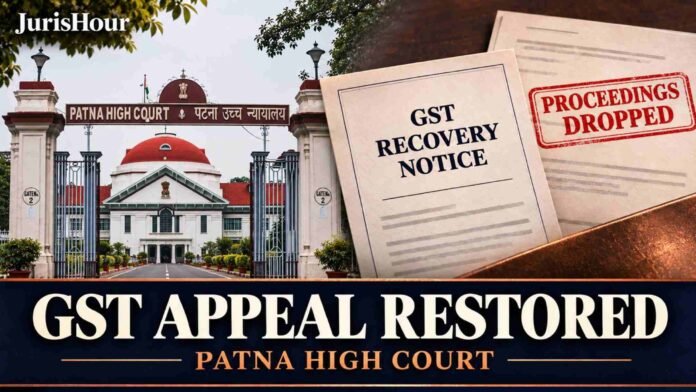
The Patna High Court has set aside an order rejecting GST appeal as time-barred. The company challenged a 2021 assessment after it received a recovery notice in January 2026, even though the tax department had dropped the underlying proceedings in July 2024.
The bench of Justice Anil Kumar Sinha and Justice Vikash Kumar has observed that the taxpayer reasonably believed the dispute was closed after a July 2024 order dropped the Section 73 proceedings. It directed the appellate authority to hear the challenge to the ₹2.62 crore tax demand on merits.
Buy Now: 210+ GST Judgments E-Magazine – October 2026
The dispute began with a scrutiny notice in Form GST ASMT-10 dated 2 December 2019. The company replied that it had taken no excess input tax credit (ITC). After the department issued a show-cause notice in Form GST DRC-01, the company reiterated its position in a reply filed on 22 February 2021.
On 24 February 2021, the adjudicating authority issued an ex parte order in Form GST DRC-07 demanding ₹2,62,26,335 in tax and ₹61,01,070 in interest. The company applied on the GST portal on 3 March 2021 to have the assessment withdrawn. It also argued before the High Court that the adjudicating authority had passed the order without granting a personal hearing under Section 75(4).
On 30 July 2024, the Deputy Commissioner of State Tax issued an order dropping the proceedings under Section 73 for FY 2019–20. The company said it understood the matter to be closed. The department nevertheless issued a recovery notice on 15 January 2026.
The company filed its appeal against the 2021 assessment on 26 March 2026, along with an application to condone the delay. The appellate authority rejected the appeal as time-barred in June 2026. Before the High Court, the State defended the rejection by pointing to the time that had elapsed since the original assessment.
Section 107 ordinarily gives a taxpayer three months from communication of the adjudication order to appeal. The appellate authority may allow one additional month if the taxpayer shows sufficient cause.
The High Court focused on the company’s conduct after the assessment. It had applied for withdrawal promptly, obtained an order dropping the proceedings, and filed an appeal soon after recovery was initiated. The bench found no delay or laches attributable to the company in the circumstances and set aside the appellate rejection.
The court remanded the matter to the appellate authority to decide the appeal on merits after giving the company an opportunity to be heard, preferably within two months. The merits of the ITC dispute remain for the appellate authority to decide.
Membership Required to Access Case Details & Order Copy
To view the complete Case Details and Download Order Copy, you must have an active membership. Please subscribe to continue.
Read More: NCLAT Can’t Invalidate RP Without Hearing to Successful Bidder: Supreme Court

